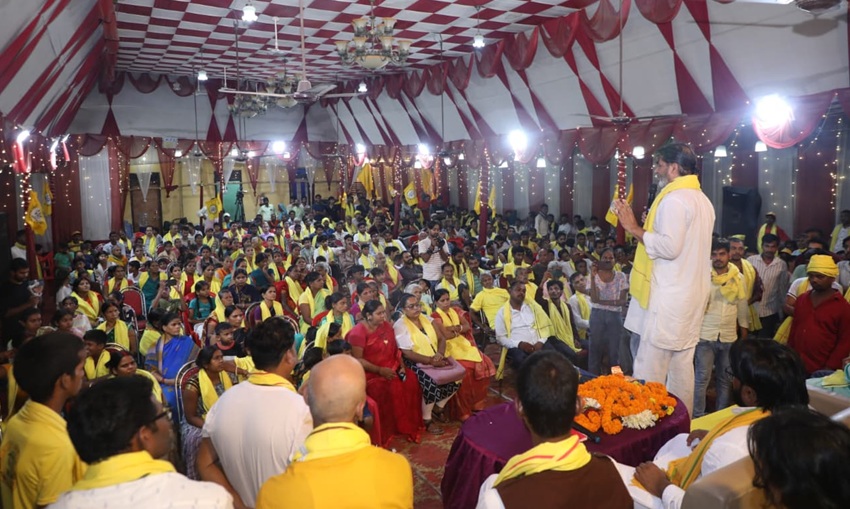
Patna: As campaigning intensifies for the Bankipur Assembly by-election in Bihar, Jan Suraaj founder and candidate Prashant Kishor has rolled out a multi-pronged campaign aimed at countering the BJP’s booth-level election machinery. While Bihar BJP president Nitin Nabin has deployed a four-layer organisational strategy centred on micro-management, Kishor is focusing on extensive public outreach, local meetings, youth issues and social media engagement.

The bypoll has emerged as a closely watched political contest, with both parties relying on different campaign models to mobilise voters ahead of polling.
Door-to-Door Campaign and Local Meetings
The BJP’s campaign is centred on booth-level management, with party workers assigned to reach every voter through an extensive organisational network.

In response, Prashant Kishor has intensified his grassroots outreach by conducting door-to-door visits, padyatras (foot marches), neighbourhood meetings and informal interactions with residents. According to Jan Suraaj leaders, Kishor has so far undertaken around 20 padyatras and held more than 24 mohalla meetings, meeting nearly 5,000 people daily through micro-level interactions.
The party has also deployed around 20 star campaigners who are conducting house-to-house visits and appealing to voters across the constituency.
During his campaign, Kishor has repeatedly highlighted issues such as corruption, civic infrastructure, government accountability and clean politics. He has promised to work towards eliminating corruption in constituency-level development works, including roads, drainage, parks and waterlogging projects.
He has also told voters that, if elected, he would serve as a strong voice against administrative injustice and raise local issues in the Assembly and other public forums.
Jan Suraaj national spokesperson and media in-charge Kumar Saurabh said Kishor begins campaigning at around 6 a.m. and continues until late evening, interacting with residents in parks, neighbourhoods and community meetings throughout the day.
Competing Organisational Strategies
The BJP has reportedly established a four-layer campaign structure involving booth workers, more than 60 Shakti Kendras, 10 organisational mandals and over 50 MLAs and MLCs campaigning across the constituency. Party leaders are also holding pocket meetings, with senior leaders assigned to areas based on local caste demographics.
Jan Suraaj has responded by creating a three-tier structure across all 422 polling booths, comprising women volunteers, booth workers and youth groups.
The party has also been reaching out to local leaders who unsuccessfully contested municipal ward elections, seeking to strengthen its presence at the grassroots level.
According to Kumar Saurabh, the booth-level organisational network has been designed to maximise voter outreach before polling.
Youth Issues and NEET Paper Leak
A key component of Jan Suraaj’s campaign has been its focus on youth-related issues, particularly the alleged irregularities in competitive examinations, including the NEET paper leak controversy.
Prashant Kishor has argued that repeated examination leaks have undermined the future of students and job aspirants in Bihar. During campaign meetings, he has linked the issue to wider concerns over employment, transparency and governance, accusing the government of failing to protect the interests of students.
Jan Suraaj is attempting to shift the electoral debate from traditional caste equations towards education, employment and opportunities for young people.
The strategy is considered significant in Bankipur, where a large number of students preparing for competitive examinations and coaching institutes are located.
Holding the Government Accountable
Kishor has also questioned the BJP-led government’s accountability over examination-related controversies, arguing that administrative failures have affected lakhs of students and their families.
His campaign seeks to frame the issue as one of political responsibility rather than merely an administrative lapse, while urging voters to demand greater transparency and accountability from the government.
Political observers note that by highlighting the NEET issue, Jan Suraaj is attempting to place the BJP on the defensive in what has traditionally been considered a BJP stronghold.
Bankipur as a Political Message
Beyond the by-election itself, Prashant Kishor has projected the contest as an opportunity for voters to send a broader political message across Bihar.
He has appealed to voters dissatisfied with the government’s performance to express their views through the ballot, arguing that the election is about more than choosing a single MLA.
According to Kishor, the outcome will also reflect how urban voters and young people view the current government’s governance and could influence the broader political narrative ahead of future elections in Bihar.
Strong Push on Social Media
Alongside ground campaigning, Jan Suraaj has mounted an aggressive social media campaign.
According to party leaders, a dedicated team of seven to eight members manages Kishor’s digital outreach, producing videos of roadshows, public interactions and campaign events.
The party claims to upload around 10 to 11 videos daily across its social media platforms in an effort to expand its reach and engage younger voters.
The BJP has not publicly responded in detail to Jan Suraaj’s campaign strategy outlined above.