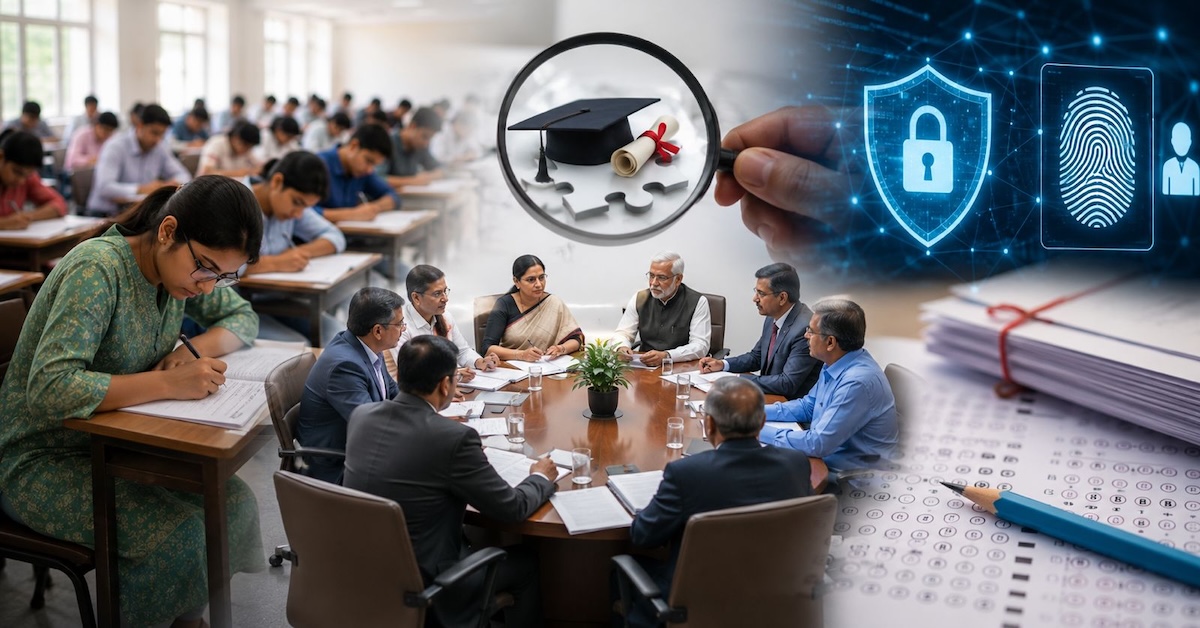
Patna: The Bihar government has constituted an Expert Committee on Examination Reforms to review the state’s examination system and recommend measures to make examinations more secure, transparent, technology-driven and reliable.

The General Administration Department issued a notification announcing the five-member committee, which will examine examinations conducted by various boards, commissions, universities and recruitment agencies in the state.
The committee will be required to submit its recommendations within three months of its inception.

Entire examination cycle under review
The committee’s mandate will extend beyond question papers and examination centres to cover the complete examination cycle, including registration, question-paper preparation, conduct of examinations, evaluation, declaration of results, grievance redressal and secure maintenance of examination records.
The government said examinations are an important means of assessing candidates’ aptitude, determining eligibility and making selections for higher education and government employment. Maintaining the confidence of candidates and the public in the examination and recruitment system is therefore essential.
The government noted that the number of examinees has increased in recent years, while competition for government jobs has intensified alongside the expansion of secondary and higher education. The growing use of digital technology and artificial intelligence has also made examination systems more complex.
Focus on leaks, cheating and malpractice
Preventing question-paper leaks, impersonation, cheating and mass malpractice will be among the committee’s key priorities.
It will also examine measures to prevent tampering with answer sheets at examination centres, unauthorised access to examination data and manipulation of results.
The committee will look into delays in evaluation and result declaration and may recommend a state-level examination calendar setting maximum timelines for each stage of an examination.
This could cover the period from publication of recruitment or examination advertisements and applications to admit cards, the examination, provisional answer keys, objections, final answer keys, evaluation and declaration of results.
Question-paper setting and security to be audited
The committee will review the question-paper preparation process, including paper setting, moderation, empanelment and training of paper setters and standardisation of difficulty levels.
The aim is to reduce unnecessary differences in the quality and difficulty of question papers across examinations.
A security audit of the examination system will also be undertaken. This will cover question-paper setting, storage, transportation, distribution and digital transmission.
The security of examination centres, candidate identification, biometric verification, CCTV surveillance, the role of invigilators and the collection and secure transportation of answer booklets will also be examined.
Technology and cybersecurity in focus
The government has emphasised the appropriate use of digital technology, data analytics, artificial intelligence and cybersecurity tools to make examinations more secure and transparent.
The committee will recommend measures to protect candidate data and prevent unauthorised access to digital examination systems.
It will also consider a clear Chain of Custody Protocol for question papers and answer booklets. The system would record who had custody of examination material at each stage, helping reduce the risk of tampering and establish accountability when irregularities occur.
Rural and disadvantaged candidates to be considered
The government has directed that examination reforms should not disadvantage candidates from rural areas, economically weaker sections, socially marginalised groups or those with limited access to digital facilities.
The committee will therefore examine how technology-driven reforms can be implemented while ensuring equal opportunities for candidates.
Multiple examinations and agencies covered
The committee may review secondary and higher secondary examinations, university examinations, vocational and technical examinations, entrance and eligibility tests, as well as recruitment and competitive examinations conducted in Bihar.
While respecting the autonomy of constitutional and statutory examination and recruitment bodies, it will recommend mechanisms for greater coordination and sharing of best practices.
The committee will also review the institutional framework governing examinations and examine the roles and responsibilities of examination boards, commissions, universities, government departments, district administrations and examination centres.
It will recommend mechanisms to establish accountability for irregularities occurring at different stages of the examination process.
Judge to head five-member panel
The government has decided to constitute a five-member expert committee. Its chairperson will be either a retired Supreme Court judge or a sitting or retired High Court judge.
The government will approach the Supreme Court or High Court, as required, for nomination of the chairperson.
During its work, the committee will consult commissions, universities and other institutions and may seek inputs from district administrations, state recruitment agencies, subject experts, technical institutions and technology specialists.
The notification also provides for confidentiality in the consultations and correspondence undertaken by the committee.