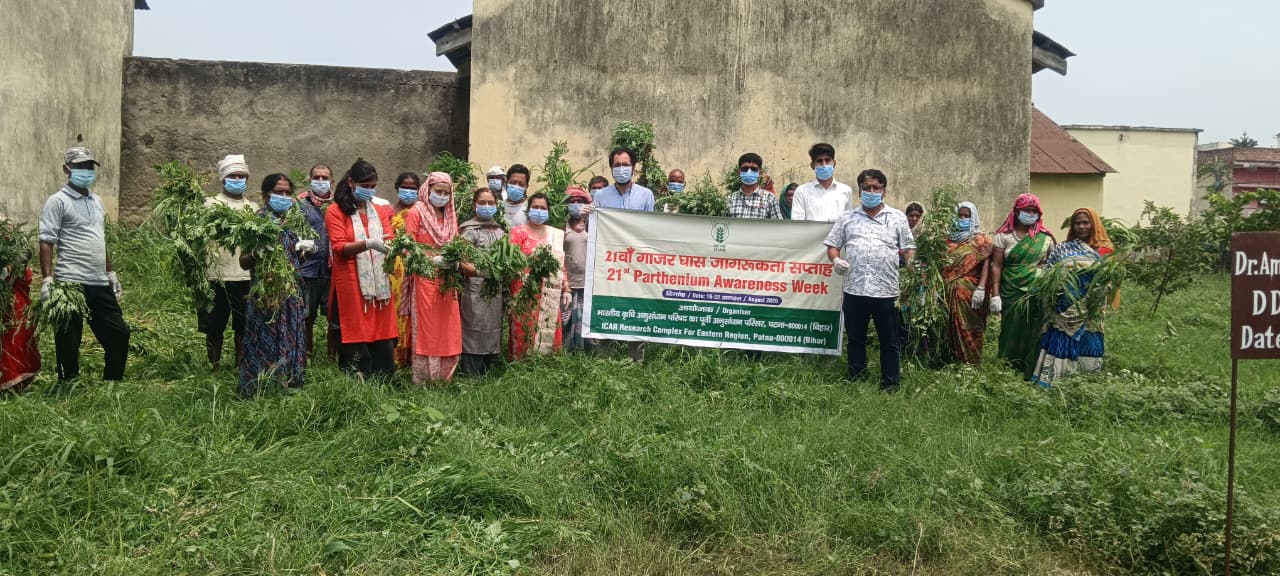
Patna: The ICAR Research Complex for Eastern Region (ICAR-RCER), Patna observed the 21st Parthenium Awareness Week from August 16 to 22, with a series of programmes aimed at raising awareness about the spread and management of the invasive weed Parthenium hysterophorus.

The awareness campaign involved the institute’s regional centres and Krishi Vigyan Kendras (KVKs) and brought together scientists, technical and administrative staff, farmers, students and farm workers.
Parthenium hysterophorus, commonly known as carrot weed, gajar ghas or congress grass, is an invasive weed that affects agriculture, biodiversity, livestock and human health. According to ICAR-RCER, the weed has infested nearly 35 million hectares of land in India.

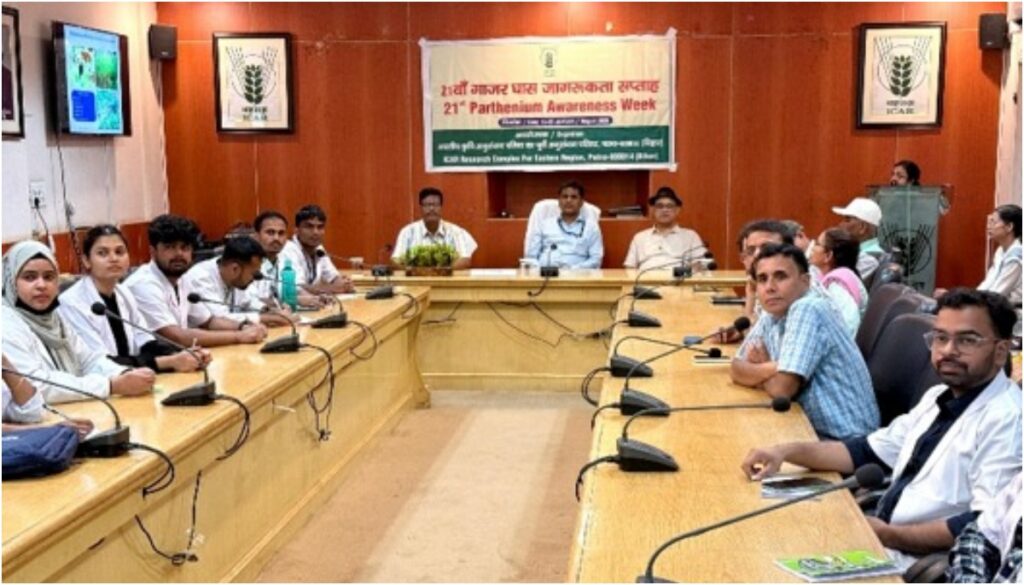
Student Interaction Programme
As part of the week, ICAR-RCER organised a Student Interaction Programme in which scientific and technical staff interacted with M.Sc. and Ph.D. students from A.N. College, Patna University, Pataliputra University, Patna Women’s College, NIPER Hajipur and J.N.L. College, Khagaul.
The discussions focused on the impact of Parthenium and approaches for its effective and sustainable management.
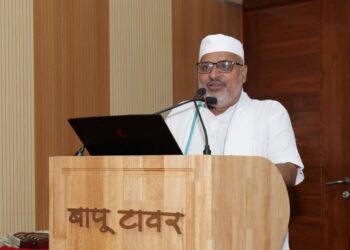
ICAR-RCER Director Dr Anup Das stressed the importance of public awareness and community participation in controlling the invasive weed. He said an integrated weed management approach combining biological, cultural and other eco-friendly methods would provide a sustainable solution for long-term management.
Heads of various institute divisions, including Dr Sanjeev Kumar, Dr Ashutosh Upadhyaya, Dr Kamal Sarma and Dr Ujjwal Kumar, also addressed the participants and discussed practical and cost-effective methods to control Parthenium infestation.
Management Strategies Discussed
Dr Sonaka Ghosh, Scientist, Division of Land and Water Management, delivered a lecture on “Strategies for Parthenium hysterophorus L. Management”.
She discussed the weed’s impact on agriculture, biodiversity and public health, along with physical, cultural, chemical and biological control methods.
Dr Ghosh highlighted the use of biological control agents such as the Mexican beetle (Zygogramma bicolorata) and competitive plant species including Cassia spp., marigold and fodder crops for suppressing Parthenium.
She also discussed the possible effects of climate change on the weed, particularly how rising atmospheric carbon dioxide levels and temperatures could influence its growth, spread and management.
Parthenium exposure has also been associated with health problems including dermatitis, asthma and nasal-dermal and nasal-bronchial allergic disorders.
Eradication Drive
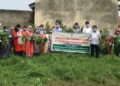
An institute-wide Parthenium eradication drive was conducted during the awareness week. Scientists, officers, technical staff and supporting personnel participated in uprooting and removing the weed from the institute premises and farm areas.
The initiative was aimed at supporting the institute’s effort to maintain a Parthenium-free campus through collective action and continued management.
The programme was coordinated by Dr Sonaka Ghosh, Dr Shivani, Dr Rakesh Kumar and Dr Ghous Ali. Dr Saurabh Kumar, Dr Abhishek Kumar Dubey, Dr Manisha Tamta and Dr Rajni Kumari served as co-organisers.
Technical support was provided by Vijay Babu, Abhishek Kumar, P.K. Singh, P.K. Mahapatra and Umesh Kumar Mishra of ICAR-RCER, Patna.
The programme concluded with a vote of thanks delivered by Dr Manisha Tamta, Scientist, Division of Crop Research, ICAR-RCER, Patna.