

Patna: OpenAI has introduced a Writing Styles feature for ChatGPT Work, designed to make AI-generated writing more closely resemble an individual user’s communication style.

The feature is aimed at users who rely on AI tools for drafting emails, messages and other written content but want the output to sound more personal and less machine-generated.
According to OpenAI, ChatGPT Work can learn patterns such as preferred phrasing, sign-offs and capitalisation habits before applying them to generated drafts.

How The Feature Works
Users can connect services they regularly use, including Gmail, Google Drive, Slack and SharePoint. After receiving permission, ChatGPT Work can analyse relevant writing samples from those connected applications.
The system uses these examples to identify characteristics of a user’s writing, including word choice, tone, sentence structure and punctuation.
OpenAI has not publicly provided detailed technical information about the feature’s underlying system. The process is broadly consistent with natural language processing techniques used to analyse and reproduce patterns in written language.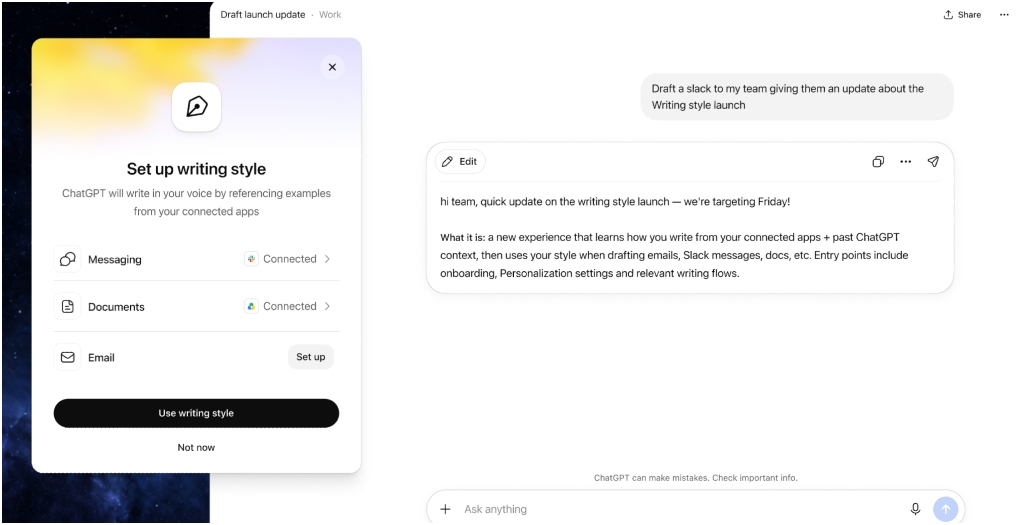
Availability
The Writing Styles feature is available through the ChatGPT web platform for paid plans that include ChatGPT Work, according to the information provided by OpenAI.
Users can configure the feature through the web interface, including the Personalization section in settings.
The feature is currently limited to ChatGPT Work. OpenAI has not announced when the same capability will become available in the standard version of ChatGPT.
Similar Feature From Anthropic
OpenAI’s move follows a similar feature introduced by Anthropic for Claude. Its Styles tool allows users to create personalised writing styles by uploading or pasting writing samples.
The development reflects a broader effort among AI companies to make generated content more closely match individual communication preferences rather than relying solely on generic writing patterns.
The Writing Styles feature was introduced shortly after the release of GPT-6 Astra, which OpenAI described as its most powerful model to date.