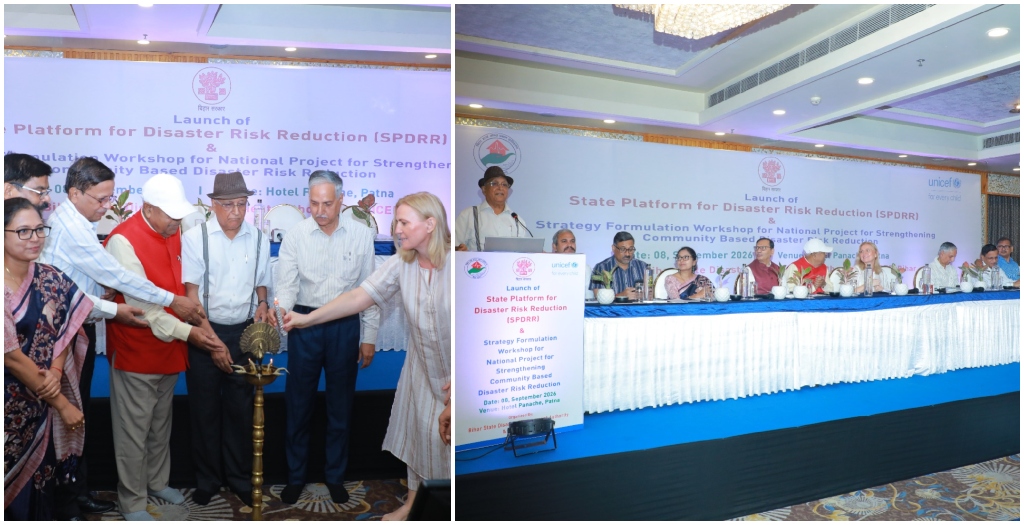
Patna: The Bihar State Disaster Management Authority (BSDMA), in collaboration with UNICEF Bihar, on September 8 launched the State Platform for Disaster Risk Reduction (SPDRR-Bihar) to strengthen community participation and disaster preparedness across the state.

The launch was held alongside a strategy formulation workshop for the National Project for Strengthening Community-Based Disaster Risk Reduction (NP-CBDRR).
The initiative aims to strengthen disaster preparedness at the village and hamlet levels, with communities positioned as key participants in disaster risk reduction and response.

Project To Cover 100 Gram Panchayats
According to the National Disaster Management Authority (NDMA), the NP-CBDRR project will be implemented across 100 Gram Panchayats in five districts: Sitamarhi, Darbhanga, Muzaffarpur, Madhubani and Supaul.
The project will focus on strengthening the disaster resilience of Gram Panchayats, integrating disaster risk reduction into development plans and promoting risk-specific mitigation measures at the local level.
Focus On Local Institutions
BSDMA Vice-Chairman Dr Uday Kant said disaster risk reduction strategies should be based on the needs of affected communities.
He stressed the importance of communication and public participation involving communities, local institutions and government agencies, and called for stronger implementation of disaster risk reduction measures at the grassroots level.
BSDMA member P.N. Rai said empowering Panchayati Raj Institutions and integrating disaster risk reduction into development planning would strengthen Bihar’s disaster management system.
He described SPDRR as a platform intended to bring government and non-government stakeholders together and highlighted the role of technology, innovation and regular review of existing programmes.
Bihar Faces Multiple Disaster Risks
BSDMA Secretary Md Waris Khan said Bihar remains vulnerable to several natural and human-induced hazards, including floods, lightning, heatwaves and cold waves.
He said strengthening community capacity and preparedness should remain central to disaster risk reduction because local residents are often the first responders during emergencies.
UNICEF Bihar CFO Monica Nelson said disasters can disproportionately affect children, women and other vulnerable groups. She emphasised coordinated action involving government departments, Panchayati Raj Institutions and communities.
Technical Sessions On Risk Reduction
NDMA Senior Consultant Dr Sweta Baidya presented the framework for the NP-CBDRR project during the workshop.
Technical sessions covered flood early warning and monitoring, earthquake-resistant construction and retrofitting, climate change and extreme weather conditions, as well as volunteerism, social inclusion and capacity building.
Participants also discussed integrating disaster risk reduction into Gram Panchayat development plans, using available financial resources and preparing local action plans.
The programme concluded with presentations of group recommendations, an open discussion and question-and-answer session, followed by deliberations on the future course of action.
The workshop ended with a commitment to integrate disaster risk reduction into development planning at the Gram Panchayat level and strengthen community capacity to act as first responders.