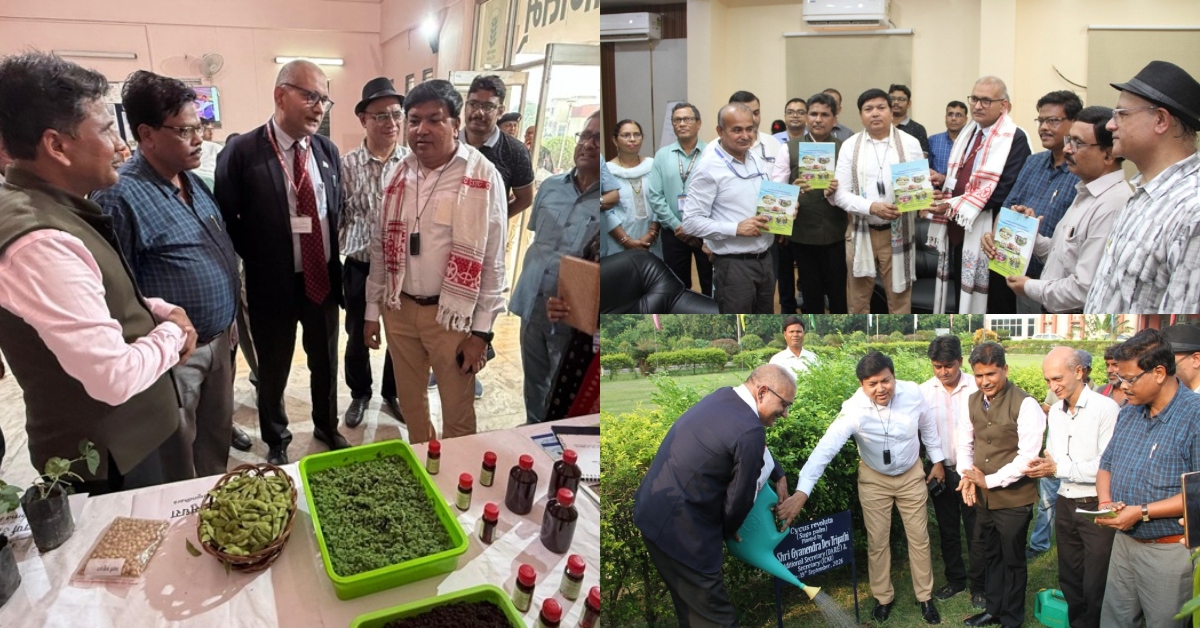
Patna, September 19: Gyanendra Dev Tripathi, Additional Secretary, Department of Agricultural Research and Education (DARE) and Secretary, Indian Council of Agricultural Research (ICAR), visited ICAR-Research Complex for Eastern Region (ICAR-RCER), Patna, on Saturday.

He was accompanied by Narmdeshwar Lal, Principal Secretary, Agriculture Department, Government of Bihar, and Dr R K Singh, Assistant Director General (Agricultural Extension).
The visit focused on strengthening science-led, demand-driven and farmer-centric agricultural research and technology dissemination, in line with national priorities and the broader goal of Viksit Bharat @2047.

Review Of Climate-Resilient Research
Tripathi reviewed ongoing research programmes and field-oriented initiatives at ICAR-RCER aimed at addressing emerging challenges in agriculture.
The visiting officials inspected several research and demonstration facilities, including long-term natural farming trials, millet-based cropping systems, diversified fruit-based nutrition gardens and solar energy-based farm mechanisation.
They also reviewed smart water management units, Rainout Shelter and Open Top Chambers facilities being used for research on climate-resilient crop varieties and preparedness for future climatic stresses.
Integrated Farming And Livestock Research
The dignitaries visited the institute’s one- and two-acre Integrated Farming System (IFS) models, including micro- and nano-homestead farming models.
Discussions focused on the potential to replicate and scale these models on farmers’ fields.
At the animal farm, they reviewed research on the genetic improvement of Black Bengal goats and Murrah buffaloes, along with the characterisation and conservation of indigenous livestock resources in the region.
Tripathi and Lal also jointly planted a sapling on the institute campus.
Farmers Share Technology Adoption Experiences
An exhibition showcasing ICAR-RCER technologies, research achievements and farmer-oriented innovations was organised during the visit.
The officials interacted with farmers associated with the institute’s technology dissemination initiatives.
Albina Ekka of Ranchi shared her experience of generating an annual income of around Rs 12 lakh through an integrated farming system.
Ramsharan of Ramgarh spoke about earning around Rs 20 lakh annually through year-round vegetable cultivation on raised beds integrated with goat and fish farming.
Focus On Scientist–Farmer Linkages
Tripathi stressed the need for agricultural research to remain outcome-oriented, field-relevant and responsive to emerging challenges.
He called for stronger scientist–farmer linkages so that research findings can be translated more quickly into technologies that improve sustainability, resource-use efficiency and farm productivity.
He also emphasised interdisciplinary research, faster technology dissemination and closer coordination with state governments and other stakeholders.
Bihar Seeks Closer Research Coordination
Lal appreciated ICAR-RCER’s research and technology development initiatives and highlighted the importance of closer coordination between the institute and the Bihar Agriculture Department.
He said collaboration would be important for the field-level validation, wider dissemination and adoption of climate-resilient and farmer-oriented technologies.
Lal also assured state government support for collaborative research, technology promotion and capacity building based on the needs of Bihar’s farmers.
ICAR-RCER Highlights Research Priorities
Dr Anup Das, Director, ICAR-RCER, briefed the visiting officials on the institute’s major research programmes, infrastructure and technology dissemination initiatives.
The institute’s work includes climate-resilient agriculture, rice-fallow system intensification, multi-stress crop improvement, improved fruit and vegetable varieties, AI and machine-learning-enabled precision water and nutrient management, affordable farm mechanisation, integrated farming systems, agroforestry, livestock and fisheries.
Das also highlighted the institute’s partnerships with state departments, Krishi Vigyan Kendras (KVKs), farmers and other stakeholders across Eastern India.
He referred to collaboration with the Bihar government through programmes including Climate Resilient Agriculture (CRA) and the Bihar Agricultural Management & Extension Training Institute (BAMETI).
Publication Released During Visit
A publication titled “Technology and Institutional Synergy for Empowering NEH Farmers: ICAR-RCER Initiatives” was released during the programme.
The dignitaries later interacted with the institute’s scientific, technical and administrative personnel, including KVK representatives.
The discussion covered research priorities, utilisation of research funds, research–extension linkages and convergence with state government programmes.
According to Umesh Kumar Mishra, Member Secretary, Media, ICAR-RCER, the visiting dignitaries appreciated the institute’s efforts to develop and disseminate demand-driven technologies through collaboration with farmers, state departments and other stakeholders.