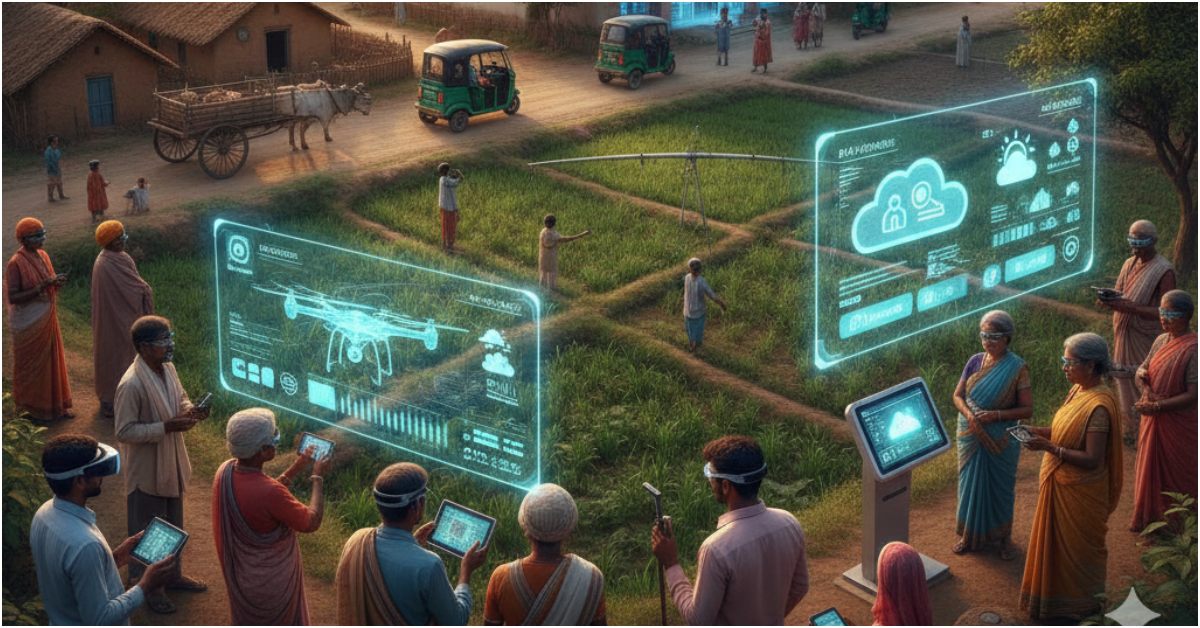
Patna: Artificial intelligence is being positioned as a catalyst for rural transformation in India, as policymakers seek to embed digital tools across farming, education and local governance.

Under the government’s “AI for All” approach, AI is increasingly framed as an instrument of inclusive growth, particularly in villages. The strategy builds on the NITI Aayog National Strategy for Artificial Intelligence, first released in 2018, which described the technology as a potential force multiplier for sectors such as agriculture, healthcare and education.
At the India AI Impact Summit 2026 in Delhi, several memoranda of understanding were signed to accelerate adoption at the state level. Bihar, among the states seeking to expand its digital footprint, announced partnerships aimed at deploying AI-driven services in remote and underserved communities.

Digitising the Gram Sabha
One of the most prominent initiatives is Sabhasaar, launched by the Ministry of Panchayati Raj in August 2025. The tool automatically generates structured minutes from audio and video recordings of gram sabha and panchayat meetings. Integrated with Bhashini, it operates in 14 Indian languages, reducing manual paperwork and enabling multilingual documentation in rural administrations.
Officials say this automation allows local bodies to focus more closely on the nine local sustainable development goals adopted by panchayats.
The e-GramSwaraj platform, meanwhile, integrates budgeting, accounting, monitoring and payments for local governments. By the 2025–26 financial year, it had expanded to more than 250,000 gram panchayats nationwide. Complementing it is Gram Nakshatra, a GIS-based system that supports asset mapping, spatial planning and disaster management within Gram Panchayat Development Plans.
Another data-focused initiative, AI Kosh, provides datasets and ready-to-deploy AI models drawn from government and non-government sources. As of February 2026, it hosted more than 7,500 datasets and 273 models across 20 sectors, with millions of recorded visits and thousands of model downloads. The platform is intended to support solutions in rural e-governance and public administration.
To strengthen transparency in public works, Bhooprahari uses AI and geospatial technology to monitor assets created under the rural employment scheme MGNREGA. Authorities say it will be expanded to track projects under the Vikas Bharat Guarantee programme, with the aim of improving accountability and resource use.
Precision Tools for Farmers
In agriculture, AI applications are being rolled out to assist farmers with decision-making. The Ministry of Agriculture’s Kisan e-Mitra virtual assistant provides information on government schemes and income support. The National Pest Surveillance System and Crop Health Monitoring Platform analyse satellite imagery, weather patterns and soil data to generate real-time advisories. Officials argue that such tools can help farmers detect pest infestations early, optimise irrigation and sowing schedules, and potentially raise yields.
Education and Language Access
Digital inclusion efforts also extend to schools. The National Council of Educational Research and Training’s DIKSHA platform incorporates AI-enabled video search and read-aloud features, aimed particularly at students with disabilities. The YUVA (Youth for Unnati and Vikas with AI) programme introduces pupils from classes 8 to 12 to AI concepts and digital skills.
Language remains a central focus of India’s AI strategy. Bhashini offers translation, speech-to-text and voice-based interfaces in more than 36 Indian languages and has been integrated into over 23 government services. By late 2025, the platform supported hundreds of AI models and recorded more than a million downloads, according to official figures.