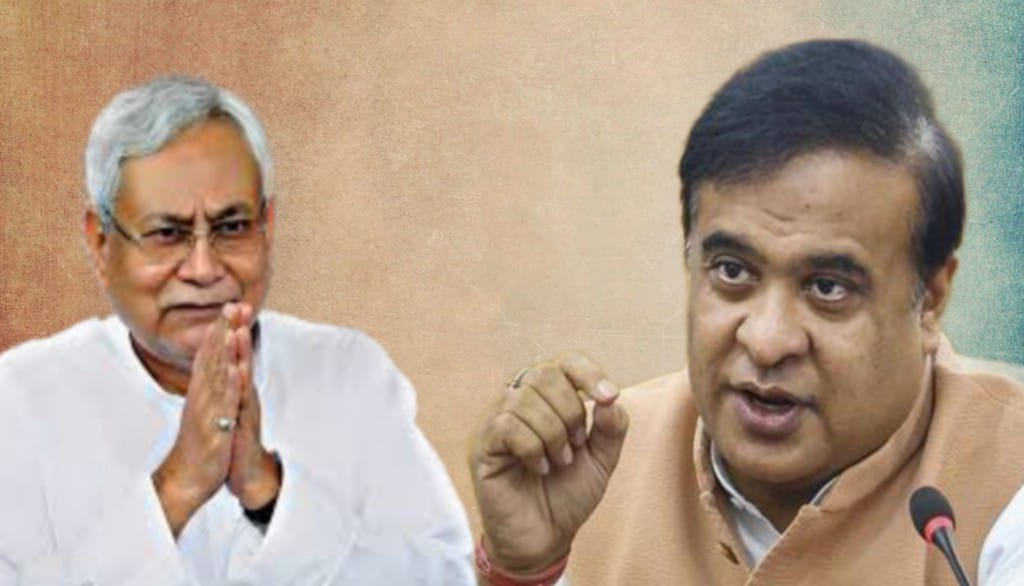
Patna: Nitish Kumar, sworn in as Bihar’s Chief Minister for the tenth time on Thursday, is being hailed within the NDA for deploying a welfare formula that may have reshaped the state’s political landscape. Central to the coalition’s sweeping 202-seat victory was the Chief Minister’s Women’s Employment Scheme, under which Rs. 10,000 was deposited into the bank accounts of 1.5 crore women during the campaign period.

Now, Assam Chief Minister Himanta Biswa Sarma has stepped forward to claim that the credit for this decisive intervention “belongs partly to Assam”.
‘I gave Nitish the Rs. 10,000 note formula’
In an interview to a national newspaper, Sarma said the idea was born months earlier when, at the invitation of the Nitish Kumar government, he dispatched senior bureaucrats to Patna.

“Five months ago, my officers gave a full presentation on the ‘Jeevika Rs. 10,000 Model’ to Bihar’s then Chief Secretary Amrit Lal Meena and Development Commissioner Pratyay Amrit,” he said.
“That model was later integrated into Bihar’s Women’s Employment Scheme — and the results speak for themselves.”
According to Sarma, the presentation was crafted at the request of Sanjay, Executive Chairman of Vision 100, who coordinated briefings for Bihar’s top officials.
Assam’s Influence: ‘My formula worked in MP too’
Sarma added that this was not the first time Assam’s welfare architecture had travelled beyond state borders.
“Even Madhya Pradesh’s Ladli Behna scheme drew inspiration from Assam’s Arunodaya model,” he said.
The monthly Rs. 1,000 payout to women was seen as a crucial factor in the BJP’s victory in the fiercely contested 2023 MP assembly elections.
Women Voters: Bihar’s Decisive Bloc
Women voters played an unusually influential role in Bihar’s 2025 election:
-
Total voters: 7.45 crore
-
Women: 3.51 crore
-
Men: 3.93 crore
-
Female-to-male ratio: 892 per 1,000
Turnout surged dramatically:
-
Women’s turnout (2020): 59.7%
-
Women’s turnout (2025): 71.6%
-
Men’s turnout (2025): 62.8%
Analysts say the Rs. 10,000 transfer, combined with Nitish Kumar’s long-standing efforts to court female voters, delivered a sharp edge against the opposition.
Ticket Distribution: Low Representation Despite Women’s Surge
Despite women driving turnout, representation remained starkly low.
Bihar’s 243-member assembly would require 80 women MLAs to fulfil the proposed 33% reservation — a benchmark no alliance came close to.
NDA Allocation
-
JD(U): 13 women candidates out of 101 (12.8%)
-
BJP: 13 out of 101 (12.8%)
-
LJP (R): 5 out of 28 (17.8%)
-
HAM (S) : 2 out of 6 (33%) — highest proportion within NDA
Grand Alliance Allocation
-
RJD: 24 women out of 143 (16.8%)
-
Congress: 5 women out of 61 (8.2%)
-
VIP: 1 out of 14 (7.1%)
-
Left parties: negligible representation
Jansuraj (Prashant Kishor)
Prashant Kishor, contesting all 243 seats independently, fielded only 25 women candidates (10.3%) — far short of his earlier claim of offering 40% tickets to women.
A Welfare Blueprint Designed to Make ‘Lakhpati Didis’
The Bihar scheme has been publicly framed as part of the Prime Minister’s broader vision to create “Lakhpati Didis” — financially empowered women capable of lifting households out of subsistence incomes.
Sarma said Assam’s engagement with this vision had been consistent:
“Our models have worked in Assam, Madhya Pradesh and now Bihar. The idea is simple — empower women, and political stability follows.”
As Nitish Kumar begins his tenth term, the debate over credit may continue, but the scale of women’s mobilisation — and the political returns it delivered — is already being read as a defining feature of Bihar’s 2025 election.