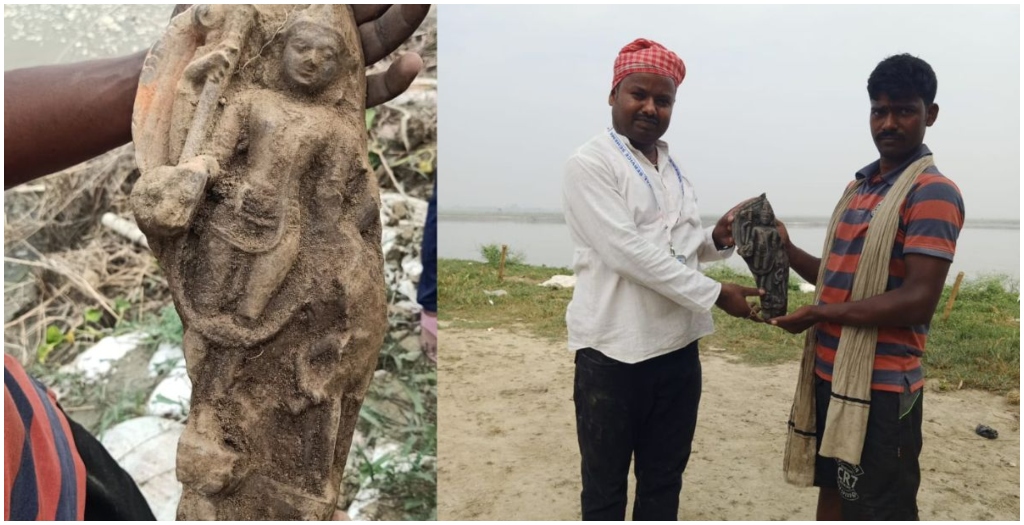
Bhagalpur: A rare 1,300-year-old statue of Lord Vishnu has been found in Guwaridih, a village in the Bihpur area of Bhagalpur district, bringing the site back into focus. The region has been known for years for producing ancient remains, but this new discovery has created fresh excitement among researchers and local residents. The idol is believed to date back to the Pala period, making it one of the most valuable finds in the area. Historians say the Pala dynasty produced some of eastern India’s finest stone sculptures, and this statue appears to be part of that tradition.

The statue is partly damaged, but many details are still visible. Lord Vishnu is shown in Abhaya Mudra, a gesture meant to assure protection. A stick-like object can be seen in one hand, and the sacred thread, or janeu, is carved clearly across the figure. Even though the lower part is broken, experts believe the deity was seated on a lotus, which is a common feature in early medieval art. Initial estimates suggest it was created sometime in the 8th or 9th century.
Local villager Avinash Kumar, known as Gangi Da, who has spent many years preserving such remains informally, said the statue was recovered about 20 days ago. It was reportedly found by Amit Kumar, also called Jhunno Chaudhary, in a marshy area affected by Kosi river erosion. Two researchers from Bhagalpur were present at the time and took the idol for study. They are now examining the statue to confirm its age and historical background. According to locals, such discoveries are becoming more frequent as the soil in the region shifts due to erosion.

The importance of Guwaridih first reached a wider audience when Prabhat Khabar highlighted the repeated findings from the mound. After the newspaper continued its coverage, Chief Minister Nitish Kumar visited the site on 20 December 2020. Following his visit, the government announced a plan to save the mound from further erosion, and it was officially declared a protected area by the district administration. The move was welcomed, as researchers from India and abroad regularly visit the site to study its archaeological value.
However, despite being marked as a protected area, the ancient remains found at Guwaridih are still not stored or secured in any official facility. Most of the artefacts recovered over time are safeguarded by villagers, especially Gangi Da, who has taken on the role of caretaker without formal support. Historians and locals say the government must now set up a proper system to document, preserve, and display the discoveries, especially after this latest find that has once again shown how culturally rich the region truly is.