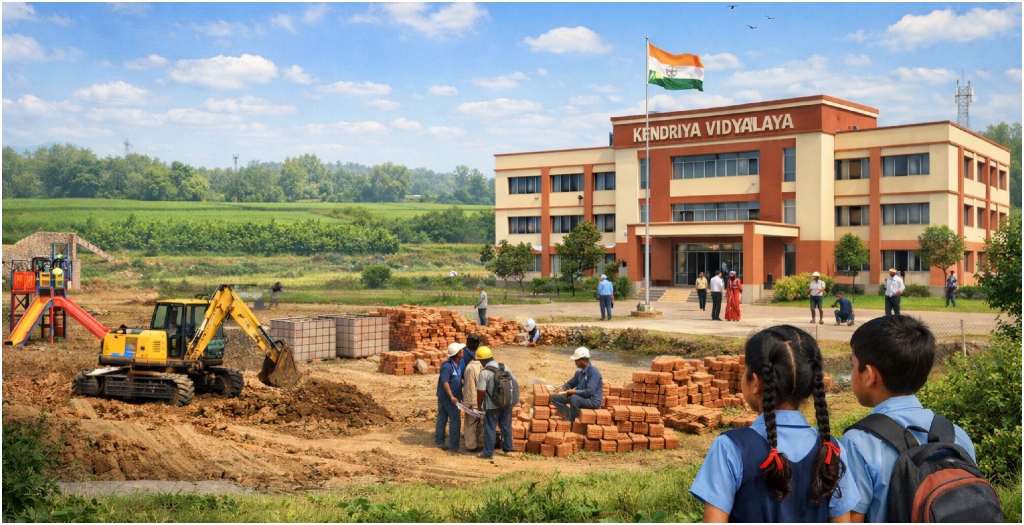
Patna: The central government has approved a major education project for Bihar, clearing Rs 2,135.85 crore for the establishment of 19 new Kendriya Vidyalayas across the state. The decision comes ahead of the assembly elections and is being seen as a significant step to improve access to quality schooling in Bihar. The money will be released from the financial year 2026–27, and once fully functional, these schools are expected to benefit around 30,000 students.

The new Kendriya Vidyalayas will be opened in 14 districts, including Gaya, Patna, Muzaffarpur, Purnia, Arwal, Madhubani, Kaimur, Madhepura, Sheikhpura, Bhojpur, Bhagalpur, Nalanda, Munger and Darbhanga. Two of the schools will be set up in Madhubani district alone. The Bihar government has already completed the process of selecting land for the new campuses. District magistrates have identified four to five acres of land at each location and submitted their reports to the state government.
A senior Education Department official said that building a Kendriya Vidyalaya normally requires 2.5 to 4 acres in urban areas and at least five acres in rural areas. This land will be transferred free of cost to the Kendriya Vidyalaya Sangathan (KVS). The central government will provide funds for constructing school buildings, classrooms, laboratories, playgrounds and other basic facilities. Until the permanent buildings are ready, the schools will operate from government buildings. District administrations have been asked to make sure that these temporary schools have electricity, drinking water and proper road access.

At present, there are 1,288 Kendriya Vidyalayas across the country with more than 1.4 million students. Bihar currently has only 16 such schools, but with the addition of 19 new ones, the total will rise to 35. Each Kendriya Vidyalaya will have 1,520 seats, with a maximum of 40 students per class. Under the Right to Education Act, 25 percent of seats in each class will be reserved for children from economically weaker sections.
For higher secondary classes, each school will offer 120 seats across Science, Arts and Commerce streams. Reservation rules will apply, including 15 percent for Scheduled Castes, 7.5 percent for Scheduled Tribes and 27 percent for OBC (excluding creamy layer). A 3 percent reservation will be available for students with disabilities. Officials say the project will not only reduce pressure on existing schools but also help bring quality education to many parts of Bihar that have long needed better facilities.