Patna: Bihar is witnessing an intensifying cold wave, with the Meteorological Centre issuing an orange alert for dense fog and cold-day conditions in 24 districts on Monday. The alert warns of severe cold, low visibility, and prolonged foggy conditions across large parts of the state.

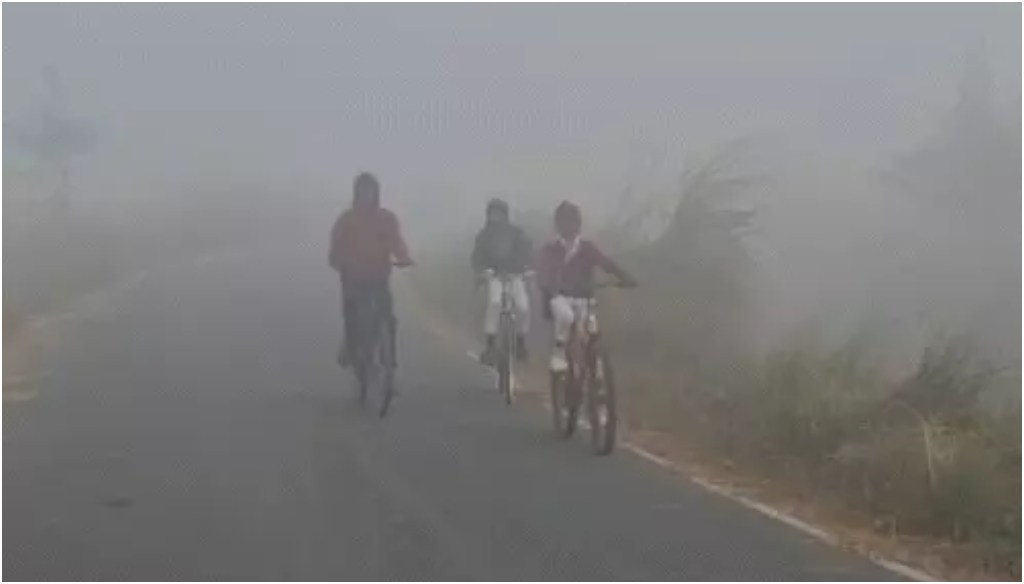
Early Monday morning, dense fog enveloped Patna, Nalanda, Aurangabad, and Chhapra, severely disrupting normal life. In Nalanda, visibility dropped to less than 20 metres, raising concerns for road, rail, and air travel. Several districts, including Purnea, Araria, Siwan, Bhojpur, Gopalganj, and Sitamarhi, have ordered the closure of schools up to Class 8 due to the biting cold.
According to the Meteorological Centre, minimum temperatures across Bihar are likely to fall by another 2 to 3 degrees Celsius over the next week, intensifying the cold wave. Over the past 24 hours, many districts experienced dense fog during early mornings and late nights. Gaya recorded the lowest minimum temperature in the state at 8 degrees Celsius.

Weather officials have warned that cold-day conditions could prevail across Bihar after December 25, with daytime temperatures remaining well below normal levels. This is expected to result in severe cold both during the day and night.
Air and rail services have also been affected due to poor visibility. On Sunday, three flights were cancelled, including Air India’s Patna–Delhi service and IndiGo flights on the Patna–Kolkata and Patna–Chennai routes. Thirteen flights operated with delays. Airline sources said dense fog is also forecast in Patna on Monday morning, which could lead to the cancellation of one Delhi and one Kolkata flight, while around 10 flights may be delayed by one to two hours. Passengers have been advised to check flight schedules before heading to the airport.
In view of the worsening cold, authorities have ordered the closure of schools in several districts. In Sheohar, all government and private schools from Classes 1 to 8 have been closed until December 23. Schools in Purnea, Araria, Siwan, Bhojpur, Gopalganj, and Sitamarhi will remain closed until December 24. Gopalganj has issued similar orders, while school timings have been revised in Muzaffarpur to reduce exposure to extreme cold.
Scenes across Bihar reflect the severity of the weather. In Gopalganj and Kishanganj, people were seen gathering around bonfires to keep warm. In Banka district, a container vehicle overturned near Ajit Nagar bridge in the Rajoun police station area on Sunday morning due to dense fog, though the driver and helper escaped unhurt. In Bihar Sharif, the municipal corporation has arranged bonfires at 19 locations to provide relief to residents.
Explaining the persistent cold-day conditions, meteorologist Gaurav Kumar said a thick layer of dense fog has formed in the lower troposphere, while high-level clouds are blocking sunlight from reaching the surface. As a result, maximum temperatures are not rising during the day. Currently, maximum temperatures across Bihar are 4 to 6 degrees Celsius below normal.
Meteorologists also pointed to the activation of a strong western jet stream over western North India, blowing at speeds of around 125 kmph at an altitude of 12.6 kilometres. Additionally, a western disturbance is expected to develop over the Himalayan region from December 25, which will further impact Bihar’s weather. Cold northwesterly winds are likely to continue, leading to a further drop in temperatures.
The weather department has forecast dense fog at isolated places in northern and south-western districts on December 23, while light to moderate fog is expected in other parts of the state over the next three days. In Patna, dense fog is likely during early mornings and nights, with cold-day conditions possible due to falling minimum temperatures. Sunshine during the day is expected to remain limited.
Meteorological experts said cold-day conditions occur when daytime temperatures remain significantly below normal despite daylight hours, mainly due to dense fog, high humidity, and calm wind conditions. Such weather is common in the plains of North India during December and January and can pose health risks, especially for children, the elderly, and those with respiratory problems. The cold and fog are expected to persist across Bihar over the coming days.