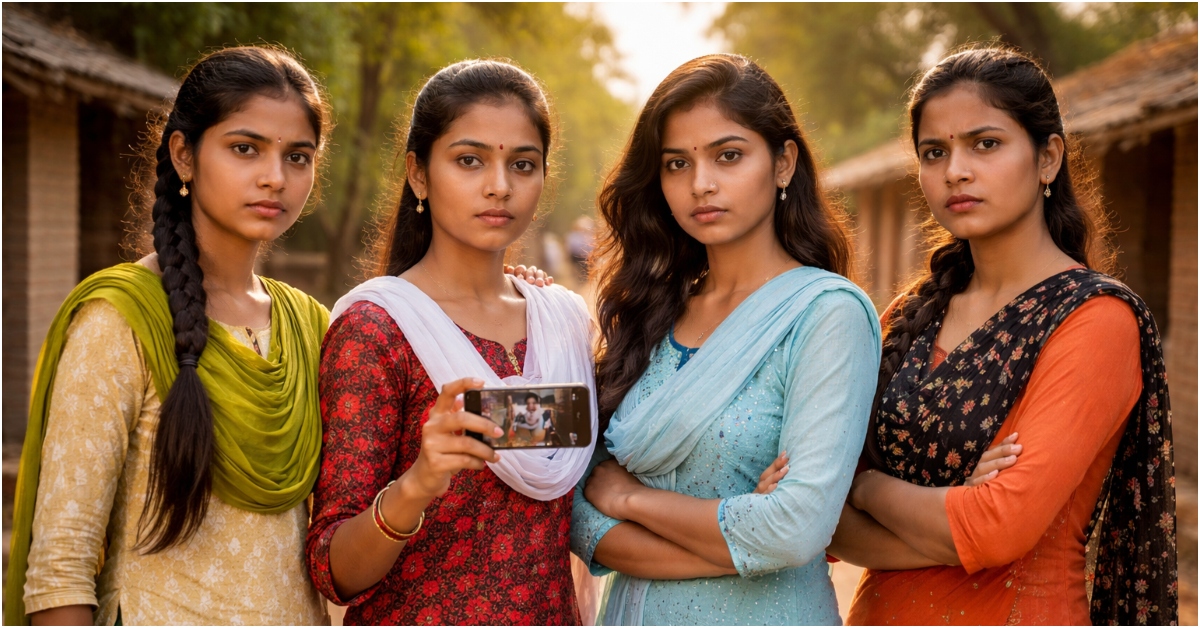
Vaishali: In Bihar’s Vaishali district, two socially driven short films are bringing attention to the growing voice and confidence of young women. Produced under the banner of Putul Baba Films, the projects—Bad Touch Ka Sensor and Viral Sharabbandi—portray girls who confront social injustice and challenge deep-rooted taboos in their communities. The films aim to highlight the changing mindset of Bihar’s daughters, who are increasingly stepping forward to question wrongdoing and drive social change.

Bad Touch Ka Sensor explores the sensitive issue of child safety. The film exposes a troubling reality in which elderly men, who are expected to command respect in society, misuse their position to harass school-going girls. Instead of remaining silent, the young protagonists confront the perpetrators and ensure they face the consequences of their actions. The narrative ultimately emphasises self-confidence and awareness among girls, portraying them as capable of protecting themselves and speaking out against abuse.
The film features strong performances from Sindhu, Anupriya Dubey, Virendra Kumar, Kileshwar Kumar and Anirudh Singh. Their natural acting style adds authenticity to the story and strengthens the film’s message. Artists such as Sindhu and Anupriya represent the diverse talents emerging from Bihar’s younger generation, bringing both emotional depth and realism to the screen.

The second film, Viral Sharabbandi, focuses on Bihar’s prohibition policy and the social problems associated with alcohol. The story follows two friends whose families are affected by the liquor trade—one girl’s father sells alcohol while the other’s father struggles with drinking. When the village panchayat fails to act, the girls take an unconventional step by recording and sharing a video online, forcing society to confront the issue. The film argues that prohibition is not just a legal policy but a broader social necessity.
Sindhu plays a key role in the film alongside Mauritian artist Sushie, while Virendra Kumar, Kileshwar Kumar, Prem Patel and Chhotu Shikari appear in important supporting roles. The ensemble cast’s teamwork contributes to a grounded and realistic portrayal of rural life and social conflict.
Both films stand out for their commitment to authenticity. The director deliberately avoided heavy makeup, allowing actors to appear in their natural form. Shooting took place at real locations in Hajipur and Rajapakar in Vaishali district, adding to the films’ realism. Cinematography was handled by Anirudh Singh and Prem Raj, editing by Divesh Kumar, while the background music was generated using artificial intelligence and arranged by Ananta Arya.
Producer and editor Divesh Kumar said the films reflect the transformation taking place among girls in Bihar. “Girls in Bihar are now far more educated and confident than before,” he said. “Government policies and education have played an important role. Through our films, we want to show that today’s daughters can distinguish between right and wrong.” According to him, work has already begun on another project inspired by the Beti Bachao, Beti Padhao campaign.
The project also brings together a diverse group of artists and technicians from the region. Sindhu, originally from Bhagalpur and now running a studio in Hajipur, is known for her work as an actor, singer and makeup artist. Meanwhile, YouTube performer Anupriya Dubey—popular for her “saas-bahu” style sketches—appears in a strikingly different avatar without makeup, which she described as a matter of pride.
Created through a collaboration between Putul Baba Films, Link Line Multimedia and Anirudh Films, the short films were released on social media to coincide with International Women’s Day. The filmmakers say the goal is not only to entertain audiences but also to spark conversation and awareness about social issues affecting communities across Bihar.