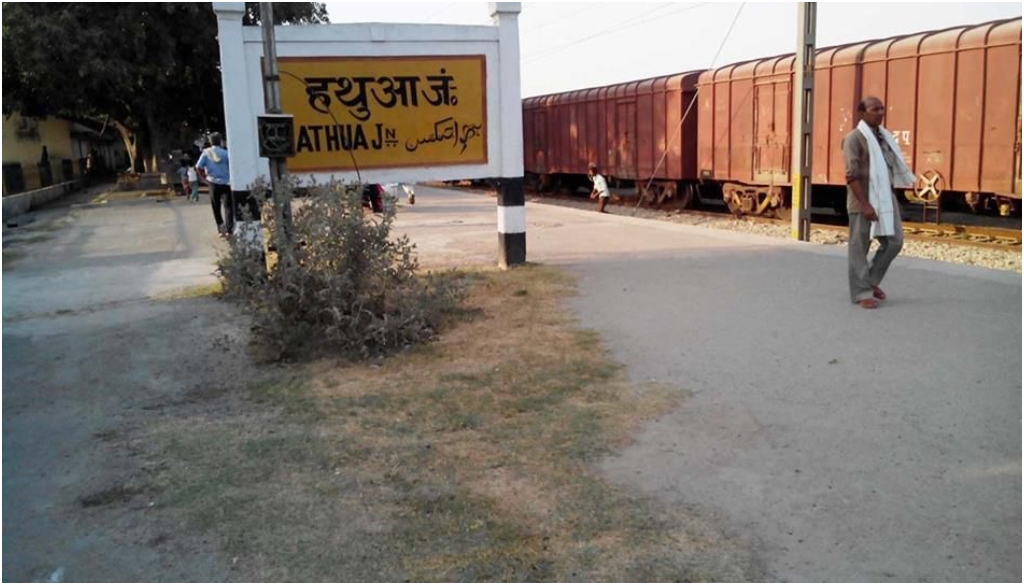
Gopalganj: Located in Bihar’s Gopalganj district, the Hathua assembly constituency occupies a distinctive place in the state’s political map. Besides being part of the Gopalganj Lok Sabha seat, the area is home to Phulwaria village — the ancestral home of Rashtriya Janata Dal (RJD) president and former chief minister Lalu Prasad. The constituency’s political shifts often mirror broader trends in Bihar, making it a key indicator of state-wide electoral sentiments.

Geography and economy
Situated in the fertile western Gangetic plains, Hathua’s economy is driven primarily by agriculture. Paddy, wheat, maize and sugarcane dominate the landscape, while dairy farming and small-scale trade supplement local livelihoods. Despite its agrarian prosperity, the region continues to grapple with migration, driven by unemployment and limited industrial growth.

In recent years, improvements in road connectivity and public infrastructure have accelerated development in the area. Hathua lies around 20 kilometres south of Gopalganj’s district headquarters, bordered by Mirganj to the east and Siwan and Saran districts to the southwest. The Siwan–Gopalganj railway line, with stations at Hathua and Mirganj, links the region to other parts of Bihar, including the state capital Patna, about 160 kilometres away.
Political landscape
Administratively, the Hathua assembly constituency comprises Hathua and Phulwaria blocks, along with Jamsar, Trilokpur, Mohaicha and Balesara gram panchayats of Uchhakagaon block, and the Mirganj Nagar Panchayat. Despite being Lalu Prasad’s home constituency, the RJD struggled for decades to secure victory here.
Since its formation in 2008, the seat was initially dominated by the Janata Dal (United), which won the 2010 and 2015 assembly elections. The tide turned in 2020, when the RJD captured the seat for the first time, defeating the JD(U). The win carried strong symbolic weight for the RJD, marking a return to strength in its founder’s backyard and signalling shifting loyalties in the region.
Caste equations and voting patterns
Like much of Bihar, Hathua’s politics is heavily influenced by caste alignments. The constituency’s electorate includes significant populations of Yadavs, Rajputs, Brahmins, Baniyas, Kushwahas and Dalits. Traditionally, Yadav voters have backed the RJD, while Rajputs and upper-caste communities tend to align with the JD(U) or the BJP.
In areas such as Mirganj and Phulwaria, Muslim voters often play a decisive role, shaping coalition strategies and outcomes. These caste and community equations make Hathua a microcosm of Bihar’s wider political fabric — where identity, alliances and local issues intertwine in every contest.
Demographic profile
According to 2024 Election Commission data, Hathua has a total population of 529,438, comprising 267,896 males and 261,542 females. Of the 320,877 registered voters, 162,882 are men, 157,988 are women, and seven are third-gender voters.