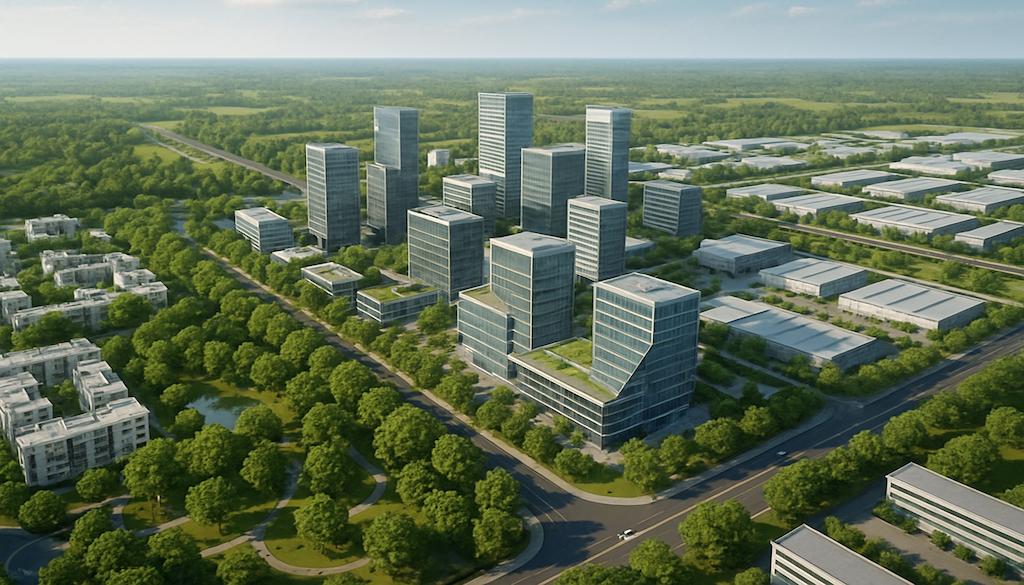
Patna: Bihar is set to undergo a major urban transformation with the state government approving the creation of Greenfield Cities in ten districts, designed as high-tech clusters integrating living, learning and industrial development. The cities will be developed in Patna, Bhagalpur, Muzaffarpur, Gaya, Darbhanga, Munger, Saran, Saharsa, Purnia and Madhubani.

The project will be jointly implemented by the Urban Development and Housing Department and the Industries Department. Officials described it as a model that brings together housing, education, healthcare, business activities and industrial zones within a single planned ecosystem.
🏙️ What’s a Greenfield City?

- 🏡 Eco-friendly residential core with 40% green cover
- 🏥 Schools, hospitals, markets & even a mini-forest inside the campus
- 🏭 Outer industrial ring focused on IT, textiles, furniture, food processing
- 🚆 Built close to highways, bus stands and railway stations for seamless connectivity
📐 Project Highlights
- 📏 15,000 acres being identified
- 🚫 Construction zones to be declared ‘no-entry’ areas for fast development
- 💰 Govt will acquire just 10–15% land; remaining area will be developed & auctioned to fund the project
💼 Why This Matters for Investors
- 🧑💼 Housing + education + healthcare + transport = ideal industrial ecosystem
- 🌐 Inspired by models in Gurugram, Chandigarh, Bengaluru, Australia & New Zealand
- 💻 IT companies and global investors prefer such integrated urban spaces
🌳 Green at the Core
- 🌿 40% green cover will serve as a “green lung” between industrial & residential areas
A new economic vision for Bihar
Industry Minister Dr Dilip Jaiswal said the initiative forms part of Bihar’s broader ambition to emerge as a major industrial state. He noted that national and international investors increasingly seek destinations where housing, education, healthcare and transport infrastructure are readily available—especially in the IT and services sectors.
The state’s new approach draws inspiration from cities such as Gurugram, Chandigarh, Bengaluru and international urban models in Australia and New Zealand, where integrated industrial–residential planning has boosted growth.
Environmental protection remains a core focus, with the mandated 40% green cover intended to act as a “green lung” separating industrial clusters from residential areas.
Officials said the Greenfield Cities project marks a significant shift from traditional urban expansion, aiming instead to build future-ready, technology-driven urban hubs capable of reshaping Bihar’s economic landscape.