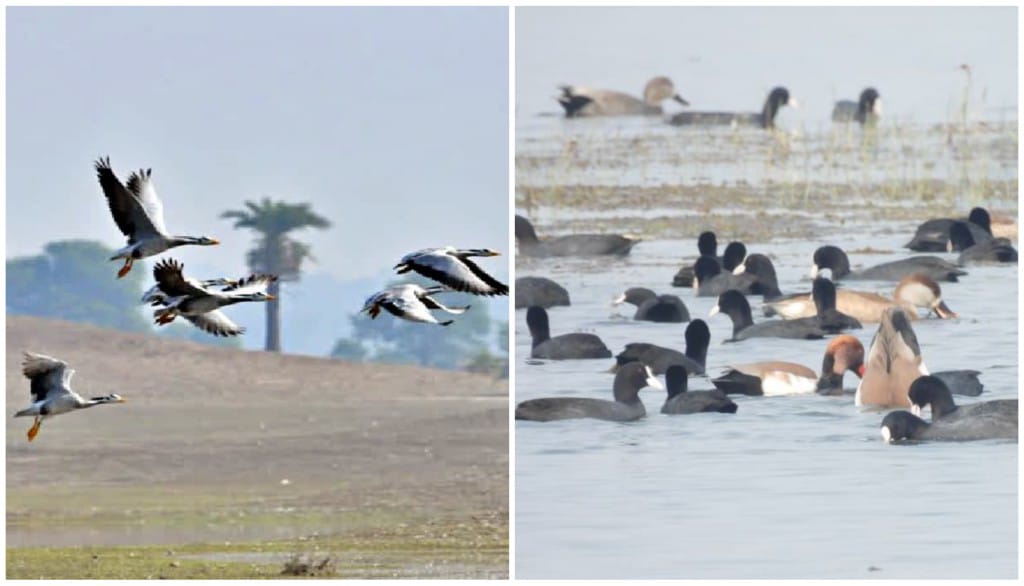
Saharsa: The Kosi floodplains are teeming with life this winter as more than 600 migratory birds from around 30 species have been spotted during an ongoing Water Bird Census, according to the state’s Environment, Forest and Climate Change Department. Officials say the findings indicate a “remarkable rise” in foreign bird arrivals, turning the region into one of Bihar’s fastest-growing ecological hotspots.

The census, part of the Asian Winter Water Bird Count, is being conducted across a 34-kilometre stretch of the Kosi river between Nauhatta and Ekamba village. Under the supervision of Divisional Forest Officer (DFO) Bharat Chintpalli, teams of forest workers and wildlife experts are surveying wetlands, river islands and marshy patches that act as seasonal refuges.
A stunning diversity: 30 species, 600 birds and more still arriving
DFO Chintpalli said the numbers have surpassed expectations.
“We have identified around 30 species and more than 600 migratory birds so far. Several rare species have been recorded for the first time in Saharsa,” he noted.

Among the visitors are species that have travelled thousands of miles, including:
-
Dalergy birds
-
White-vented species (Safed Chanjan)
-
Temminck’s stint
-
Indian spotted eagle
-
Eurasian coot
-
Spotted bill
-
Long-legged buzzard
-
Siberian stonechat
-
Little ring plover
The census team also recorded an exceptionally rare ‘Darling’ species, believed to have migrated from the Arctic Circle, indicating the ecological richness of the Kosi belt.
Rare sightings spark excitement among experts
The survey has brought several firsts.
“We found rare birds like the Short-eared Owl and Black Stork in Saharsa for the first time,” DFO Chintpalli confirmed.
Local species have also appeared in good numbers, including:
-
Dry black munia
-
River lapwing
-
Plain prinia (Pudukki)
-
Delicate prinia
-
Dhausela
The ten-day study aims to map new habitats, feeding grounds and nesting zones.
Officials say they are also gathering details on “why these birds choose the Kosi wetlands, what they feed on, and how they adapt”.
Jumui’s Nagi–Nakti Bird Sanctuary draws global visitors
Beyond Kosi, the Nagi–Nakti Bird Sanctuary, a Ramsar site in Jamui, continues to attract a vibrant range of foreign birds.
DFO Tejas Jaiswal said species like Rajhans, Lalsar, and the rare Indian Skimmer are regular winter arrivals.
Last year, two Rajhans birds were fitted with GPS trackers, revealing that they travelled from Tibet to reach Bihar. This year, officials plan to tag more birds to study routes and migration behaviour.
Bihar’s next big birding hotspot taking shape
The Forest Department is now focusing on conservation awareness and nature tourism.
Workshops will soon be held to train local youth as nature guides and bird guides, giving them new employment opportunities.
“Twelve-pass candidates can apply at the divisional office,” officials said.
A growing sanctuary for global travellers
According to the Asian Waterbird Census 2024, Bihar has seen a steady rise in migratory arrivals.
Between 2023 and 2024, more than 80,000 migratory birds reached 28 districts, with Bhagalpur, Jamui and Katihar recording the highest numbers.
Each year, World Migratory Bird Day is celebrated in May and October, highlighting the need to ensure a safe, protected habitat for these winged travellers.
“The government wants Bihar to be a safe winter home for birds that travel across continents,” DFO Chintpalli said.