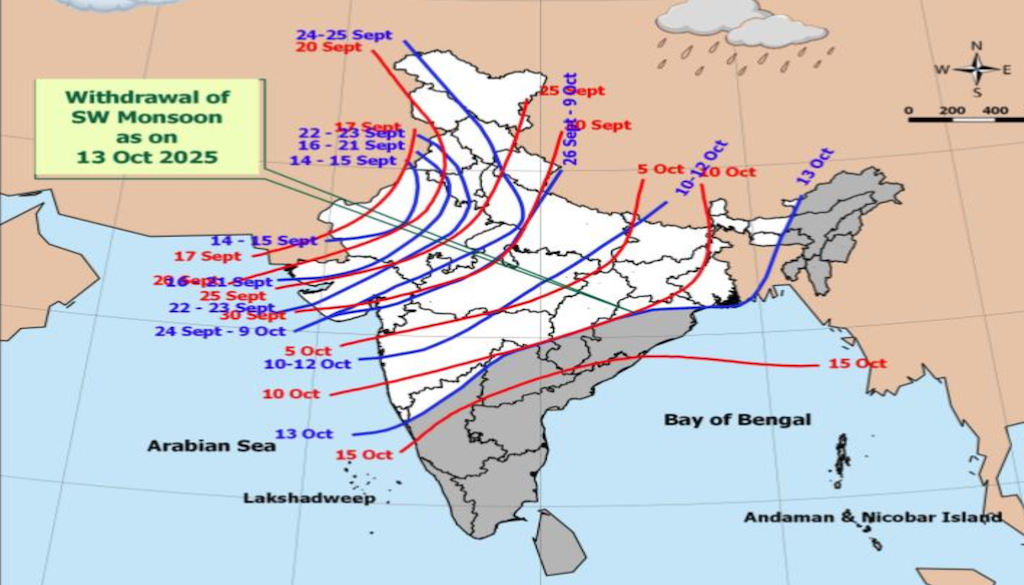
Patna: The Southwest Monsoon has officially completed its withdrawal from the entire state of Bihar on Monday, October 13, 2025, according to a press release issued by the Meteorological Centre, Patna.

The monsoon, which arrived in Bihar on June 17,2025, and covered the entire state by June 20, concluded its season with a significant rainfall shortfall, impacting the state’s agricultural prospects.
Seasonal Deficit and Distribution

Press release on monsoon withdrawl pic.twitter.com/tmF7YqKqZR
— Mausam Bihar- IMD Patna (@imd_patna) October 13, 2025
For the core monsoon season (June 1 to September 30, 2025), Bihar recorded a total rainfall of 686.3 mm, which is 31% less than the long-period average of 992.2 mm.
The shortfall was most pronounced in the early and late stages of the season:
- July saw the highest deficit at -41% (200.5 mm actual vs. 340.5 mm normal).
- June was close behind with a -36% deficit, and September ended with a -38% deficit.
- August was the only month that came close to normal, registering a deviation of only -9%.
The geographical distribution across the districts also highlighted the widespread nature of the deficit. Of the districts tracked, 23 districts were categorized as “Deficient” (rainfall departure between -20% and -59%), while 13 districts fell under the “Normal” category (departure between -19% and +19%). Notably, no district recorded “Excess” or “Large Excess” rainfall during the core monsoon period.
Districts like Sitamarhi, East Champaran, Muzaffarpur, Supaul, Araria, and Purnea were among those that faced the most significant shortfalls, registering deficits of over 40%. Conversely, districts like Aurangabad, Gaya, and Rohtas managed to stay within the normal range.
Late October Surprise
Interestingly, while the withdrawal process began on October 10 and concluded on October 13, the period from October 1 to October 13 recorded an exceptionally high amount of rainfall. The state received 128.6 mm of rain during these 13 days, registering a departure of +235% against the normal for this early-October period (38.4 mm). This late surge, however, was not enough to offset the substantial deficit accumulated during the primary monsoon months.