Patna: The Bihar government is set to introduce a modern education system in government schools, colleges and universities, focusing on the use of advanced technologies such as Artificial Intelligence (AI), robotics and smart classrooms to improve the quality of education.

Under the new system, teaching will combine written and practical methods. Teachers will not only explain concepts in classrooms but will also demonstrate them using models and practical experiments to help students understand and remember subjects for a longer period.
The education curriculum will be structured and classified from Class 1 to postgraduate level, ensuring a systematic learning approach. Teachers will avoid unnecessary topics and focus more on subjects that are useful for students in the future.

The system will also emphasise the development of creative and co-curricular skills. Students will be introduced to music, dance, sports and other creative arts at school, college and university levels so that they can develop multiple skills alongside academic learning.
The government plans to replace the traditional marks-based evaluation with a grading system in schools. The modern education initiative has been designed with a five-year implementation target, during which periodic surveys will be conducted to assess improvements in the education system before further strategies are developed.
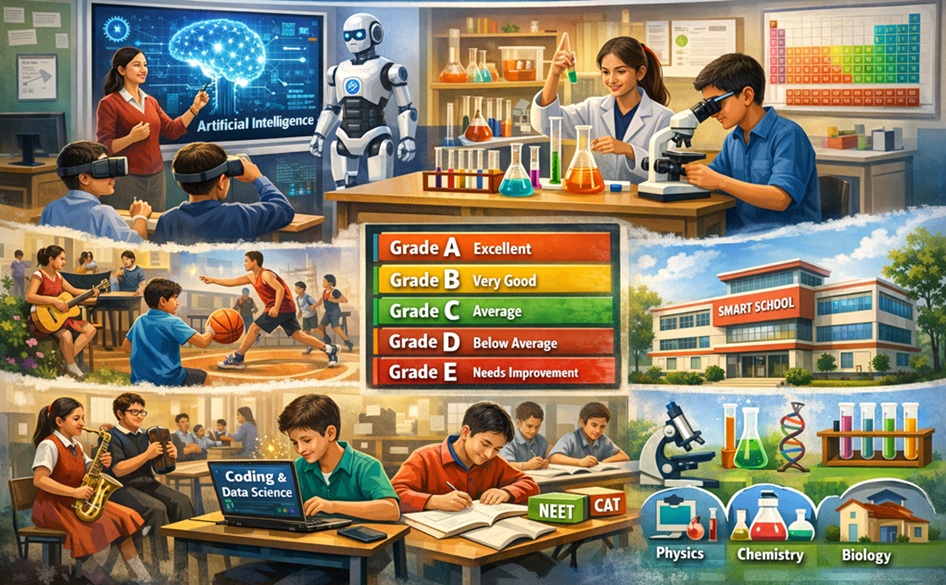
The new system will incorporate technologies and modern learning methods such as smart classes, virtual reality, a mix of online and offline learning, coding, data science, soft skills training, projects, internships and practical-based education.
State Education Minister Sunil Kumar said the government is modernising schools and colleges to improve the standard of education. “The use of projectors, AI, smart classes and other technologies will help students gain new knowledge and remain updated every day,” he said.
Five-category grading system for students
Under the proposed grading system in government schools, students will be divided into five categories based on their annual examination results.
Students scoring between 81 and 100 percent will receive Grade A and will be placed in the ‘Excellent’ category. Those scoring 61 to 80 percent will receive Grade B and will be classified as ‘Very Good’. Students with 41 to 60 percent will receive Grade C and will be placed in the ‘Average’ category, requiring additional academic attention.
Students scoring between 33 and 40 percent will receive Grade D and will fall in the ‘Below Average’ category, while those scoring between 0 and 32 percent will receive Grade E. Students in Grades C, D and E will be provided special classes in schools to help improve their academic performance.
The State Council of Educational Research and Training (SCERT) has prepared the detailed implementation plan for the new education model.
Infrastructure upgrades in schools
The Bihar government is also undertaking a phased modernisation of government schools. In the first phase, 789 secondary and higher secondary schools have been selected for upgradation.
These schools will be equipped with smart classrooms, ICT laboratories, libraries and integrated science laboratories. The government has approved a budget of Rs 1,485 crore for the project.
In addition, ICT labs will be established in 5,277 higher secondary schools, while smart classrooms will be introduced in around 8,000 schools. Integrated science laboratories along with dedicated physics, chemistry and biology labs will also be developed to strengthen science education.
About 1.61 lakh tablets have already been distributed in schools, and Rs 44.83 crore has been sanctioned to promote music and arts education.
Preparation for competitive exams
As part of the modern education system, students will also receive guidance for competitive examinations such as NEET, CAT and various government job tests from the primary school level.
Important concepts in each class will be highlighted and compiled into separate notes, with key points underlined to help students remember lessons more effectively over a longer period.