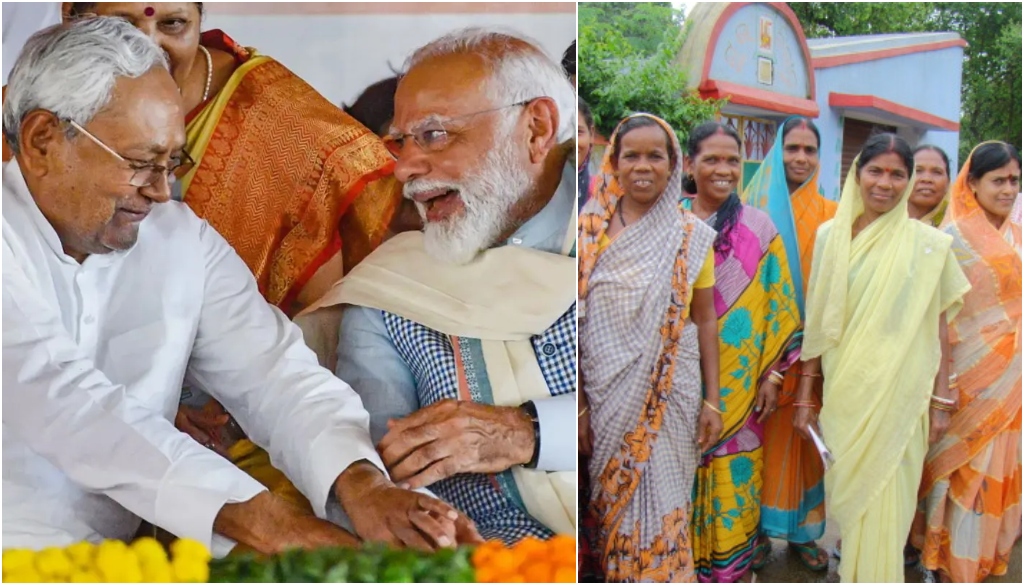
Patna: Bihar’s fiscal stress is mounting as the Nitish Kumar government struggles to fund its flagship welfare schemes, including the Rs 10,000 assistance to women and the proposed Rs 2 lakh payout under the new employment scheme. Officials and economists say the financial burden has reached a point where even salary and pension payments may come under strain if the State does not receive additional support from the Centre.

According to estimates, the government still needs massive funds to continue free electricity supply and meet welfare payouts. Bihar’s outstanding debt has already touched Rs 3.61 lakh crore — translating to a per capita debt of over Rs 27,700.
With two supplementary budgets passed in a single year, and no clarity on new revenue sources, concerns are rising over the sustainability of government finances.

Rs 2 Lakh Payout to Women: A Financial Impossibility for Now
The government’s biggest promise — providing Rs 2 lakh each to 1.40 crore women — requires an expenditure of Rs 2.8 lakh crore. Even covering 1 crore women would cost Rs 2 lakh crore.
Experts say the current budget cannot accommodate such an outlay. Bihar’s 2025–26 budget stands at Rs 3.16 lakh crore. Even assuming an 11% increase next year, the budget would rise only to Rs 3.51 lakh crore, with an additional Rs 34,858 crore available. At best, this could support payments to about 17 lakh women.
“Giving Rs 2 lakh each to 14 million women simultaneously is practically impossible,” said Economics faculty at Patna University. “The required amount is 88% of the state budget. Bihar neither has the borrowing capacity nor the fiscal space to mobilise such large funds.”
He added that most of the State’s revenue is committed to salaries, pensions, subsidies and interest payments, leaving little room for new expenditure.
Supplementary Budget: Big Allocations, Unclear Funding
The Bihar government recently passed a second supplementary budget of Rs 91,717 crore. The largest share — Rs 21,000 crore — was allocated to Jeevika self-help groups as free grants.
An economist says the government is banking on central assistance. “If sufficient aid does not come, the State will either have to borrow more or cut essential expenditure,” he said.
Election-Year Expenses Pushed Debt Higher
Ahead of the Assembly elections, the government rolled out multiple direct benefit schemes, increasing borrowing substantially. This year alone, Bihar borrowed Rs 55,737 crore.
Since the COVID-19 pandemic, the pace of debt accumulation has accelerated sharply.
Borrowing Limit Nearly Exhausted
States are allowed to borrow up to 40% of their Gross State Domestic Product (GSDP). Bihar has already reached 39.1%, leaving minimal headroom.
If the fiscal deficit crosses the 3% threshold, the situation turns critical. Bihar exceeded this limit last year, touching 4.2%. For 2025–26, the government has set a target of reducing it to 2.8%.
Risk to Salaries and Pensions
The economist warns that if corrective measures are not taken, Bihar’s fiscal deficit could rise to 6–7%. “Further increases in debt will directly affect the government’s ability to pay salaries to 10 lakh employees and pensions to 5 lakh people,” he said.
Interest Payments Rising Steadily
The 2025–26 budget estimates Rs 23,013 crore for interest payments — up from Rs 20,526 crore in 2024–25. This rising interest outflow is eating into funds meant for development works.
Without central aid, the State may struggle to build roads, bridges and execute infrastructure projects.
Bihar’s Economy: Growth but Low Incomes
Bihar posted an 8.64% growth rate in 2024–25, with the economy rising from Rs 4.89 lakh crore to Rs 5.31 lakh crore. Growth was strong in construction, manufacturing, transport and communication sectors.
However, per capita income remains low at Rs 66,828 — far below the national average of Rs 1,14,710.
Where Bihar Gets Its Money — and Loans
GST remains the State’s biggest revenue source, followed by central government assistance and state taxes.
For borrowing, Bihar has tapped market loans, the RBI, NABARD, RIDF and international agencies through the Centre.
As pressure mounts from welfare schemes and rising debt, economists say Bihar will need to balance populist promises with strict fiscal discipline to avoid a deeper financial crisis.