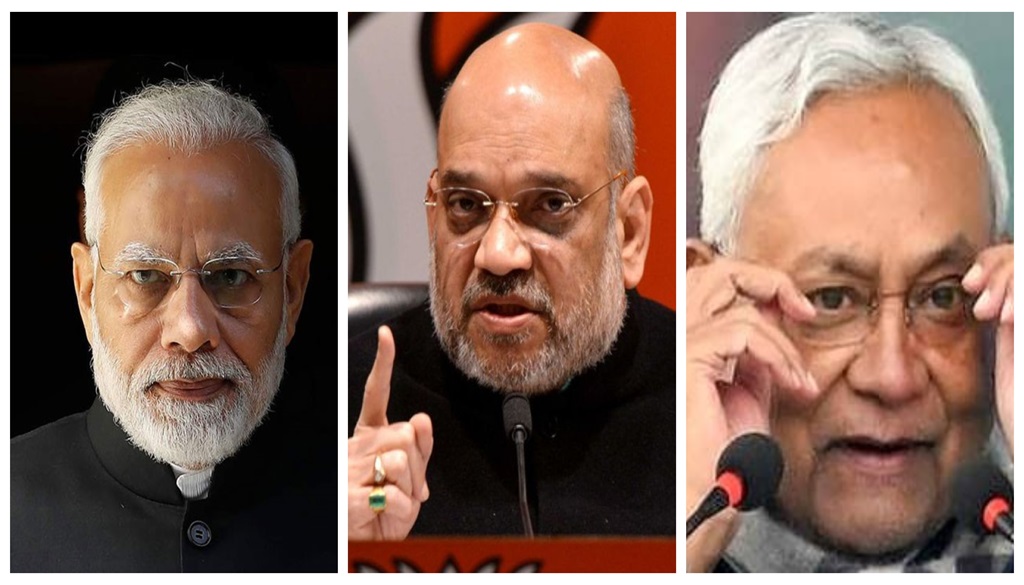
Patna: With the Bihar Assembly elections approaching, the Bharatiya Janata Party (BJP) has intensified its campaign, deploying its top leadership and star campaigners across the state. From Prime Minister Narendra Modi to Union Ministers and Chief Ministers of BJP-ruled states, the party is mobilizing its full organizational strength to dominate the electoral battlefield.

With less than five days left for the first phase of polling and 11 days for the second, the BJP’s campaign machinery is in full swing. Prime Minister Modi is expected to hold around 12–15 rallies and roadshows across Bihar, while Home Minister Amit Shah and election in-charge Dharmendra Pradhan are continuously camping in the state to oversee the strategy.
Mission Bihar: BJP’s Three-Pronged Strategy

- Aim to Emerge as Bihar’s Largest Party
- The BJP’s goal this election goes beyond forming a government—it aims to become the number one party in the Bihar Assembly. According to party insiders, Amit Shah has directed leaders to secure victory in 80–90% of the seats the BJP contests.
Despite strong performances in past elections, the BJP has never been the largest party in the state. In 2010, it won 91 of the 102 seats it contested but was still smaller than the JD(U). In the 2020 polls, the BJP secured 74 seats, just one less than the RJD’s 75.
- No Strong Anti-Incumbency or Pro-Incumbency Factor
- Internal BJP surveys suggest that the current mood among voters is balanced, with neither strong support nor strong resentment toward the government. According to a Political Vibe survey released on October 25, the NDA has 34.4% public support, while the Grand Alliance has 34.7%, making the contest nearly neck-and-neck.
To swing voter sentiment, the BJP is invoking the narrative of “Jungle Raj” and corruption associated with previous RJD regimes, contrasting it with its development agenda.
- Managing Local Dynamics and the PK Factor
- The BJP’s aggressive push also stems from local-level disruptions caused by Prashant Kishor’s Jan Suraj movement and rebel candidates affecting caste equations. For instance, in Danapur, Jan Suraj’s decision to field a Vaishya candidate altered traditional Yadav-dominated voting patterns. The BJP quickly countered by inducting the candidate into its fold.
The entry of local influencers and Kishor’s caste experiments across constituencies have prompted the BJP to tighten its booth-level strategy.
Amit Shah’s Command: From Booth to Cluster Strategy
Amit Shah has taken direct control of the campaign, managing everything from seat-sharing and rebel negotiations to rally logistics. Over the past three weeks, Shah has visited Bihar multiple times, holding marathon meetings with state, district, and booth-level workers.
To streamline coordination, Bihar has been divided into 45 clusters, each corresponding to a Lok Sabha constituency and averaging six assembly seats. Each cluster has dedicated teams consisting of organization ministers, MLAs from other states, and local BJP leaders. Their task: collect ground-level feedback and mobilize workers. Reports from these clusters are sent directly to Shah’s team, forming the backbone of BJP’s tactical planning.
The state is also divided into seven political zones, each with a zonal in-charge responsible for supervising the 40 clusters and coordinating campaign execution.
Focus on Strike Rate, Not Just Seat Count
At a strategy meeting in Patna on October 15, Amit Shah made it clear that this election is about improving strike rate, not merely winning seats. The BJP aims to win at least 80% of the seats it contests. The benchmark comes from the party’s record 89.21% strike rate in 2010, when it won 91 out of 102 seats.
After Nitish Kumar’s 2015 exit from the NDA, the BJP’s strike rate had dropped to 33.75%, before improving to 67.27% in 2020. The party now wants to reclaim its 2010 performance level.
Strategic Rallies: From Modi to Chief Ministers
- Prime Minister’s Rallies in Key Battleground Districts
- The BJP is scheduling Prime Minister Modi’s rallies strategically in districts where it sees maximum potential gains. His campaign began in Samastipur, where the NDA holds five of ten seats. Upcoming rallies are planned in Begusarai, Muzaffarpur, Chhapra, Nawada, and Saharsa, along with a roadshow in Patna—all constituencies with close NDA–Grand Alliance contests.
- Chief Ministers Deployed Based on Caste Calculations
- Chief Ministers and Union Ministers from BJP-ruled states are being assigned rally locations based on local caste equations. Uttar Pradesh CM Yogi Adityanath, one of the party’s most in-demand campaigners, is leading rallies in constituencies where the BJP seeks consolidation of Hindu votes.
Madhya Pradesh CM Mohan Yadav is being fielded in regions like Banka and Bhagalpur, where Yadav votes play a decisive role, to project inclusivity within the BJP’s leadership. Delhi CM Rekha Gupta is focusing on areas with significant migrant populations from Delhi, particularly to connect with women voters.
Experts Call It the BJP’s Trademark Campaigning Style
Political analyst Awadhesh Kumar said, “The BJP’s full-scale campaign isn’t surprising. It fights every election like a war—systematic, resource-heavy, and data-driven. While the RJD’s influence is limited to Tejashwi Yadav, the BJP mobilizes leaders from across India. That’s their political culture.”
BJP’s Response: ‘We Fight Every Election Strategically’
BJP spokesperson Ravi Tripathi said, “Whether it’s a municipal or assembly election, we go all out. Every BJP Chief Minister is a worker first, which is why our campaigns are so coordinated. Yogi Adityanath, Mohan Yadav, and others are deployed strategically to maximize impact. Amit Shah is our Chanakya—his planning ensures everyone works with equal intensity.”
With Bihar emerging as one of the most fiercely contested battlegrounds, the BJP’s “Mission 80%” and multi-layered strategy signal an all-out effort to dominate both the narrative and numbers in this election.