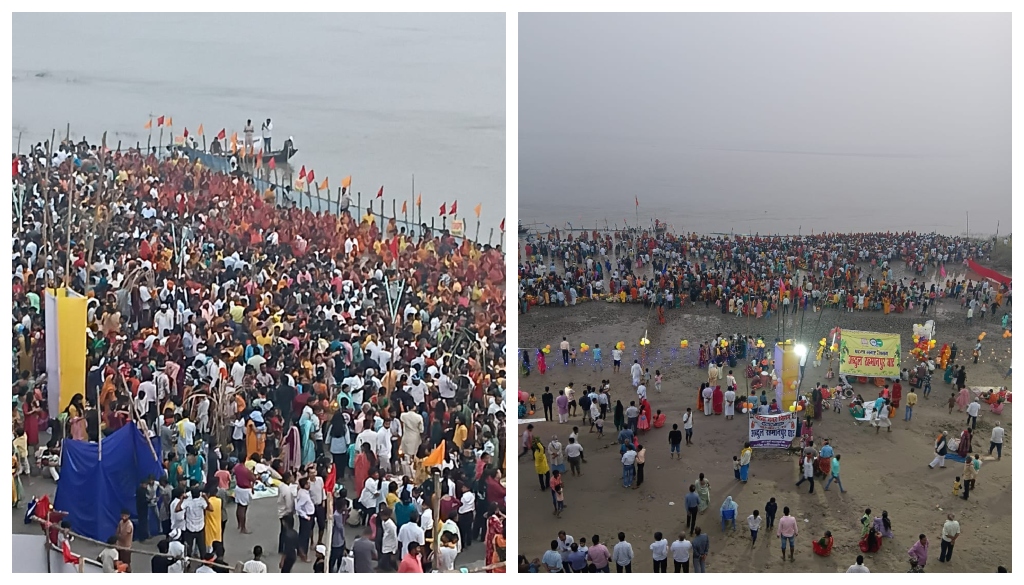
Patna: The four-day-long Chhath Mahaparv, Bihar’s grandest festival of faith and endurance, concluded on Tuesday morning with lakhs of devotees across the state and beyond offering Usha Arghya — prayers to the rising Sun — to mark the end of their 36-hour waterless fast.

From the riverbanks of Patna to the ponds of Purnia, fasting women and men stood knee-deep in cold water from as early as 3 am, waiting for the first glimpse of the Sun between 5:45 am and 6:27 am. The ritual, which signifies gratitude and renewal, saw devotees pray for the happiness and prosperity of their families and the long life of their children.
However, the Sun remained hidden behind thick clouds across most parts of the state. The India Meteorological Department (IMD) attributed the overcast conditions to the inland movement of Cyclone Montha, which has brought moisture and instability across eastern India.

“Due to the cyclonic circulation, several districts of Bihar are likely to experience light to moderate rainfall accompanied by thunderstorms and gusty winds over the next 48 hours,” an IMD official in Patna said. The storm, which made landfall along the Andhra Pradesh coast, is expected to affect Bihar, Jharkhand, West Bengal, and Odisha, bringing sporadic showers through midweek.
Despite the gloomy weather, the spirit of the festival remained undiminished. Devotees, dressed in traditional attire, carried dauras (bamboo baskets) filled with offerings — thekua, fruits, and sugarcane — to more than 500 ghats across Patna, while municipal workers and security teams maintained round-the-clock vigilance.
In the capital, JP Setu Ghat, Collectorate Ghat, and Kadamkuan Ghat witnessed large gatherings. Disaster response teams were deployed for crowd management, while the district administration arranged lighting, sanitation, and medical assistance through the night.
“Even though we couldn’t see the Sun, we felt its presence through faith,” said Meera Devi, a devotee at Patna’s Collectorate Ghat. “The clouds cannot hide devotion.”
The Chhath Mahaparv, celebrated six days after Diwali, is unique in Hindu tradition for its worship of both the setting and rising Sun. It involves rigorous fasting, holy bathing, and four days of rituals culminating in Parana — the breaking of the fast after sunrise.
As the mist slowly lifted and the chants of ‘Chhathi Maiya ki Jai’ echoed across riverbanks, devotees broke their fasts with ginger water and jaggery sherbet, symbolising the completion of one of India’s most spiritually intense and ecologically grounded festivals.
Even as Cyclone Montha casts a shadow over Bihar’s skies, the morning of Usha Arghya — quiet, devotional, and humbling — once again reaffirmed the timeless bond between faith, nature, and endurance that defines Chhath.