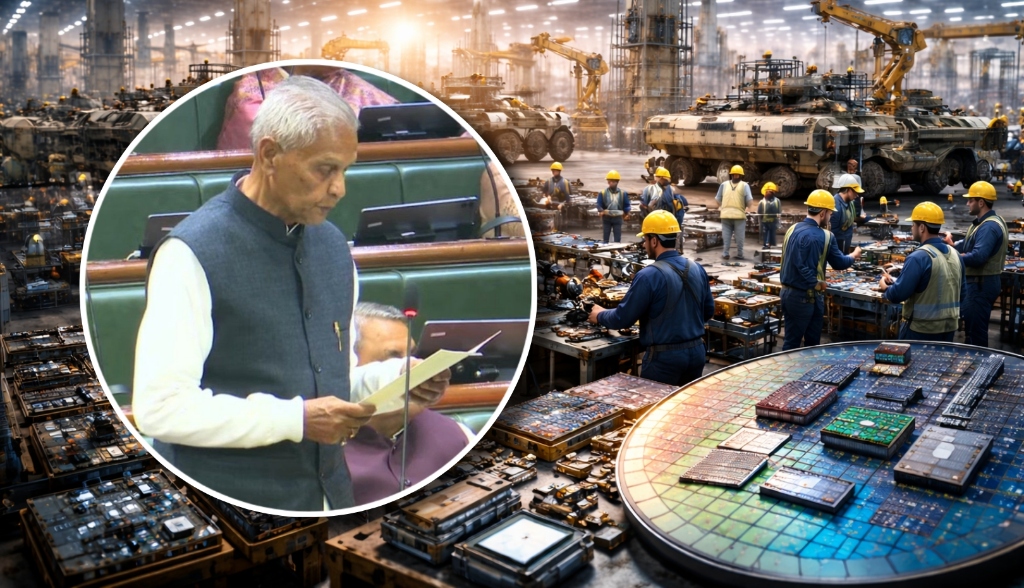
Patna: Bihar has announced plans to establish a defence manufacturing corridor and a semiconductor production park as part of its 2026–27 state budget, in what the government describes as one of the most ambitious industrial pushes in the state’s recent history.

Presenting the budget on Tuesday, the Nitish Kumar government said the twin projects are designed to accelerate industrialisation, attract private and public investment, and generate large-scale employment. Officials argue that the move could help reposition Bihar long seen as lagging in manufacturing as an emerging hub for defence and high-tech industries.
The proposed defence corridor will operate as an industrial cluster spread across several districts, bringing together companies that manufacture equipment for the armed forces and security agencies. Production is expected to range from military uniforms and protective gear to advanced systems including drones, artillery components and small arms such as AK-47 rifles, carbines, pistols and sniper rifles. Both government-owned and private firms are likely to participate.

Districts including Munger, Kaimur, Jamui, Banka and Arwal are expected to form part of the corridor. Many of these regions have a historical association with arms production. In Nalanda, an ordnance factory already manufactures the Bi-Modular Charge System (BMCS), used to fire artillery shells from guns such as the Bofors, with some of its output exported abroad.
Munger, once known for its traditional gun-making industry dating back to the 18th century under Mir Qasim and later the British, is also set to benefit. While the town’s reputation was later marred by illegal arms manufacturing, officials say the new corridor could formalise and regulate production, restoring its industrial credibility and creating lawful employment opportunities.
The semiconductor manufacturing park, announced alongside the defence project, is intended to draw technology investments and diversify Bihar’s industrial base beyond traditional sectors. Together, the two initiatives are expected to create thousands of direct and indirect jobs, improve infrastructure and strengthen the state’s long-term economic prospects.
Government officials said a committee had already been approved in November to plan both projects, and the formal budget announcement signals that implementation will now be fast-tracked. If realised, the initiatives could mark a significant shift in Bihar’s development strategy from agriculture-led growth to advanced manufacturing.