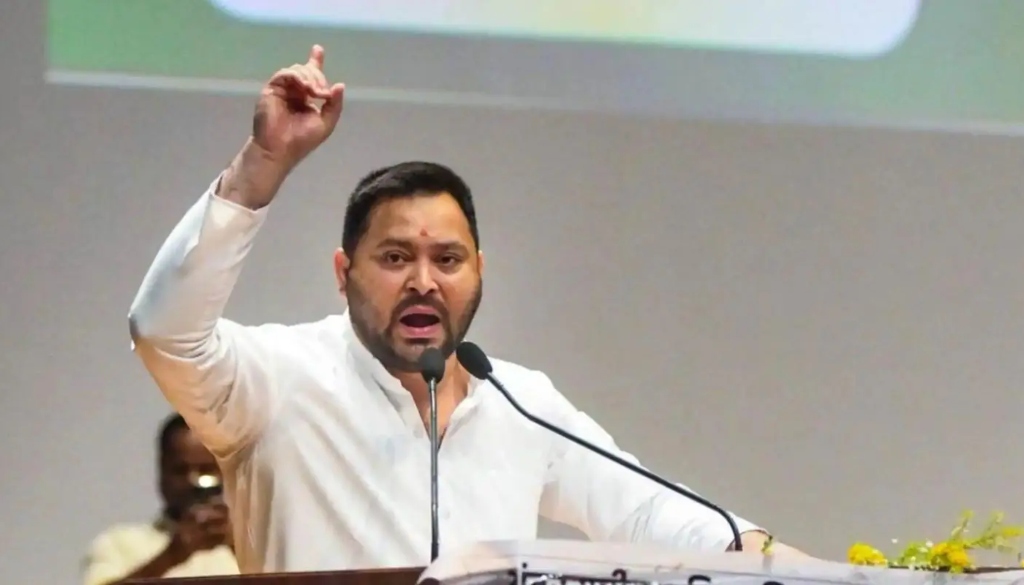
Patna: Mahagathbandhan’s Chief Ministerial face Tejashwi Yadav has sparked a fresh political row after declaring that he would “throw the Waqf (Amendment) Act into the dustbin” if his government comes to power in Bihar. His statement, made while campaigning in a Muslim-dominated area on October 26, drew sharp criticism from the BJP, with Deputy Chief Minister Vijay Sinha retorting, “Tejashwi is a namajwadi (worshipper). How can a Chief Minister repeal a central law?”

While Tejashwi’s remarks have ignited debate over the Waqf Amendment Act, legal experts say such a promise is constitutionally impractical. Political observers believe the RJD leader’s comments are aimed at consolidating Muslim votes ahead of the Bihar Assembly Elections 2025.
What Is the Waqf Act and What Changed Under Modi Government?
The Waqf Act, first enacted in 1954, governs the management of Muslim charitable properties. It was amended in 1995 and 2013, but the most sweeping changes were made in April 2025 by the Modi government.

Key provisions of the amendment include:
- Inclusion of two women and two non-Muslim members in Waqf Boards.
- Audit of Waqf properties by the CAG or a government-appointed auditor.
- The District Collector will now survey Waqf properties instead of the Survey Commissioner.
- No undocumented property can be declared as Waqf.
- Waqf Tribunal decisions can now be challenged in court.
- Any government property declared as Waqf before or after the amendment will no longer retain Waqf status.
Why Are Many Muslims Opposed to the New Waqf Act?
Sections of the Muslim community have expressed concern that the amendments will dilute the autonomy of Waqf Boards. Their major objections include:
- The fear that graveyards, mosques, and schools may get embroiled in legal disputes.
- Under the Limitation Act, properties occupied for 12 years or more cannot be reclaimed by the Waqf Board.
- Greater control by the District Collector, reducing the influence of Muslim representatives.
- The end of verbal Waqf transfers, which were accepted traditionally without a formal deed.
Can Tejashwi Yadav Repeal the Waqf Act If He Becomes CM?
Legal experts say no. The Waqf Act falls under the Concurrent List of the Constitution, allowing both central and state governments to legislate. However, Article 256 mandates that state governments must comply with central laws.
Senior Advocate Prabhat Bhardwaj of the Patna High Court explained, “A state government cannot repeal or invalidate a central law. Administrative control of the Waqf Board can be adjusted at the state level, but repealing the Act requires approval from the Centre or the President.”
Why Did Tejashwi Make This Statement?
Political analysts believe Tejashwi’s remark is a strategic move to mobilize Muslim voters, who constitute around 18% of Bihar’s population. There are nearly 60 to 70 assembly constituencies in the state where Muslim voters play a decisive role.
1. To Strengthen Muslim Mobilization
Political analyst Satyabhushan Singh said, “After Mukesh Sahni was named Deputy CM candidate, many Muslims on social media expressed anger, questioning why the 18% Muslim population was ignored. Tejashwi’s strong opposition to the Waqf Act is meant to reassure them and counter Owaisi’s growing appeal.”
2. To Counter the Owaisi Factor
AIMIM chief Asaduddin Owaisi is contesting 32 seats, including 16 in the Muslim-dominated Seemanchal region. In the 2020 Assembly Elections, AIMIM won five of the 14 seats it contested in Seemanchal—Amour, Bahadurganj, Baisi, Kochadhaman, and Jokihat—cutting into the Mahagathbandhan’s vote share.
Senior journalist Girindra Nath Jha said, “Owaisi has become the most vocal voice for Muslim issues in Bihar. His narrative is resonating with youth and traditional voters alike. Tejashwi’s recent comment is an attempt to prevent AIMIM from splitting Muslim votes again.”
Will This Affect the NDA?
Experts say the Waqf issue will not impact the NDA’s prospects. Political commentator Prof. Sanjay Kumar stated, “The NDA has never been the first choice for Muslim voters. Even in the best of times, BJP and its allies have secured only 4–6% of Muslim votes.”
Historical voting data supports this:
- 2005: RJD+ got 40% of Muslim votes; NDA just 4%.
- 2010: NDA 21%, RJD 32%, Congress 22%.
- 2015: Grand Alliance (RJD-JDU-Congress) 69%, NDA 6%.
- 2020: Grand Alliance 76%, NDA 5%.
Prof. Kumar added, “The Waqf issue may help Tejashwi consolidate his base but won’t hurt the NDA. Nitish Kumar’s limited influence among Pasmanda Muslims hasn’t translated into votes except during the 2015 alliance.”
The Bottom Line
Tejashwi Yadav’s fiery comment on the Waqf (Amendment) Act may not hold legal ground, but it makes political sense. With elections nearing and AIMIM threatening to cut into the Muslim vote bank, his statement appears designed to signal solidarity with the state’s Muslim electorate — even if it means promising something beyond his constitutional authority.