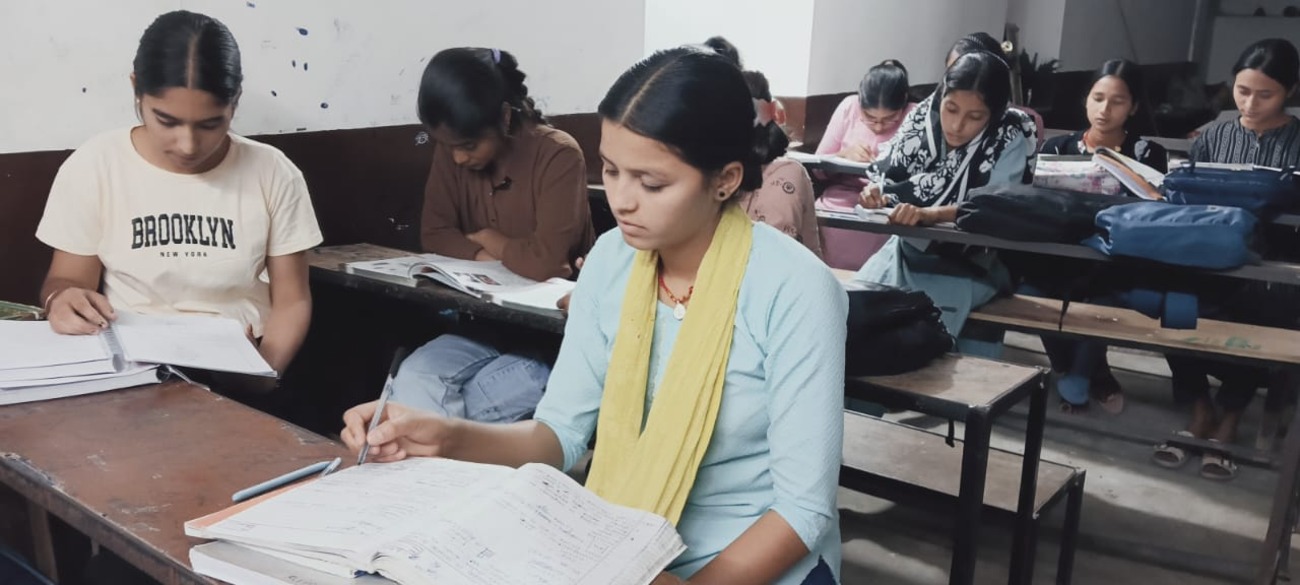
Gaya: In the Imamganj block of Bihar’s Gaya district, a village once associated with fear and Maoist insurgency is undergoing an unexpected transformation. Raniganj, long considered a remote and troubled area, is emerging as a centre of ambition for medical aspirants – many of them girls.

In recent years, several students from the village have cleared the highly competitive National Eligibility cum Entrance Test (NEET), the gateway to medical education in India. Among them are Khushi Gupta, Roshni Kumari, Sanjana Sharma, Anjali Kumari and Monika Kumari, along with Amar Nath and Sachin Kumar. All prepared locally in Imamganj and are now studying or working in different parts of the country.
The village’s progress has drawn comparisons with Patwa Toli in Manpur, also in Gaya district, which has earned the nickname “IITian village” after more than 100 students from the area cleared the Joint Entrance Examination (JEE) since 1996.

At the centre of Raniganj’s transformation is Dev Prakash, a local educator whose efforts have helped reshape aspirations in the village. Prakash turned down multiple career opportunities – including positions as a scientific trainer in Patna, a government post at a medical college and a role with the Defence Research and Development Organisation – to focus on teaching.
“I chose not to take those jobs because I wanted to teach,” he said.
Prakash had been preparing students in Patna for engineering and medical entrance exams when the Covid-19 lockdown in 2020 forced him to return to his native village. What he encountered there was a lack of access, resources and confidence among students, especially girls.
“It was quite challenging,” he said. “Most families cannot afford coaching institutes in places like Kota. I began reaching out to students and speaking with their parents.”
He started conducting daily classes from his own home in Raniganj, offering guidance and mentorship free or at minimal cost. His approach combined academic preparation with
community engagement, encouraging families to support their children’s ambitions despite financial constraints.
Prakash emphasized that once students secure admission to government medical colleges, the cost of education becomes manageable, often with the help of bank loans. “If parents understand this, they can help build a better future for their children,” he said.
His efforts appear to be paying off. The growing number of successful candidates has begun to change perceptions in the village, particularly around girls’ education and career choices.
What was once a region defined by insecurity is gradually being reimagined as one of opportunity – a shift driven not by large institutions or policy interventions, but by sustained local initiative and the determination of its young people.