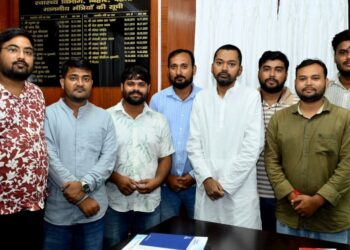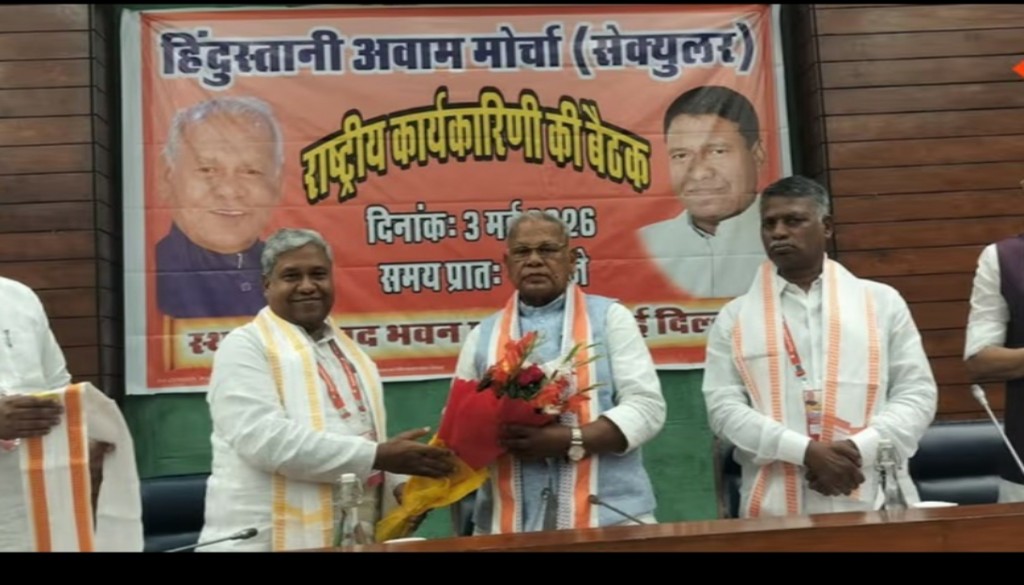
Hindustani Awam Morcha (Secular) has announced a fresh organisational drive, an extended membership campaign and a renewed focus on social justice after a national executive meeting in New Delhi on Sunday.

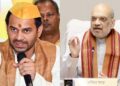
The meeting, held at Parliament House Annexe, was chaired by the party’s national president, Santosh Kumar Suman. Former Bihar chief minister and presently union micro, small and medium enterprises (MSME) minister Jitan Ram Manjhi, party’s patron, attended as chief guest.
Senior leaders said discussions focused on organisational growth, internal elections, membership expansion, education policy and reservation reform, with strategy mapped out for the coming years.

The party said elections would be held across its structure, from block-level units to the national presidency, with the process expected to be completed within two months. It also signalled a particular focus on expanding its presence in Jharkhand as part of preparations for the 2029 elections.
HAM (S) said its membership drive would now continue until May 31this year in an effort to bring more supporters into the party fold.
Leaders also announced plans for a nationwide outreach programme through “Garib Chaupal”, aimed at strengthening contact with poorer communities, and a “Samadhan Yatra”, intended to address public grievances.
A major theme of the meeting was the demand for a common school system, which party leaders described as central to achieving equality.
Manjhi said separate systems of education for rich and poor children prevented genuine social equality. He argued that a common school model would reduce social and economic disparities while widening opportunity.
He also raised the issue of separate electoral representation for highly marginalised communities, saying stronger measures were needed to ensure political participation among deprived groups. He referred to Musahar and Bhuiyan communities and called for steps including postal ballot access and ensuring names were included on electoral rolls.
Suman said the party would no longer remain confined to Bihar and would expand rapidly into other states, particularly Jharkhand. He added that organisational elections would strengthen the party’s democratic structure and improve its grassroots reach.
Several state leaders and national executive members from Uttar Pradesh, Kerala, Karnataka, Madhya Pradesh, Telangana, Chhattisgarh, Haryana and Jharkhand also attended the meeting.