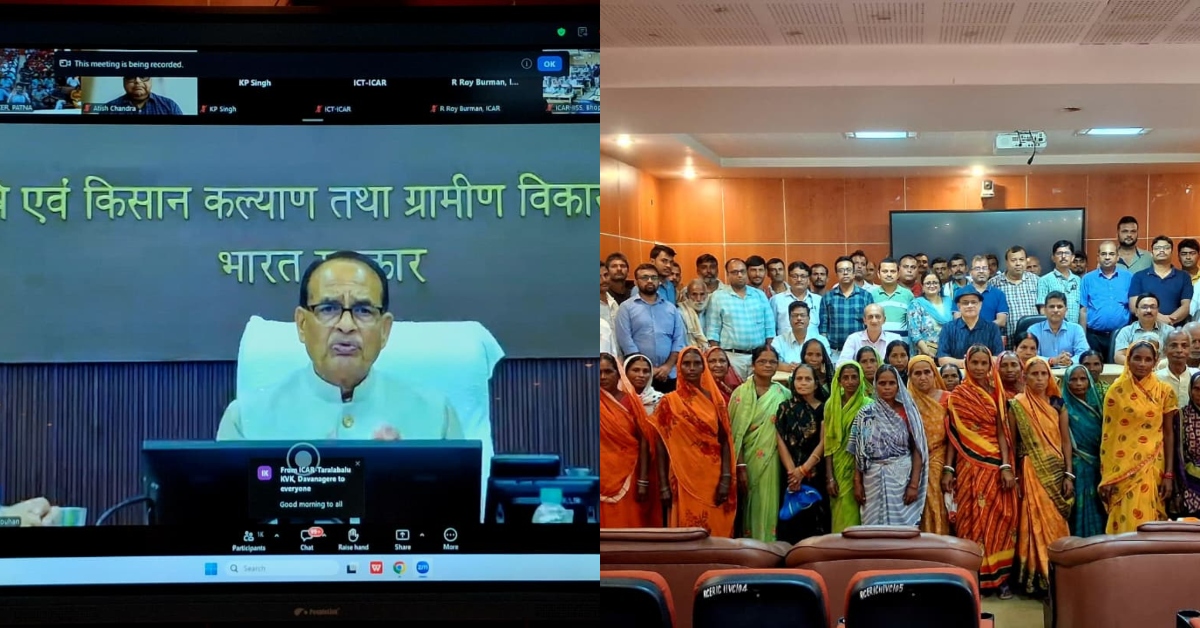
Patna: The ICAR Research Complex for Eastern Region (RCER), Patna, along with its centre in Ranchi and Krishi Vigyan Kendras (KVKs) in Ramgarh and Buxar, organised an online interaction on strategic planning for the upcoming Rabi season 2026.

Around 186 participants, including 101 farmers, attended the programme and joined the address by Union Agriculture and Farmers Welfare Minister Shivraj Singh Chouhan.
The interaction focused on developing a roadmap for the Rabi season while taking into account climate challenges, changing farming conditions and the needs of farmers.

Agriculture Minister Calls For Bottom-Up Rabi Planning
Chouhan congratulated farmers, scientists and other stakeholders for the record agricultural production recorded during the previous season.
He called for a comprehensive roadmap for the upcoming Rabi season and stressed that planning should follow a bottom-up approach, with farmers playing an active role.
The minister said ICAR, KVKs, state governments, ATMA teams and farmers should work together to prepare the plan. He also emphasised systematic brainstorming at the district level, followed by coordination at the state and national levels.
Focus On Integrated Farming And Diversification
The minister highlighted the importance of the Integrated Farming System (IFS) approach, particularly for small farmers.
He said IFS models should be demonstrated directly in farmers’ fields so that farmers can understand their practical benefits.
Chouhan also highlighted crop diversification, natural farming and farm mechanisation as important components of future agricultural planning.
He said the Rabi roadmap should cover different aspects of farming and incorporate the views and experiences of farmers.
Farmer Welfare Schemes To Be Strengthened
The minister also called for follow-up action on earlier initiatives, including the Viksit Krishi Sankalp Abhiyan (VKSA) and Khet Bachao Abhiyan (KBA).
He emphasised the importance of improving the quality of agricultural produce and ensuring that farmers are able to benefit from opportunities in export markets.
A decentralised approach will be important for the next Rabi planning exercise, he said, while welfare schemes such as Fasal Bima, VB-G RAM G and Kisan Samman Nidhi should reach eligible farmers effectively.
The minister also called for active participation of KVKs in the upcoming planning exercise, in coordination with state governments, ATMA and other stakeholders.
ICAR Officials Outline Convergence-Based Approach
Dr ML Jat, Director General of ICAR and Secretary, DARE, and Atish Chandra, Secretary, Department of Agriculture and Farmers Welfare (DA&FW), also provided guidance on implementing the next Rabi planning exercise.
They emphasised a coordinated approach involving different institutions and stakeholders to ensure better implementation through convergence.
Farmers And Scientists Discuss Farming Challenges
A separate farmer-scientist interaction was also organised during the programme to discuss practical issues related to farming.
Dr Anup Das, Director, ICAR-RCER, Patna, stressed that time is one of the most important resources available to farmers and should be used efficiently in day-to-day farming.
He said the principle of considering the opportunity cost of time should also be applied while planning agricultural activities for the Rabi season.
Scientists from different disciplines interacted with farmers and responded to their questions on crop production and farm management.
Farmers Raise Questions On Water Availability
Farmers from Karai village in Naubatpur block raised questions about crop varieties suitable for the current conditions of erratic water availability.
Scientists discussed varieties suited to different water and climatic conditions and provided guidance based on local requirements.
The interaction also covered crop residue management, climate-resilient agriculture, timely sowing and harvesting, crop rotation and balanced fertiliser use.
Farmers were also introduced to Integrated Farming System models developed by the institute, along with information on animal husbandry, particularly goat farming, and the potential of nutri-gardens.
Farmers Visit Demonstration Units
At the end of the programme, participating farmers visited the institute’s demonstration units to gain practical knowledge about different agricultural practices.
The visit followed a “seeing is believing” approach, allowing farmers to observe farming models and technologies directly.
According to Umesh Kumar Mishra, Member Secretary, Media, ICAR-RCER, Patna, the programme was aimed at strengthening interaction between farmers and scientists while supporting more effective and locally relevant planning for the upcoming Rabi season.