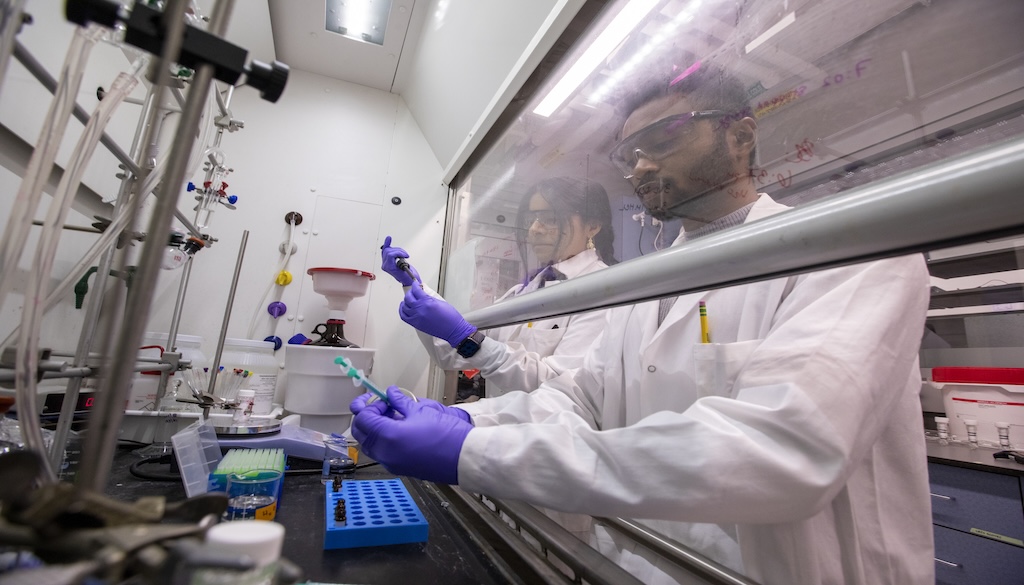
New Delhi: As universities across the world intensify cooperation in advanced technologies, academic partnerships are increasingly being judged not only by research output but by their ability to translate ideas into deployable technologies.

The collaboration between Indian Institute of Technology Kanpur and New York University (NYU) Tandon School of Engineering reflects this shift, bringing together joint research initiatives spanning cybersecurity, biotechnology, artificial intelligence, robotics and wireless communications.
“We launched seven joint research projects within the first year of the formal agreement, which is exceptionally fast for this kind of partnership,” said Juan de Pablo. He noted that the NYU Tandon-IITK Advanced Research Centre at IIT Kanpur had given the collaboration a “permanent home”, while a doctoral dual-degree programme was building institutional ties on both sides.

Partnership Rooted In Cybersecurity Collaboration
The collaboration traces its origins to 2016, when NYU Tandon’s Cyber Security Awareness Week expanded to India with IIT Kanpur hosting the competition. That engagement later evolved into a multidomain research partnership, culminating in a memorandum of understanding signed in 2023.
According to Manindra Agrawal, the partnership works because both institutions contribute complementary strengths.
“In India, we have access to a vast pool of engineering talent, and recent developments in biotechnology, healthcare and space technology have demonstrated that India leads in the development of low-cost solutions to global problems,” he said.
He contrasted this with the research infrastructure and funding ecosystem available at leading American universities, describing the combination as central to the success of the IITK-NYU partnership.
De Pablo similarly pointed to NYU’s research centres in cybersecurity and 6G wireless technology, alongside IIT Kanpur’s highly competitive faculty and experience operating at India’s scale.
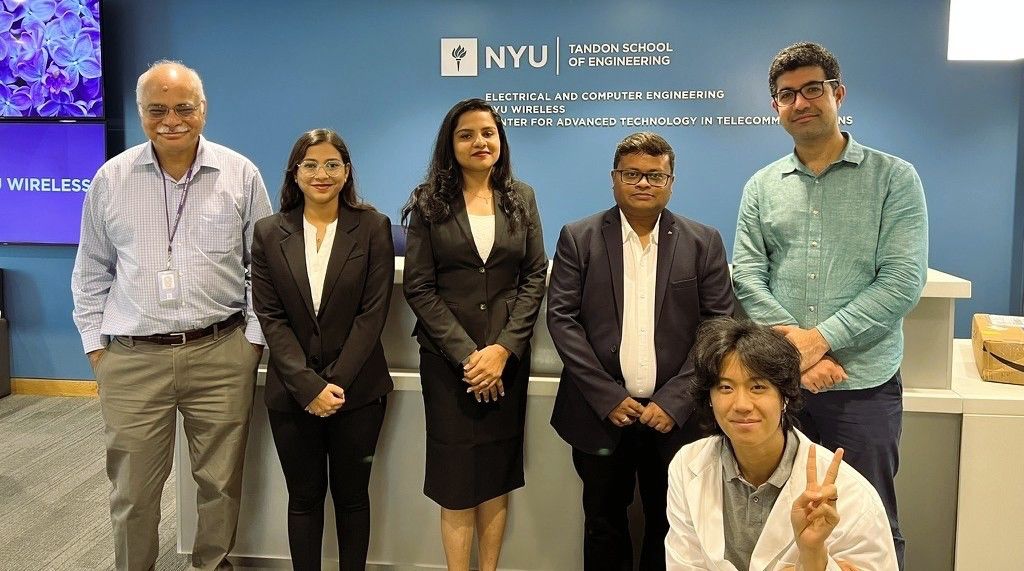
Focus On Secure Authentication And Biomedical Technologies
One of the collaboration’s major research areas involves secure authentication systems for supply chains and biomedical applications through physically unclonable materials and biochip technologies.
Researchers have developed systems capable of generating unique material signatures for authentication, which are then processed using machine-learning models to maintain accuracy even under noisy conditions.
“These physical features are processed and authenticated using deep learning techniques, achieving 95.8 percent accuracy and demonstrating robustness against adversarial noise,” Agrawal said.
The collaboration is also exploring biomedical therapies, including research into specialised proteins designed to disrupt survival signals that allow cancer tumours to continue growing.
De Pablo said the emphasis was on practical application rather than purely theoretical research. “What I think is so important about this work is the real-world immediacy,” he said.
Wireless Power And Commercialisation Push
The partnership also extends into advanced engineering systems, including wireless power transfer and engineered radio-frequency surfaces capable of directing electromagnetic waves efficiently.
Agrawal described the research as having strong potential for improving power transfer to millimetre-scale biomedical implants.
Commercialisation remains a defining feature of the partnership. De Pablo highlighted projects involving wireless electric vehicle charging systems equipped with advanced safety features, saying the research was designed “for real deployment from day one”.
He also pointed to a pending US patent application linked to a biochip authentication technology developed through the collaboration.
Agrawal said shared funding structures and access to advanced facilities were helping accelerate the transition from research to application.
Broader US-India Technology Alignment
Both institutions framed the partnership as part of a larger convergence between India and the United States in frontier technologies.
“The US and India have many complementary strengths,” Agrawal said, arguing that collaborations of this kind could advance research in critical and emerging technologies.
Looking ahead, de Pablo said NYU Tandon was investing heavily in areas including AI, robotics, quantum information sciences, chip design, materials science, systems engineering and smart cities — areas where further collaboration with IIT Kanpur was expected.
“India has the engineering talent pool, the domestic scale, and increasingly the ambition to lead in these fields. The United States brings research infrastructure and global industry networks,” he said.
“Neither country or university has everything required on its own. When institutions from both countries build genuine working relationships, not just signed agreements, they develop technical capacity that is far more durable than any single research project.”
(This article was first published in the U.S. Embassy’s SPAN magazine)