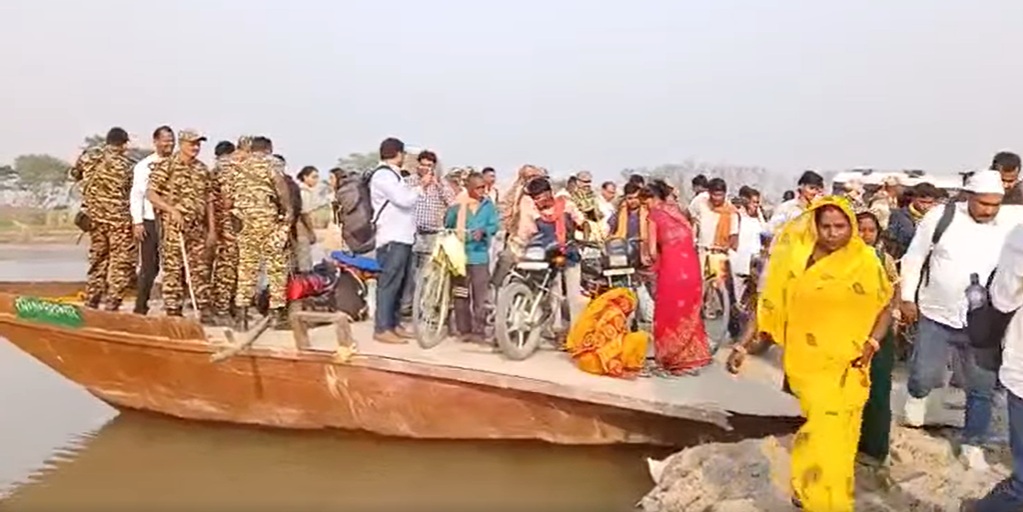
Bettiah: Amid the election fervour sweeping Bihar, the people of Baijua village in West Champaran’s Diara region voted not with celebration but with resilience. For the 4,000 residents here, reaching the polling booth means crossing the Gandak River by boat, trudging through knee-deep mud, and traveling several kilometres by tractor — a four-hour journey each way.

For them, democracy is not about slogans or rallies; it is a struggle for survival.
‘Even in a free country, we suffer slavery’
“Leaders smile, take our votes, and forget we are human beings,” said 54-year-old Ramakant Yadav, his voice shaking with anger. “We cross the river by boat, then by tractor. Roads and electricity are still dreams. Pregnant women die on the way to hospitals.”

Ramakant’s pain echoes across Baijua, a flood-prone village along the Gandak where every election comes with promises of bridges and power lines — but no change.
Polling tents instead of booths
With no permanent buildings to host polling stations, Booths 130 and 131 were set up under bamboo and tarpaulin tents. Seven CRPF personnel stood guard as voters queued under the open sky.
Officials admitted that the area’s lack of electricity and mobile connectivity made CCTV monitoring impossible. “It’s a sensitive region. We’re just focused on ensuring polling happens peacefully,” one official said off-camera.
Some political workers were seen distributing food to voters — a clear violation of election rules — but the administration seemed more concerned about logistics than law.
Four hours, one tractor, no roads
Reaching the last village in Bihar took hours. Around 10 a.m., a patrolling team passed by — on a tractor. “It takes four hours to reach the booth,” said a constable. “Rain changes routes. Sometimes the mud doesn’t dry for months.”
Female constable Ananya Kumari smiled through fatigue: “Performing duty here is hardest. No roads, no shade, just endless mud.”
Her colleague Shabana Turi added, “We patrol five booths by tractor. It’s slow, but peaceful.”
Nearby, voters rode to the booths in the same way. “We walk nine kilometres to vote,” said Kalavati Devi, clutching her ID. “There’s no electricity, no road, but we’ll still vote.”
Another villager, Binda Devi, added bitterly, “They gave us gas, but we still cook on wood. Hospitals are 10 km away, and no one comes after elections.”
‘Everything here is out in the open—both people and suffering’
At Booth 131, Subhash Yadav pointed at the EVM placed under a tent. “See, even the machine is out in the open. Everything here is—our lives, our pain.”
Around him, villagers cooked near the booth on wood stoves. Umesh Ram, another voter, said, “We have no electricity poles, no rations, and no roads. We light fires at night.”
Patrolling on horseback, petrol in bottles
In the absence of proper roads, police patrols also used horses to reach booths. “It’s impossible to walk in this terrain,” said one jawan, “sometimes we even give voters a ride to the booths.”
Locals like Vicky Kushwaha sell petrol from plastic bottles. “The water washes away everything,” he said. “We bring fuel from the market and sell it here. It’s risky, but necessary. Until a bridge is built, we have no choice.”
No webcast, no electricity, no bridge
At 11 a.m., webcasting equipment for election monitoring had still not arrived. A technician admitted, “We got delayed by rain and lost our way at night.”
The BJP MLA representing the area for the past decade hasn’t delivered even basic facilities. “Politicians win with our votes but don’t even send a boat for our children,” women told this reporter.
Many families rely on solar panels purchased with daily wages, after government schemes failed. “I bought this solar plate after working as a labourer,” said Shravan Yadav. “We light lamps with it at night. We don’t get rations, but we still vote.”
Hope amid hardship
In this remote corner of Bihar, voting is not a festive right but a journey of endurance. People here know the promises — bridges, schools, roads, power — by heart, yet they keep showing up, year after year.
As the sun dipped over the Gandak, casting a golden glow on the muddy waters, Shravan Yadav smiled outside his hut. “There’s a lot of hardship,” he said softly, “but we’ll vote every time. Maybe someday the government will remember us.”
For Baijua’s people, democracy is not comfort — it is courage.