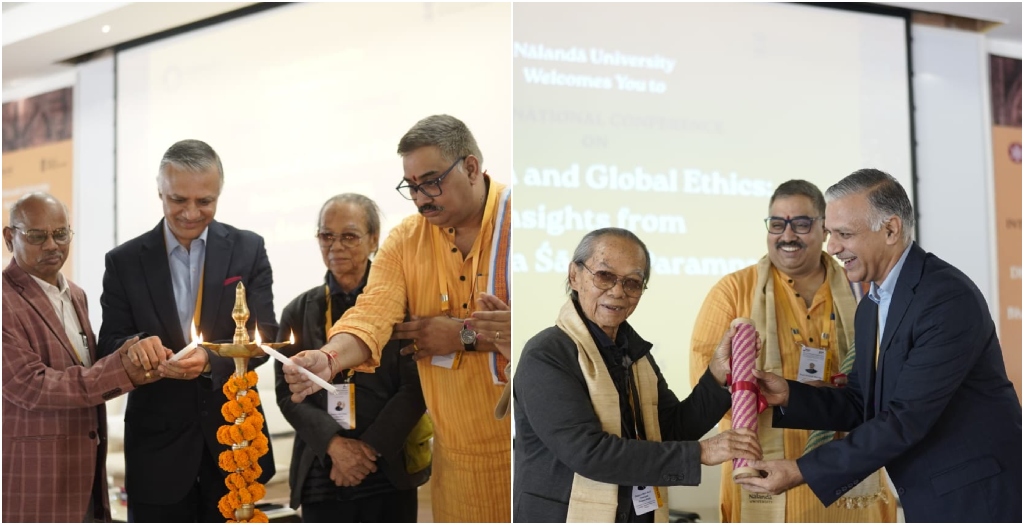
Nalanda: An international conference on “Dharma and Global Ethics: Insights from Bhāratīya Śāstra Paramparā” ended on Friday at Nalanda University in Rajgir. The event brought together famous scholars, policymakers, spiritual thinkers and academic leaders from India and many other countries. The conference focused on how ancient Indian wisdom can be used to solve modern-day problems related to ethics, sustainability, social harmony and human behaviour. Speakers said that the traditional Indian knowledge system, which was once ignored, is now becoming important again in both research and real-life applications.

The programme began with students chanting the Dhyāna Śloka from the Bhagavad Gita, which created a peaceful and inspiring atmosphere. After this, Prof. Godabarisha Mishra, Dean of SBSPCR and Coordinator of the conference, delivered the Welcome Address. In the inaugural address, Anju Ranjan, Joint Secretary in the Ministry of External Affairs, highlighted the importance of cooperation among different countries. She said that the world is deeply connected today, and shared ethical values are necessary for building trust and partnership across nations.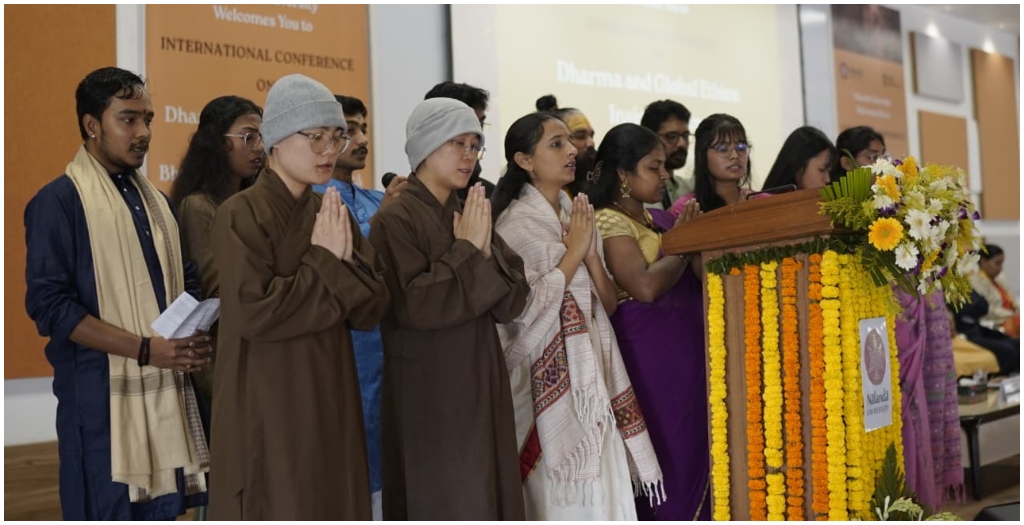
In the keynote speech, Prof. Ganti S. Murthy, National Coordinator of the Indian Knowledge Systems Division, explained how Indian intellectual traditions offer a holistic approach to thinking. According to him, Indian philosophical ideas can support both scientific research and ethical leadership. Another important speaker, Padma Shri Prof. Chirapat Prapandvidya, a leading Sanskrit scholar from Thailand, spoke about the shared cultural heritage of Asia. He said that classical Sanskrit and Pali literature reflects unity among Asian civilizations and supports Dharma as a universal value for humanity.

Vice-Chancellor of Nalanda University, Prof. Sachin Chaturvedi, delivered the Presidential Address. He stressed that the world is facing increasing instability and dissatisfaction, and therefore there is a strong need to return to values such as compassion, interdependence and self-control. He said that global peace and happiness can only be achieved if ethical thinking becomes a part of policies, society and daily life. Delegates from India, Russia, Belarus, Malaysia, Nepal, Thailand, Kazakhstan, China, Ethiopia, Hungary and Fiji participated in the event, along with officials from the Ministry of External Affairs, the Indian Knowledge Systems Division, academic institutions, cultural organisations and spiritual groups.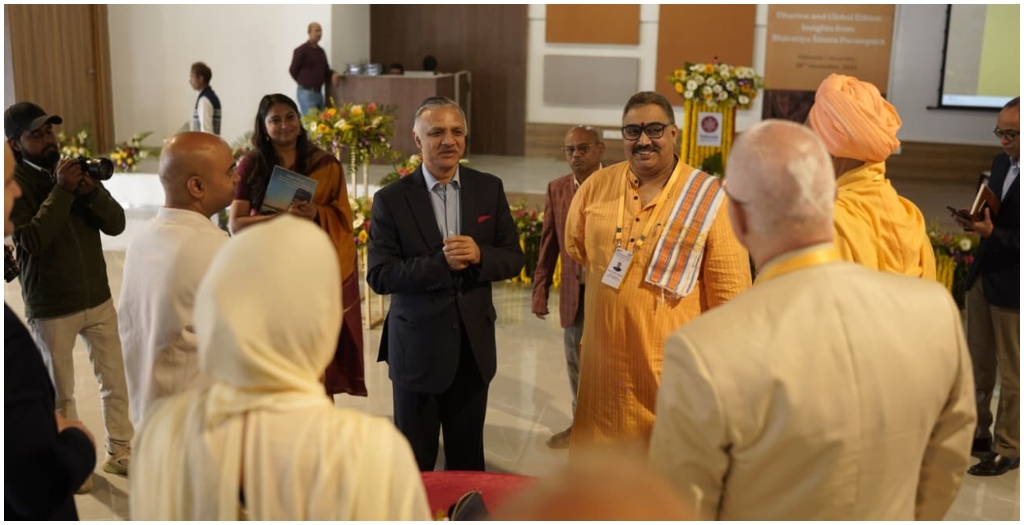
The conference included four major sessions that discussed Dharma in relation to culture, philosophy, economics and environment. A public session on Lokasaṃgraha focused on how ethical leadership can help the world face present and future challenges. The conference concluded with a strong commitment to continue discussions on global ethics, sustainability and traditional wisdom. The university also marked the 150th anniversary of the national song Vande Mataram with a special student-led commemoration.
The event played an important role in strengthening international academic cooperation and building a global network to promote the Bhāratīya Śāstra Paramparā. Speakers agreed that such conferences are necessary for sharing research, exchanging knowledge and spreading awareness about the contribution of ancient Indian ideas to modern society. Nalanda University stated that it will continue to organise similar programmes that support ethical thinking, sustainable development and global harmony.