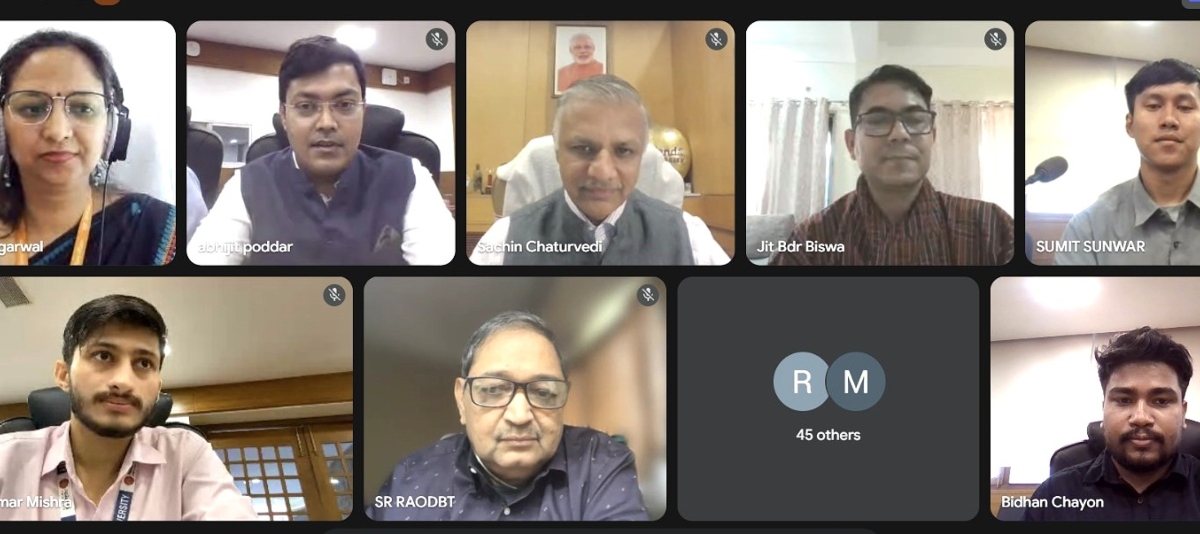
Rajgir/Patna: Nalanda University organised an international webinar on ‘Regional Drivers of One Health through South-South Cooperation’ on Tuesday to mark World One Health Day, bringing together experts and policymakers from India, Bhutan, Bangladesh, Nepal and other parts of the region.

The webinar, organised by the Department of Science, Technology and Policy Studies, School of Languages and Literature/Humanities, focused on interconnected challenges involving human, animal and environmental health, with particular attention to the developmental priorities of the Global South.
Speakers discussed regional cooperation, emerging diseases, antimicrobial resistance (AMR), climate change, technological innovation and the need for integrated health surveillance systems.

One Health As A Driver Of Development
Delivering the inaugural perspective, Nalanda University Vice Chancellor Professor Sachin Chaturvedi said One Health should be viewed not only as a public health priority but also as an instrument for economic development, technological equity and international cooperation.
Highlighting India’s expanding bioeconomy and capabilities in vaccine development, diagnostics and biomanufacturing, he said the country had the potential to develop affordable healthcare solutions and extend health technologies to other developing nations.
He called for South-South Cooperation to become a central pillar of the global One Health movement, enabling countries facing similar developmental challenges to exchange knowledge, resources and technological capabilities.
Dr Sangeet Agarwal, Scientist at the Office of the Principal Scientific Adviser to the Government of India, highlighted the National One Health Mission and the vision of ‘One Planet, One Health’.
Drawing lessons from the Covid-19 pandemic, she emphasised institutional coordination, integrated surveillance, regulatory preparedness and early detection to prevent future outbreaks.
She also referred to India’s initiatives, including a network of high-containment laboratories, identification of 54 priority pathogens, the National One Health Assembly and youth engagement programmes such as IDEA and the One Health Hackathon.
Agarwal stressed that technological innovation must be accompanied by equitable access so that its benefits reach communities at the last mile.
AI, Genomics And Regional Early-Warning Systems
Dr S R Rao, former Senior Adviser in the Department of Biotechnology, discussed the potential of emerging technologies in strengthening One Health preparedness.
He highlighted applications of artificial intelligence, predictive analytics, genomics, metagenomics, affordable diagnostics and wastewater-based surveillance.
Rao emphasised the need for AI-enabled regional early-warning systems and meaningful technology transfer through local adaptation, joint validation and regional production. He also identified antimicrobial resistance as a critical area requiring sustained cooperation among countries.
Professor D Venkat Rao, Dean of Nalanda University, explored the relationship between traditional knowledge and contemporary One Health science.
Drawing on the Charaka Samhita, he discussed the holistic understanding of the human body and its relationship with the natural environment in Indian knowledge traditions. He highlighted their conceptual convergence with the contemporary One Health framework and called for systematic research, scientific validation and interdisciplinary collaboration.
Climate Change And Food Security Concerns
Chime Tshewang, Director of FCBL, Bhutan, discussed the implications of El Niño and climate variability for human health, animal health, agriculture and ecosystems.
Focusing on the Himalayan region, he highlighted concerns related to changing rainfall patterns, drought, glacier melting and water availability. He said climate change was both a food security and health security concern, calling for coordinated regional surveillance and risk assessment among countries sharing common ecosystems.
Abhimanyu Singh, Senior Consultant, International Relations, Department of Telecommunications, Ministry of Communications, examined the economic foundations of South-South Cooperation in One Health.
He highlighted the importance of including farmers and agricultural communities in policy discussions. Citing estimates of approximately US$11.5 billion for prevention compared with US$30 billion for pandemic management, he discussed the economic case for investing in preventive measures.
Singh also raised concerns about agricultural practices, antibiotic use in animal feed, unsustainable land use and antimicrobial resistance, advocating a more equitable economic framework for One Health cooperation.
Wildlife Surveillance In Focus
Dr Surojit Das of Vidyasagar University, West Bengal, highlighted the emerging environmental dimension of antimicrobial resistance, focusing on wildlife.
He discussed how contaminated water, industrial and municipal effluents, agricultural waste and other environmental pathways expose wildlife to resistant microorganisms.
His presentation underlined the importance of incorporating wildlife surveillance into national AMR strategies and strengthening environmental monitoring and coordination across sectors.
Nalanda University Emphasises Regional Partnerships
The webinar concluded with an emphasis on interdisciplinary research, regional partnerships and sustained engagement across Asia and the Global South.
The discussions highlighted the need to bring together scientific knowledge, public policy, traditional wisdom and technological innovation to address shared challenges such as emerging diseases, antimicrobial resistance, climate change and food security.
The university said the deliberations would help shape deeper institutional collaboration and practical cooperation, positioning Nalanda as a centre for regional dialogue and knowledge exchange in the spirit of Vasudhaiva Kutumbakam — the world as one family.