Patna: Bihar Chief Minister Nitish Kumar has unveiled a sweeping industrial package promising subsidies, tax breaks and free land to investors, in what observers see as both a bold bid to lure capital into the state and a political statement ahead of next year’s assembly elections.

Announced via social media on Tuesday morning, the Bihar Industrial Investment Promotion Package 2025 (BIPPP-2025) pledges up to Rs 40 crore in interest subsidies, reimbursement of up to 300% of net SGST for 14 years and a 30% capital subsidy for new units. Exporters will be eligible for up to Rs 40 lakh a year, while industries can claim support for skill development, renewable energy adoption, patent registration, and reimbursement of stamp duty and land conversion charges.
The headline-grabbing measure, however, is land. Units investing over Rs 100 crore and generating 1,000 jobs will be allotted up to 10 acres free of cost, while projects exceeding Rs 1,000 crore can secure up to 25 acres. Fortune 500 companies have been promised 10 acres.

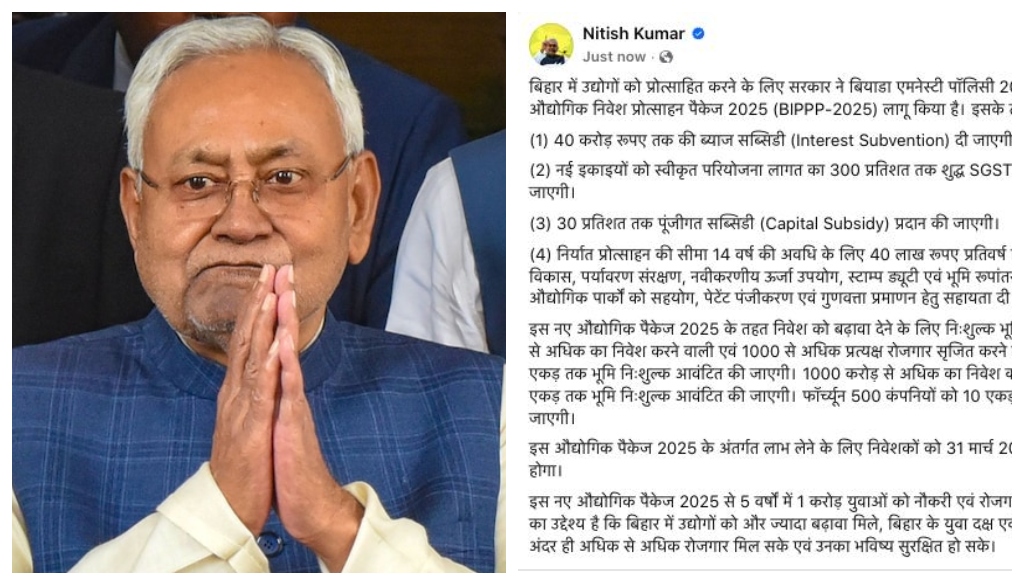
बिहार में उद्योगों को प्रोत्साहित करने के लिए सरकार ने बियाडा एमनेस्टी पॉलिसी 2025 के बाद अब नया बिहार औद्योगिक निवेश प्रोत्साहन पैकेज 2025 (BIPPP-2025) लागू किया है। इसके तहत:-
(1) 40 करोड़ रूपए तक की ब्याज सब्सिडी (Interest Subvention) दी जाएगी।
(2) नई इकाइयों को स्वीकृत…
— Nitish Kumar (@NitishKumar) August 26, 2025
CM Nitish said applications must be filed by March 31, 2026, and projected that the package would generate employment for one crore youth in five years. “Our objective is to promote industries in Bihar so that the youth are skilled, self-reliant and find secure employment within the state,” he said.
The announcement comes just weeks before Bihar heads into a high-stakes election. With unemployment consistently ranking as a top voter concern and opposition leaders sharpening attacks over outmigration and lack of opportunities, the chief minister’s timing is unlikely to be dismissed as coincidence.
While Nitish cast the package as a developmental milestone, critics are likely to view it as an attempt to reset the political narrative. Whether the promise of jobs and industrialisation can shift ground realities before polling remains an open question.