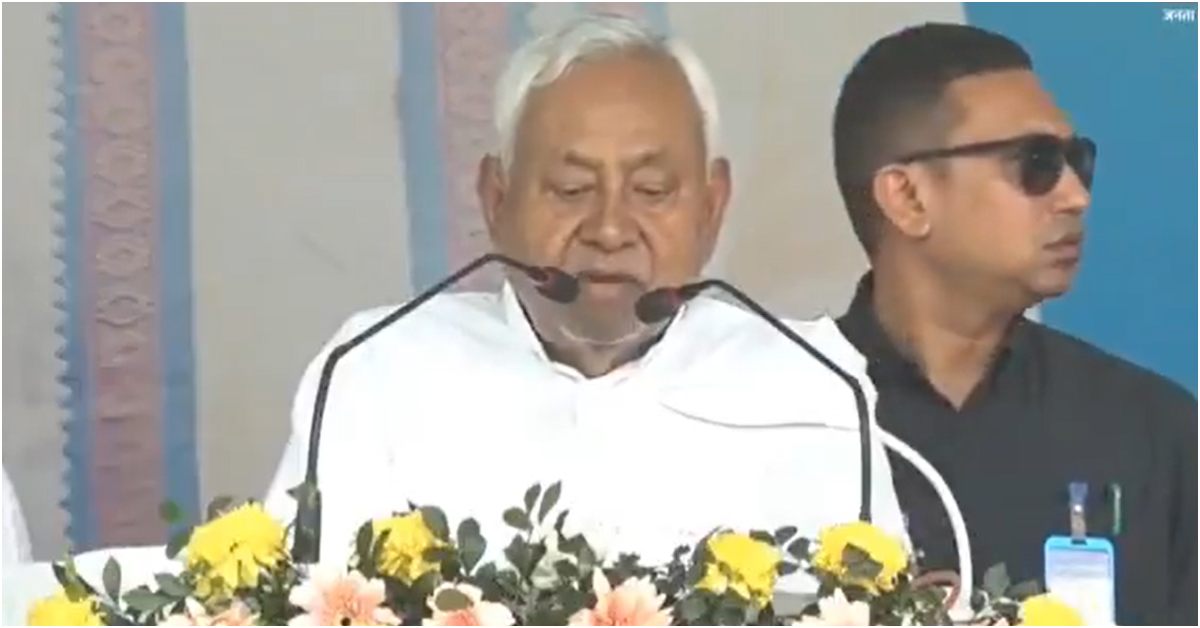
Patna: Bihar’s chief minister, Nitish Kumar, on Tuesday outlined an ambitious development roadmap for the next five years while addressing a public gathering in Supaul as part of his “Samriddhi Yatra”.

He said planning for the period between 2025 and 2030 had already begun and that his government would focus on expanding industry, generating employment for young people and strengthening welfare schemes for women.
Presenting what he described as a seven-point vision for the state, the chief minister said the government aimed to double both employment opportunities and the average per capita income in the coming years. He also promised financial support of Rs 2 lakh for women and employment opportunities for 10 million young people.

A key focus of the plan is industrial development. CM said industrial zones were being developed across districts and that several closed sugar mills would be revived to boost manufacturing and local economies.
Agriculture will also remain a priority, he said, highlighting efforts to strengthen farm-based industries. The state has established the Bihar Marketing Promotion Corporation to improve agricultural marketing, while production of makhana is being promoted alongside dairy and fisheries.
In the education sector, He said model schools and degree colleges were being established in every block to improve access to higher education. A large “Education City” is also under construction to expand academic and research facilities in the state.
Healthcare infrastructure will be upgraded by developing district and block hospitals into specialised medical centres, he added. The government is also considering incentives to encourage reputed private hospitals to set up operations in Bihar, alongside a policy aimed at restricting private practice by government doctors.
The chief minister said infrastructure expansion would include the construction of five new expressways and the conversion of rural roads into two-lane routes. Plans also include rooftop solar installations for households willing to adopt renewable energy and initiatives to promote tourism across the state.
He said the final element of the vision centred on improving governance and the ease of living for residents through modern technology and administrative reforms.
During his speech, the chief minister also criticised the period when Bihar was governed by Lalu Prasad and Rabri Devi, referring to the years before 2005.
He claimed that during that time people were afraid to leave their homes after dusk and that social tensions and communal conflicts were common. According to him, education levels were low, medical facilities were scarce and road infrastructure was limited.
“Today there is no atmosphere of fear in Bihar,” he said, crediting his government with improving law and order, infrastructure and public services across the state.