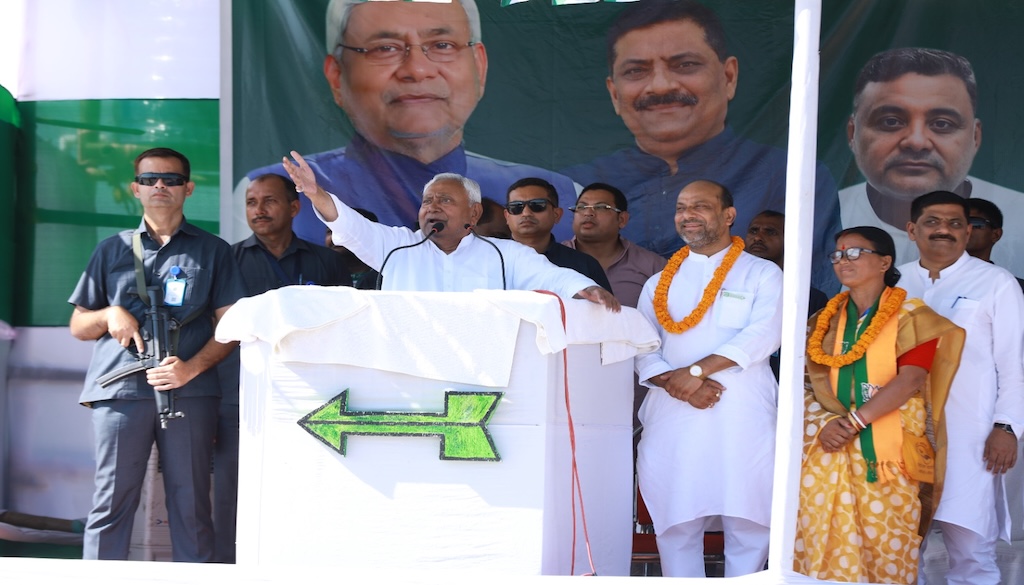
Kishanganj: Bihar Chief Minister Nitish Kumar on Wednesday claimed that his government had transformed Bihar from a state once plagued by fear and neglect into one of progress and safety, asserting that the “dark days” of the Lalu-Rabri era were long gone.

Addressing an election rally in Thakurganj, Kishanganj, the JD(U) leader attacked the RJD, saying that “no work was done during their rule.” He said, “Before, there was no electricity, no roads, no education, and people were afraid to leave their homes after dusk. When our government came to power, we built roads and improved safety. Now, boys and girls move around freely even at night.”
Nitish described the previous RJD government as a “useless regime” responsible for communal tension and the collapse of governance. “Before, there were Hindu-Muslim conflicts and no access to medical facilities. We worked for everyone without discrimination,” he said.

The Chief Minister also made a major promise of employment, asserting that his government had already fulfilled its 2020 pledge of creating 10 lakh jobs. “We not only created 10 lakh jobs, but today, 40 to 50 lakh people have employment. In the next five years, we will ensure jobs for 1 crore youth,” Nitish said.
Highlighting his government’s record on women’s empowerment, he said Bihar had become a model for the rest of the country. “We gave 50% reservation to women in Panchayati Raj in 2006, 35% in the police force in 2013, and 35% in all government jobs in 2016. Today, Bihar has the highest number of women in the police in the entire country.”
Nitish also praised the success of the JEEViKA self-help group initiative, which began in 2006 with World Bank support. “When we started JEEViKA, it was small, but now it has grown to include 1 crore 40 lakh women across Bihar,” he said, calling it one of his government’s proudest achievements.
As the first phase of the Bihar Assembly elections approaches, Nitish Kumar’s message focused on continuity and stability, presenting himself as the architect of Bihar’s development and a counter to the RJD’s return to “jungle raj.”