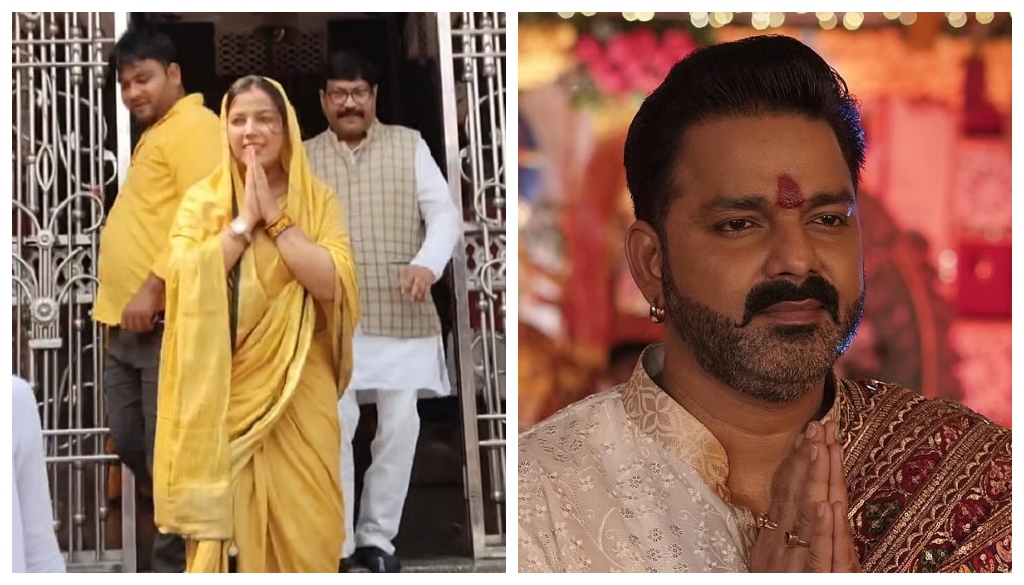
Rohtas: “Pawan Singh’s wife, Jyoti, is very sweet. We want Pawan and Jyoti to reunite and live together. Jyoti is talking about development, but Nitish Kumar has done a lot for women — giving them reservations and opportunities. Because of him, girls are stepping out to study. So, we’ll vote for Nitish,” says Sudha Sinha from Karakat in Rohtas district.

Her words reflect the mood of many women voters in Karakat, who admire independent candidate Jyoti Singh — wife of Bhojpuri actor and singer Pawan Singh — yet credit Chief Minister Nitish Kumar’s welfare schemes for changing their lives.
The Karakat Assembly constituency, part of Rohtas district, goes to polls on November 11 in the second phase of Bihar Assembly elections. The seat has turned into a high-profile contest with CPI(ML)’s sitting MLA Arun Singh seeking re-election against JD(U)’s former MP Mahabali Singh, while Jyoti Singh’s surprise entry has added a new dimension to the race.

A Historical Stronghold with Left Influence
Karakat has a long electoral history dating back to 1967, when Tulsi Singh of the United Socialist Party became its first MLA. Tulsi Singh remains the most successful leader here, having won five times. CPI(ML)’s Arun Singh, who won in 2020, has represented the seat four times.
Since 2000, Left parties or their allies have largely dominated Karakat, except in 2010, when JD(U)’s Rajeshwar Raj won, and in 2015, when RJD’s Sanjay Kumar Singh secured victory. This time, 13 candidates are in the fray.
Local Issues Overshadow Star Power
Despite the celebrity presence, people’s concerns remain basic — unemployment, migration, poor roads, and lack of administrative transparency. Many residents complain that government offices are mired in red tape and bribes.
“Roadlights don’t fill the stomach — we need jobs,” says Ranjit Kumar Singh, a resident of Karakat. “Nitish has brought some development, but most of it is cosmetic. Even small-time work is difficult to find in Bihar. Earlier, ₹10,000 was enough to survive, now even that isn’t possible.”
Young voters, too, appear disenchanted. Dharmendra, 27, preparing for a government job, says, “We’ve seen Lalu and Nitish. This time, we want change. Politicians come, make promises, and vanish. Modi promised trains here, but there are no jobs.”
Sympathy for Jyoti Singh, But Questions About Experience
Independent candidate Jyoti Singh, who has been actively campaigning across Karakat, is drawing attention — and sympathy — amid her strained relationship with Pawan Singh.
“She came to our house and asked for votes,” says Shilpi Shikha, a local resident. “She’s honest and deserves a chance.”
However, others remain cautious. “She needs political experience,” says Ranjit Singh. “Sympathy can get her attention, but not votes.”
Gulabi Tiwari, another voter, argues that women want to see Jyoti win. “Arun ji was MLA, Mahabali ji was MP, but no one worked. Nitish’s schemes are just vote politics. Jyoti understands local problems and should be given a chance,” she adds.
Mixed Reactions to Nitish’s Development Record
While some voters remain skeptical, others defend the JD(U) government’s work.
Pankaj Singh from Munshi village says, “Before 2005, reaching our village was difficult. Now, old-age pension has increased to ₹1,100, farmers get support, and we can work late without fear. What bigger development do we need?”
He questions RJD leader Tejashwi Yadav’s job promise: “Where will those jobs come from? There aren’t enough posts in Bihar.”
Experts: Divided Votes May Decide the Outcome
Political expert Priyadarshi Ranjan says, “This election isn’t just about development — it’s about caste arithmetic. Both the JD(U) and CPI(ML) have strong support bases. With two Kushwaha candidates and multiple Rajput contenders, vote division will play a decisive role.”
Local journalist Amit Kumar believes the contest is between CPI(ML) and JD(U). “Jyoti Singh’s popularity is growing among women, but it may not convert into votes. The Rajput vote is likely to split between Jyoti and Jan Suraaj candidate Yogendra Singh — which could benefit the CPI(ML),” he explains.
Candidates’ Pitch to Voters
CPI(ML)’s Arun Singh says, “Around 75% of Karakat’s population depends on agriculture. Our priority is to strengthen the farm sector and improve farmers’ income.”
JD(U)’s Mahabali Singh is banking on Nitish Kumar’s governance record.
Jyoti Singh insists she’s in the race “with the blessings of the people,” while Jan Suraaj candidate Yogendra Singh says the public “is in a mood for change,” promising better roads, irrigation, and jobs.
As Karakat readies to vote, the battle remains tight — between tradition and change, ideology and emotion, governance and sympathy. Whether Jyoti Singh’s independent foray can challenge the established political equations or merely split votes will be known when ballots are counted.