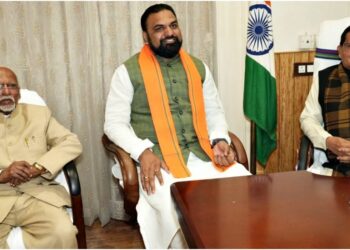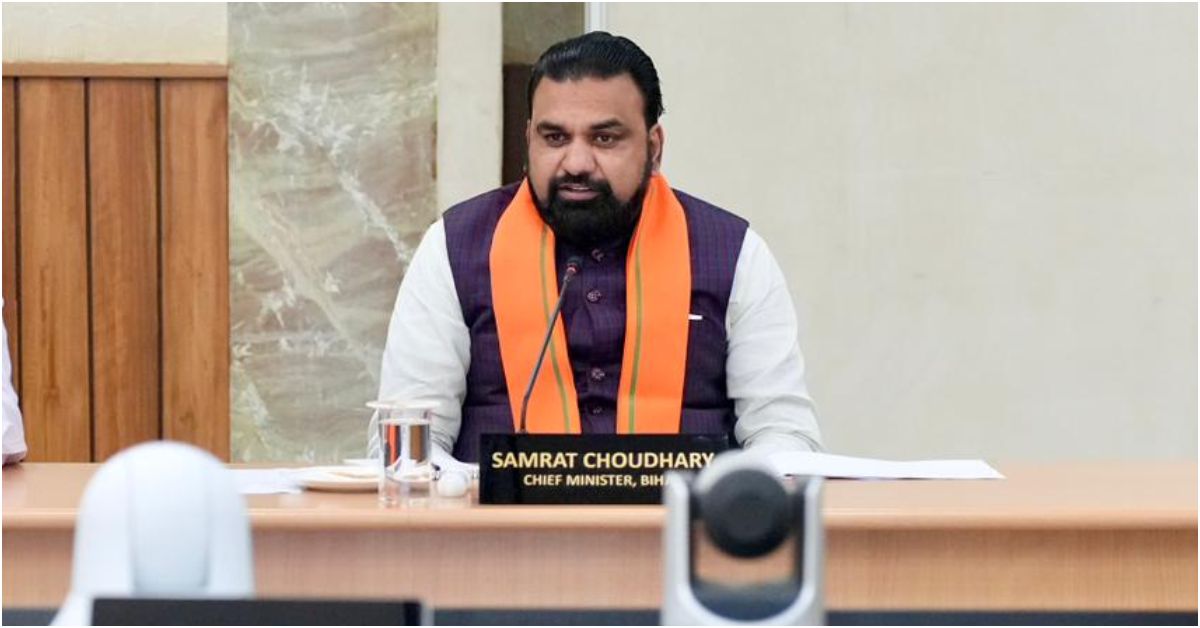
Patna: Bihar Chief Minister Samrat Choudhary on Friday sought to allay concerns over the state’s newly approved Panchayat taxation rules, asserting that the government has no intention of imposing taxes on poor villagers.

Replying to a discussion in the Bihar Legislative Council, Choudhary said the proposed rules do not provide for taxing economically weaker sections and clarified that the debate largely concerns taxation on hoardings in rural areas.
“The government has no such intention. There is no provision to tax the poor. The discussion is about hoardings in villages. Bihar already has a system under which Rs 30 each is collected for waste management and tap water supply. The government has framed a rule, and several provisions will be modified while finalising the rules,” Choudhary said.
The clarification came after RJD MLC Sunil Kumar Singh demanded a discussion on the government’s decision to introduce holding tax in villages, alleging that the move would burden poor rural residents.

Opposition Raises Concerns Over Rural Taxes
Singh accused the government of attempting to boost revenue by imposing holding tax of up to Rs 5,000 in rural areas, describing the proposal as an “outdated colonial-era approach.”
The controversy stems from the Bihar Cabinet’s approval on July 15 of the Bihar Gram Panchayat (Tax, Rate and Fee) Rules, 2026, aimed at making Gram Panchayats financially self-reliant.
Under the proposed framework, Panchayats would be empowered to levy annual taxes ranging from Rs 50 to Rs 5,000 on residential and commercial properties. The Panchayati Raj Department is expected to issue detailed implementation guidelines.
The proposed rules also envisage charges on water supply and sanitation services, markets and fairs, slaughterhouses, brick kilns, petrol pumps, gas agencies, marriage halls, transport stands, advertisements, and certain commercial establishments. Religious institutions, including temples, mosques and monasteries, have also been included under the proposed taxation framework.
Government Clarifies Scope of Taxation
Responding to criticism, Choudhary reiterated that the government’s intention is not to tax poor households. He maintained that charges for drinking water and solid waste management already exist in Bihar, with villagers currently paying Rs 30 each for the two services.
He also indicated that the government would make necessary modifications while framing the final rules.
Not the First Policy Rollback
The Panchayat tax clarification is the latest in a series of instances where the Samrat Choudhary-led government has softened or revised its decisions following public criticism.
State Highway Toll Policy
On July 6, the Bihar government notified a new toll policy for state highways and bridges. Although two-wheelers, three-wheelers, tractors and combine harvesters were exempted, the notification created an impression that private cars and jeeps would also be charged toll.
A day later, Choudhary clarified that only commercial vehicles would pay toll on state highways, while private vehicles would remain exempt.
Satellite Township Land Restrictions
In April, the Cabinet approved the development of 11 satellite townships and imposed restrictions on the sale and purchase of land in designated areas.
The move triggered protests as landowners said they were unable to sell property to meet urgent financial needs such as medical treatment, education and marriages.
Following the backlash, the government revised the policy in June, allowing landowners to sell property to the Bihar State Housing Board under specified conditions. The government also announced compensation at double the circle rate in urban areas and four times the rate in rural areas, along with a 10% incentive under the Bihar Land Purchase Policy, 2026.
Urban Development and Housing Minister Nitish Mishra told the Legislative Council on July 22 that 750 landowners had voluntarily applied to provide land for the satellite township project and reiterated that no land would be acquired forcibly.
Chief Minister’s Residence Controversy
Another policy reversal occurred over the extension of the Chief Minister’s residence.
On April 30, the government merged the bungalow at 5 Deshratna Marg with the Chief Minister’s official residence at 1 Anne Marg. The decision drew criticism from the Opposition, particularly as former Chief Minister Rabri Devi was simultaneously being asked to vacate her official residence.
Amid the controversy, the government reversed its decision on June 4, separating the bungalow from the Chief Minister’s residence complex.
Revenue-Boosting Measures Introduced
Even as it has modified some decisions, the Bihar government has introduced several measures aimed at increasing revenue.
These include:
- A four-fold increase in trade tax on vehicle purchases, effective from July 23.
- A 1% increase in registration charges for two-wheelers, likely to raise on-road vehicle prices.
- A four-fold increase in dealership-related taxes on commercial vehicle inventories.
- Higher Minimum Value Register (MVR) circle rates, increasing stamp duty and registration costs on property transactions.
- A new Rs 200 fee for land mutation, ending the earlier practice of free mutation services.
- A provision imposing 100% penalty on buyers and sellers found undervaluing properties during registration to evade stamp duty.
The government maintains that these reforms are intended to strengthen revenue collection, improve local governance and enhance administrative transparency, while the Opposition argues that several of the measures will increase the financial burden on citizens.