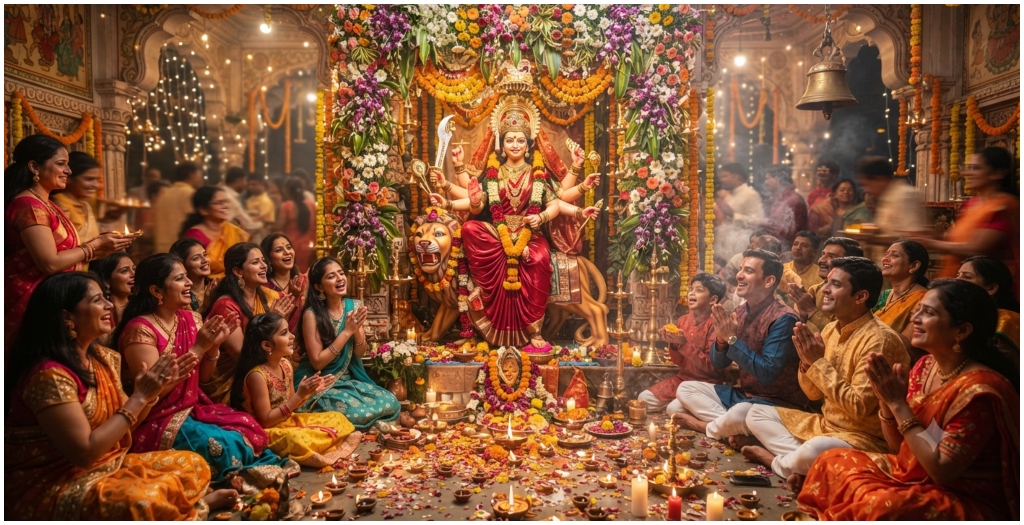
Patna: Sharadiya Navratri is a nine-day Hindu festival dedicated to the worship of Goddess Durga and her nine forms. However, the festival does not always span exactly nine calendar days. Depending on the Hindu lunar calendar, Navratri may last eight, nine or ten days, affecting the schedule of fasting and rituals.

The variations occur because lunar dates, known as tithis, do not correspond to fixed 24-hour periods. As a result, certain rituals may fall on the same day, while others may extend across two days.
According to astrologer Dr Raghav Nath Jha, these changes are linked to the movement of the moon and the calculation of dates in the Panchang, the traditional Hindu almanac.

How Lunar Dates Affect Navratri
The Hindu calendar follows lunar cycles, meaning the duration of a tithi can vary. This influences the timing of rituals, from Kalash Sthapana to the worship of Goddess Durga on Ashtami and Navami, followed by Vijayadashami.
When a lunar date is skipped at sunrise and does not receive a separate day in the calendar, it is known as tithi kshaya. When a lunar date continues across two sunrises, it is called tithi vriddhi.
These variations can compress the sequence of Navratri rituals into fewer calendar days or extend the festival’s observance. Devotees therefore consult the Panchang to determine the appropriate dates for fasting and worship.
When Navratri Rituals Coincided In 2014 And 2021
In 2014, the omission of Navami led to the observance of Ashtami and Navami rituals on the same day. Kalash Sthapana took place on September 25, while Vijayadashami was observed on October 3.
A similar variation occurred in 2021, when the omission of Chaturthi resulted in the rituals associated with Tritiya and Chaturthi being observed on the same day.
These examples illustrate why the festival’s ritual sequence cannot always be determined by counting nine consecutive calendar days. The placement and duration of individual tithis are also important.
Why Navratri Lasted Ten Days In 2016 And 2025
Navratri can also extend beyond nine calendar days when a lunar date continues across two sunrises.
In 2016, the extension of Dwitiya, the second lunar date, resulted in a ten-day observance. In 2025, the extension of Chaturthi similarly contributed to Navratri lasting ten days.
Such variations concern the calendar arrangement of the rituals rather than a change in the religious significance of the festival.
Religious Beliefs About Goddess Durga’s Arrival
Traditions also associate Goddess Durga’s arrival and departure during Navratri with different vehicles, or vahanas, depending on the day of the week on which the festival begins or ends.
These vehicles include an elephant, horse, boat and palanquin. According to traditional interpretations, the Goddess’s arrival was associated with a boat in 2018, an elephant in 2019, a horse in 2020 and a palanquin in 2021. An elephant was associated with her arrival in 2022 and 2023, while a palanquin was associated with it in 2024.
These associations form part of religious tradition and are distinct from the astronomical calculations that determine the festival’s duration.
Why Checking The Panchang Matters
The dates of Kalash Sthapana, Ashtami, Navami and Vijayadashami can vary from year to year because of changes in lunar dates. In some years, two important rituals may fall on the same day, while in others, an additional calendar day may be included.
Consulting the Panchang for the relevant year helps devotees establish the appropriate dates for fasting and worship. It also explains why Sharadiya Navratri, despite traditionally being associated with nine days, may be observed over eight or ten calendar days.