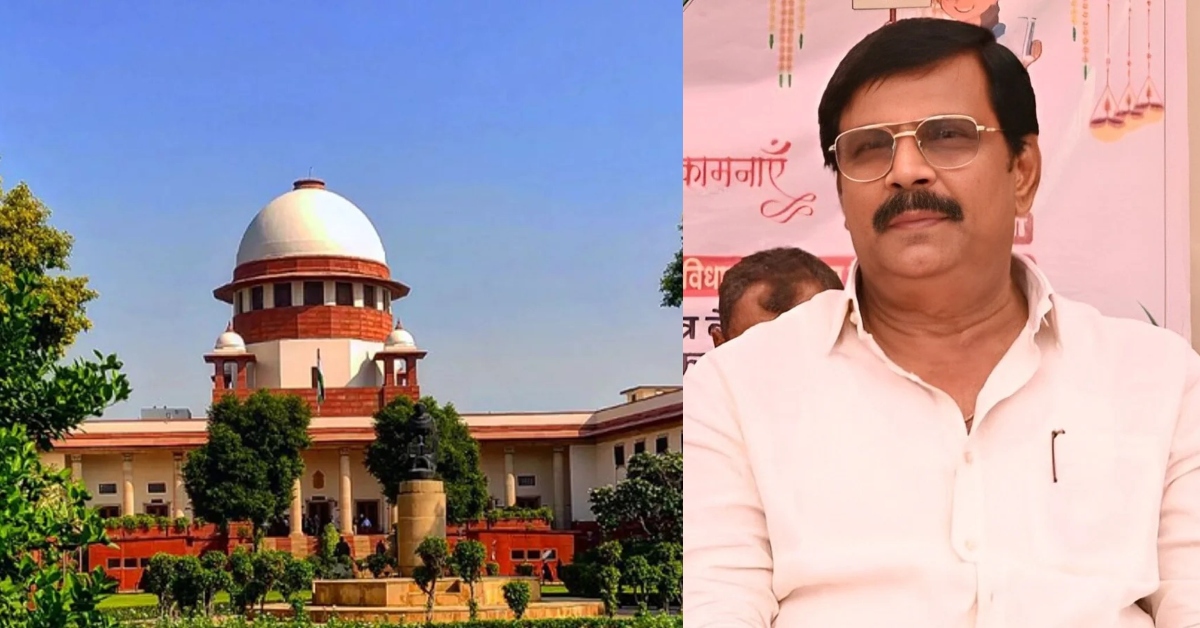
New Delhi/Patna: The Supreme Court on Friday reserved its verdict on a petition challenging the Bihar government’s decision to grant premature release to former MP Anand Mohan, convicted in the 1994 murder of then Gopalganj District Magistrate G. Krishnaiah.

A bench comprising Justice Dipankar Datta and Justice Sheel Nagu concluded hearings after listening to arguments from all parties. The court will now decide whether the remission granted by the Bihar government in 2023 complied with the law.
Court Questions High Court’s Observation

During the hearing, the bench expressed concern over an observation made by the Patna High Court that the case did not fall within the “rarest of rare” category.
Justice Dipankar Datta remarked that if the killing of a public servant while on duty was not considered among the gravest crimes, it raised questions about what offences would qualify.
The bench observed that such reasoning could weaken the deterrent effect of the law and send an inappropriate message to potential offenders.
Justice Datta also said the state government should have challenged such an observation if it disagreed with it.
Scrutiny Of Remission Process
The court closely examined the process through which Anand Mohan was granted remission.
It noted that under the applicable rules, a life convict must ordinarily complete 14 years of actual imprisonment and 20 years in total, including remission, before becoming eligible for premature release.
The bench pointed out that Anand Mohan’s first application for remission in 2021 had been rejected because he had not fulfilled the 20-year requirement. It questioned how that rejection could later be treated as erroneous when the eligibility criteria had not changed.
Discrepancies In Official Records
The hearing also focused on information placed before the remission board.
According to the court, the Jail Superintendent informed the board that no criminal cases were pending against Anand Mohan. However, records before the court indicated that two criminal cases were still pending.
Justice Datta observed that had the remission board been furnished with complete information, its decision could have been different.
The bench also questioned the roles of prison officials and probation authorities, indicating that relevant facts may not have been fully disclosed during the decision-making process.
Justice Sheel Nagu remarked that the reports submitted by officials appeared uniformly supportive of Anand Mohan’s release and sought clarification on who was responsible for disclosing the pending FIRs.
Defence Cites Prison Conduct
Counsel appearing for Anand Mohan argued that his conduct in prison had been exemplary and submitted that he had authored a book that is now taught in some schools in Bihar.
The defence also referred to his family’s association with India’s freedom movement.
Justice Datta, however, observed that a person’s entitlement to legal relief could not be determined by the contributions of their ancestors and rejected that line of argument.
Petitioner’s Arguments
Senior Advocate Siddharth Luthra, appearing for petitioner Uma Krishnaiah, the widow of G. Krishnaiah, argued that the period Anand Mohan spent on parole should not be counted towards the actual sentence served.
He also alleged discrepancies in official records concerning the convict’s age and sought closer scrutiny of the remission process.
The Supreme Court asked the Bihar government to respond to these issues during the proceedings.
Background
On December 5, 1994, G. Krishnaiah, then District Magistrate of Gopalganj, was beaten to death by a mob while on official duty.
Anand Mohan was convicted in the case. A trial court initially awarded him the death penalty, which was later commuted to life imprisonment by the Patna High Court.
The Bihar government granted him premature release on April 24, 2023, after amending its remission policy. The decision was subsequently challenged in the Supreme Court by Uma Krishnaiah.
With hearings now complete, the apex court has reserved its verdict. The judgment is expected to determine not only the legality of Anand Mohan’s release but also whether the remission process complied with statutory requirements and whether material facts were withheld from the authorities while considering his case.