Patna: The Supreme Court on Thursday stayed the University Grants Commission’s (UGC) recently notified regulations aimed at preventing caste-based discrimination in higher education, citing concerns that the rules were unclear and could be misused. A bench comprising Chief Justice Surya Kant and Justice Joymallya also directed the central government and the UGC to prepare a fresh draft of the regulations.

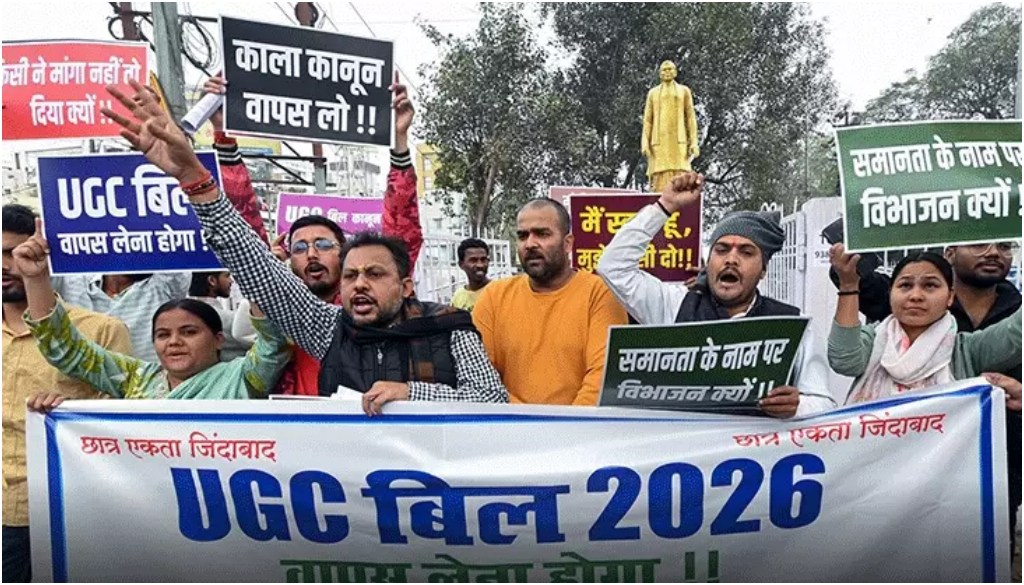
The regulations, titled Promotion of Equity in Higher Education Institutions Regulations, 2026, were notified on January 13 and came into effect on January 15, prompting widespread protests across India. The rules mandate the formation of Equality Committees and monitoring teams in universities and colleges, establish helplines, and set reporting mechanisms to address complaints from SC, ST, and OBC students.
Petitions challenging the regulations claim they discriminate against students from the general category, arguing that the provisions define discrimination narrowly and risk portraying upper-caste students as “inherent perpetrators.”

During the hearing, advocates questioned the scope of the rules, pointing to the absence of provisions for ragging and other forms of discrimination outside caste-based incidents. Chief Justice Kant noted the complexity of the issue, citing potential scenarios where derogatory remarks could be made against students from the Northeast or other regions, and questioned whether the regulations would provide a remedy.
“Even within reserved communities, some people have become prosperous… Suppose a Scheduled Caste student uses derogatory language against a student from another community, is there any remedy for that?” the bench asked.
The court observed that a committee of experts familiar with social values and societal challenges should be constituted to draft a revised version. The next hearing has been scheduled for March 19.
Background
The UGC’s rules were first proposed following several high-profile suicides linked to caste-based discrimination, including Rohit Vemula (Hyderabad Central University, 2016) and Payal Tadvi (Maharashtra, 2019). A 2019 IIT study found that 75% of students from historically disadvantaged castes reported facing discrimination in colleges.
The new regulations expanded the definition of caste discrimination to include unfair treatment based on caste, religion, gender, disability, race, or place of birth. They also included Other Backward Classes (OBCs) in the scope of protection, removed provisions penalising false complaints, and introduced enforceable mechanisms such as Equal Opportunity Centers (EOCs), Equity Committees, and national monitoring bodies. Colleges failing to comply could face suspension of UGC recognition or distance learning programs.
Opposition and Controversy
Upper-caste students and some academics argue that the rules are biased, as they do not allow members of the general category to be recognised as victims of discrimination. Critics also highlight that colleges may hesitate to act fairly, fearing penalties or false complaints.
Social media campaigns, including hashtags like #UGCRollback and #ShameOnUGC, have amplified opposition. Former UGC chairman M. Jagadesh Kumar defended the rules as a step to ensure equality in higher education. Meanwhile, Tamil Nadu Chief Minister M.K. Stalin praised the regulations as a “belated but welcome step” to reform India’s higher education system.
Opponents such as BJP leader Brij Bhushan Sharan Singh have described the regulations as divisive, arguing they cast one community as oppressors while excluding them from decision-making committees.
The UGC’s current chairman, Vineet Joshi, has not issued an official statement on the stay. BJP MP Nishikant Dubey defended the regulations, stating they comply with Article 14 of the Constitution and that there is no discrimination against any community.
The Supreme Court’s stay adds a temporary pause to the rules while the government and UGC prepare a revised framework, underlining the delicate balance between protecting historically disadvantaged students and ensuring fairness for all communities in India’s higher education system.