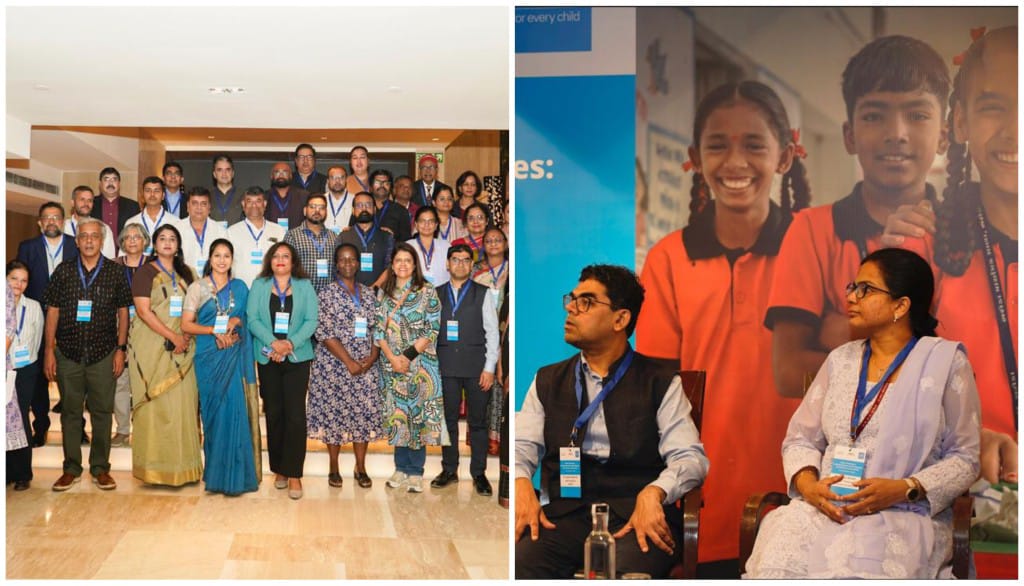
Patna: A two-day national Training of Trainers workshop organised by UNICEF India has concluded with a strong appeal to the country’s health editors and journalists: deepen reporting on cervical cancer and road safety, two of India’s most persistent yet under-reported public health challenges.

Titled “Workshop for Strategic Engagement of Health Editors: Emerging Adolescent Health Challenges – Cervical Cancer and Road Safety,” the programme brought together senior editors, health reporters, media scholars and public-health specialists from across India. The workshop focused on using Critical Appraisal Skills (CAS) to strengthen evidence-based journalism and develop strategic, human-centred storytelling for adolescent health.
‘Media is our strongest ally against misinformation’
Addressing the opening session, Zafrin Chowdhury, Chief of Communication, Advocacy and Partnerships at UNICEF India, said the media’s role in shaping public understanding of health issues had never been more crucial.

“Young people deserve accurate, reliable information. Scientific and medical data must be translated responsibly and clearly. Nothing counters misinformation better than this,” she said.
“The media — and those who produce news and information — remain UNICEF’s strongest ally in reaching people with the knowledge they need.”
She emphasised that awareness on cervical cancer and road safety can improve significantly when journalists, guided by senior editors, apply critical appraisal skills to verify scientific data and contextualise it for everyday readers.
Cervical cancer: preventable but still deadly
India reported an estimated 79,103 new cervical cancer cases and 34,805 deaths in 2022, despite the disease being largely preventable.
Dr Vivek Virendra Singh, Chief, Health (a.i.), UNICEF India, stressed that media narratives can influence early intervention.
“Cervical cancer is the only cancer preventable by a vaccine. Awareness is the strongest intervention we have,” he said.
“Every accurate, empathetic story helps break stigma and brings us closer to a future where no woman dies from a preventable disease.”
Road safety: shifting focus from tragedy to accountability
India records over 150,000 road deaths every year, with adolescents and young people among the most vulnerable. In a dedicated session, public-health experts urged editors to reframe road safety as a governance and accountability issue, not merely a post-incident tragedy.
“Every crash is preventable,” Dr Singh said.
“The media must focus on enforcement, equity, and data-driven accountability — not just sympathy after accidents.”
Speakers including Dr Pallavi Shukla (AIIMS), Dr Gautham M. Sukumar (NIMHANS) and Dinesh Kumar (Ministry of Road Transport and Highways) reinforced the need for sustained, evidence-based coverage.
Editors craft strategies for stronger newsroom engagement
Throughout the workshop, editors worked in six groups to design newsroom strategies aimed at increasing visibility for women’s health and road safety. Discussions also explored how AI tools can help newsrooms analyse data, translate research, and make scientific material more accessible to regional and language media.
The workshop was conducted under UNICEF’s Critical Appraisal Skills (CAS) framework, launched in 2014 in partnership with the Indian Institute of Mass Communication, Oxford University and the Thomson Reuters Foundation.
Next steps: state-level training across India
The newly trained mentors will now lead state-level workshops for journalists in Maharashtra, Madhya Pradesh, Bihar, Rajasthan and Karnataka, expanding evidence-based health reporting across regional media ecosystems.