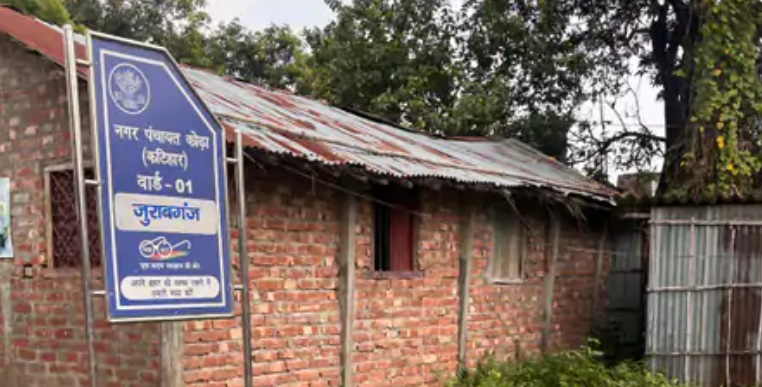
Katihar: For the residents of Jurabganj village in Korha tehsil of Katihar district—infamously known as Korha Gang—life continues under a cloud of suspicion. With police records across several states linking hundreds of villagers to theft and robbery cases, locals say they are being unfairly branded as criminals.

“In the eyes of the police, our entire village is full of thieves, but that’s not true,” said Ronit, a 29-year-old resident and a mathematics graduate from Delhi University. “Only 10% of the people are involved in such activities, yet police from other states barge into our homes without reason and beat us. They don’t even have our house numbers.”
According to police data, around 300 people from Korha are allegedly part of criminal gangs, and more than 8,000 cases have been registered against residents across Jharkhand, Delhi, Rajasthan, Punjab, Uttar Pradesh, Maharashtra, and West Bengal. But villagers insist that the majority are law-abiding citizens trying to rebuild their lives.

‘We Are Not All Thieves’
When media teams, which visited the area to gauge the election mood, found a community deeply aware of its poor image and eager to change it. The moment reporters entered Jurabganj—located barely 200 metres from Korha police station—residents gathered around, hesitant and defensive. After some persuasion, a few agreed to speak.
“Not everyone here is a criminal,” said 21-year-old Sameer Banjara, who studies at IGNOU and works part-time in catering. “Our elders made mistakes, but things are changing. People want to move on and live with dignity.”
Sameer traces the village’s criminal history back to the 1970s, when migrants from Rajasthan and Chhattisgarh settled here with limited employment options. “They started stealing to survive, and that’s how the village got this tag,” he said.
A Village Divided Between Crime and Reform
Despite the stigma, the younger generation is striving for change. Many students from the village now study in Navodaya and Sainik Schools, while some youth serve in the Indian Navy and Air Force. Others have migrated abroad—to countries like Canada and Singapore.
Yet the fear of police harassment persists. Ronit recalls being chased by a sub-inspector while travelling to Purnia. “He followed me for five kilometres, suspecting my bike was stolen. Only after checking my Aadhaar did he let me go,” he said.
Another youth, Aryan, who works at a bike garage, said police raids are common. “They come at night, drag people out of their homes, slap them, and sometimes even take money to let them go,” he alleged.
Police Say Strict Action Is Changing the Village
When contacted, Korha Police Station in-charge Vivek Vikram said the crackdown on the Korha Gang has yielded results. “Crime in the village has reduced by 80%. A special team under the SHO monitors the area regularly,” he said.
According to police data, ₹11 lakh was recovered from 90 cases in 2024–25, while ₹40 lakh was recovered from 30 cases in 2024 alone. Over 70 arrests were made, and a special cell was formed earlier this year under SP Vaibhav Sharma to monitor habitual offenders.
However, officers admit that identifying suspects remains a challenge. “The houses are built close together, like tunnels. Criminals escape easily, and people often refuse to disclose their names,” said one officer. “Still, the number of habitual offenders has dropped sharply.”
Church and Local Leaders Drive Reform
Efforts to rehabilitate the community are also being led by local churches and youth volunteers. Seventeen-year-old Avanti (name changed), who is part of the Salvation Army Church, said their organization regularly visits homes to counsel people. “We tell them that crime has brought nothing but shame to the village. Many have already left that path,” she said.
Local leader Nandu Yadav, chosen by villagers to represent them before authorities, said the community has about 1,500 voters. “We take decisions together during elections. Most people have supported Nitish Kumar and the BJP,” he said.
However, he pointed out the village’s civic problems. “High-tension wires run low over our homes. We have complained many times, but nothing has been done,” he added.
Poverty and Unemployment Still Deep-Rooted
Women in the village said they rely on government schemes but struggle to survive.
Seventy-five-year-old Soni Devi, a widow, said her ₹1,000 pension barely covers her medical expenses. “I haven’t received benefits under the Pradhan Mantri Awas Yojana. If leaders come here, I’ll tell them this hut is falling apart,” she said.
Another resident, Leela Devi, 50, said, “Nitish Kumar is the best leader. I like Tejashwi Yadav too, but he can’t do much for us.”
A Village Trying to Reclaim Its Identity
While police cite success in reducing crime, the social stigma attached to Jurabganj remains strong. For many, shedding the “Korha Gang” label is as important as finding steady work.
“Young people want to study, get jobs, and live respectfully,” said Sameer. “But until society stops calling us thieves, that dream will stay incomplete.”