Patna, 30th August 2025: When Chandragupta Maurya rose to power in 321 BCE, he not only founded the Mauryan Empire but also laid the foundation of one of the most organized states in Indian history. Guided by his mentor Chanakya, Chandragupta’s reign stretched from Afghanistan in the northwest to Bengal in the east and down to Karnataka in the south. But beyond the vast territory and powerful administration, what was daily life like for people living under his rule?

Life in Villages and Cities
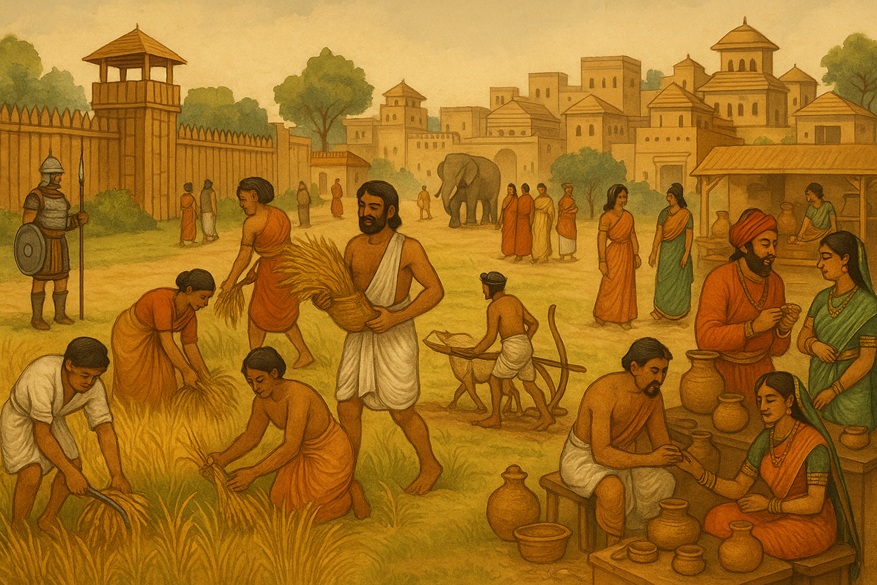
Most Indians during Chandragupta’s time lived in villages. Agriculture was the backbone of the economy, with farmers cultivating rice, wheat, barley, pulses and sugarcane. Cattle rearing and irrigation through canals and wells were part of everyday routines. Villages functioned as largely self-sufficient units, where barter and small-scale trade were common.
At the same time, cities such as Pataliputra (modern-day Patna), Taxila, and Ujjain thrived as bustling urban centres. Greek envoy Megasthenes, who lived at Chandragupta’s court, described Pataliputra as a city surrounded by wooden palisades and guarded by soldiers. Wide roads, markets, gardens and administrative offices reflected a structured urban life.

Occupations and Trade
While farmers formed the majority, artisans played a vital role in society. Potters, carpenters, weavers, blacksmiths and jewelers supported both local needs and the demands of royal courts. Traders connected India to distant lands—spices, cotton, pearls and elephants found their way to Central Asia and the Mediterranean.
Taxes were carefully regulated, and Chanakya’s Arthashastra reveals a sophisticated system of revenue collection. State officers, tax collectors and even spies ensured order and efficiency in everyday affairs.
Society and Family Life
Society broadly followed the Varna system—Brahmins as priests, Kshatriyas as warriors, Vaishyas as traders and Shudras as laborers. Yet, Megasthenes noted that people lived with a sense of discipline and honesty, often leaving their houses unlocked. Families were usually joint, with patriarchal authority guiding household decisions.
Women’s roles varied. While most were involved in household work and weaving, some took part in trade, entertainment and even served as guards in the royal court.
Food, Clothing and Lifestyle
The Indian diet was largely vegetarian, shaped by religious influences of Jainism and early Buddhism. Grains, pulses, fruits, milk and ghee formed the staple diet, though some communities consumed meat.
Men generally wore dhotis or cotton cloth draped around the waist and shoulders, while women wore garments similar to sarees. Jewelry—made of gold, silver, beads and ivory—was popular across social classes.
Faith and Philosophy
Religion played a central role in daily life. Hindu rituals and local deities were widely worshipped, while Jainism and Buddhism gained followers. Chandragupta himself eventually embraced Jainism and spent his final years as an ascetic in Karnataka. Festivals, rituals and spiritual discourses were part of community bonding.
Entertainment and Culture
Despite strict laws, people found joy in arts and recreation. Music, dance, storytelling, dice games and wrestling entertained both urban and rural audiences. Seasonal festivals tied to agriculture marked collective celebrations.
Order and Law
Chandragupta’s administration was highly centralized and disciplined. The Arthashastra prescribed strict punishments for crime but also stressed fair trade and justice. Spies maintained law and order, while market inspectors checked weights, measures and prices. This framework gave people a sense of stability and security.
A Blend of Simplicity and Grandeur
Daily life during Chandragupta Maurya’s reign was a mix of rural simplicity and urban sophistication. While farmers toiled in the fields, traders and artisans kept markets alive, and the state machinery maintained a firm but efficient grip. Strong administration, flourishing trade and cultural richness made the Mauryan Empire a golden chapter in Indian history—one where ordinary lives were shaped by discipline, devotion and the promise of prosperity.