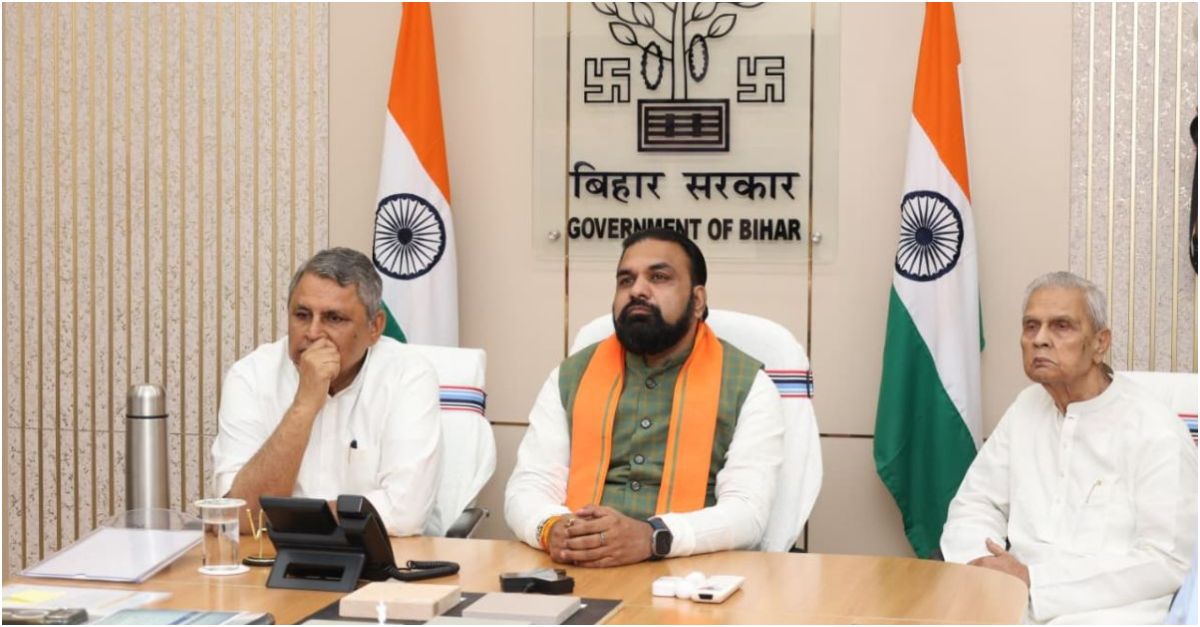
Patna: Bihar Chief Minister Samrat Choudhary has appealed to people from the state living outside Bihar to return and contribute to the state’s economic growth by setting up industries and businesses. The appeal has sparked discussions across political and business circles, with the government positioning the move as part of a broader strategy to transform Bihar into an industrial and employment hub.

The Chief Minister’s statement comes at a time when the state government is aggressively promoting industrial investments, infrastructure development and entrepreneurship schemes. However, experts point out that the vision also faces several structural and economic challenges.
Why Is Bihar Calling Back Migrants?

According to government officials and policy discussions, the appeal is driven by three major economic and strategic factors.
Reverse Migration and Economic Opportunity
The Bihar government believes that the state’s migrant workforce and business community, currently contributing significantly to industries in states such as Gujarat, Maharashtra, Delhi and Karnataka, can play a major role in Bihar’s industrial growth if they return with capital, skills and experience.
Officials say Bihar-origin entrepreneurs and skilled workers are actively involved in sectors such as textiles, real estate and food processing across India. The government now wants that investment and expertise to benefit Bihar’s economy.
The state has also developed “plug-and-play” industrial sheds in several districts, inspired by the Kumarbagh model in West Champaran. These facilities are aimed at supporting sectors like garments, textiles and leather industries while providing local employment opportunities to returning workers.
Rs 5 Lakh Crore Investment Target
The state government has prepared a roadmap targeting investments worth Rs 5 lakh crore by focusing on governance reforms, law and order improvements and industrial expansion.
Recently, the State Investment Promotion Board approved mega cement projects of Dalmia Cement and Ambuja Cement in Muzaffarpur and Kishanganj, which are expected to create large-scale employment opportunities.
The government is also setting up the country’s third National Institute of Food Technology Entrepreneurship and Management (NIFTEM) in Hajipur, Vaishali district, over 100 acres. Officials say the project could help Bihar emerge as a major food processing hub.
Business tycoon Gautam Adani had also announced plans to invest Rs 60,000 crore in Bihar before meeting Chief Minister Samrat Choudhary in Patna earlier this month.
New Industrial Policies and Incentives
The Bihar government has introduced several incentives aimed at attracting investors and entrepreneurs.
Projects investing over Rs 100 crore and generating more than 1,000 jobs may receive land through the Bihar Industrial Area Development Authority (BIADA). The state has also integrated its systems with the National Single Window System to simplify approvals and reduce bureaucratic delays.
Investors are being offered capital subsidies of up to 30 percent of project costs along with SGST reimbursements for up to 14 years. Separate policies for semiconductors, IT, logistics, textiles and leather sectors have also been introduced.
The government claims infrastructure conditions have improved significantly, with better road connectivity and electricity supply reaching even rural areas for 20 to 22 hours daily.
Officials also say artificial intelligence-based monitoring systems are being used to improve transparency in tenders and government processes.
Under the Bihar Startup Policy and Mukhyamantri Udyami Yojana, entrepreneurs can receive financial assistance of up to Rs 10 lakh, including subsidy support.
Major Challenges Before the Government
Despite the ambitious vision, several challenges remain.
Employment for Returning Migrants
Bihar has one of the country’s largest migrant populations after Uttar Pradesh. Reports suggest that between 2.5 crore and 3 crore people from Bihar work outside the state, mainly in construction, factories and transport sectors.
Experts say creating immediate employment and business opportunities for such a large population within Bihar would be extremely difficult.
Land Availability and Disputes
Industrial development requires large parcels of dispute-free land, but Bihar faces serious land-related challenges due to high population density and fragmented land holdings.
Government data shows that over 91 percent of farmers in Bihar own less than one hectare of land. This makes land acquisition for large factories and manufacturing plants highly complicated.
Land disputes also remain a major concern. According to police data, nearly 50 to 60 percent of serious criminal cases in Bihar are linked to land disputes.
Banking and Capital Constraints
Industry experts point out that access to credit remains limited in Bihar. Although the state’s Credit-Deposit (CD) ratio has improved to over 60 percent, it still remains below the national average.
Officials say Bihar’s bank deposits increased from Rs 5.63 lakh crore in 2025-26 to Rs 6.15 lakh crore in 2026-27. During the same period, loan disbursement in the state crossed Rs 3.70 lakh crore.
However, economists argue that unless banks become more supportive towards local entrepreneurs and MSMEs, industrial growth may remain slow.
Law and Order Concerns
The state government also faces the challenge of changing Bihar’s long-standing perception regarding crime and law and order.
Industrialists have often raised concerns about extortion demands, local interference and administrative support during business disputes.
To address these concerns, the government is planning to establish the Bihar Industrial Security Force (BISF), modelled on the Central Industrial Security Force (CISF), to provide security to industrial zones, mega food parks and major factories.
Chief Minister Samrat Choudhary has also directed police officials to take strict action against criminals and mafia groups allegedly attempting to intimidate industrialists or citizens.
Focus on Job Creation, Not Government Jobs
Government officials have clarified that the state’s objective is not to provide direct government employment to all returning migrants, but to create opportunities through private investment and industrial expansion.
The government is focusing on sectors such as IT, MSMEs, textiles, leather and food processing. Bihar is also attempting to position itself as an emerging technology hub in eastern India by attracting companies like Tata Consultancy Services (TCS) and Wipro.
Officials believe agriculture-based industries involving maize, makhana and litchi processing could generate large-scale employment in rural areas in the coming years.