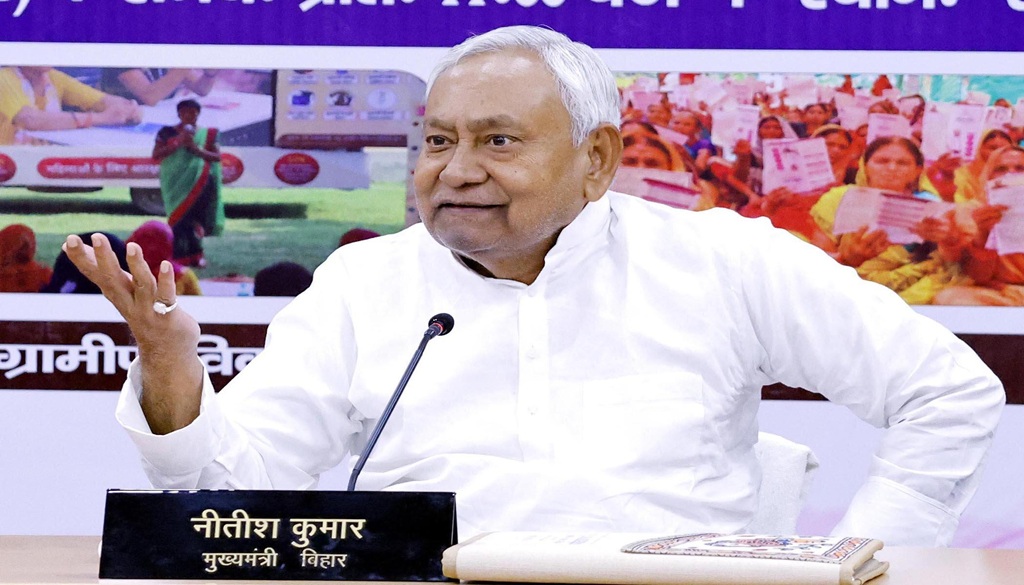
Patna: Bihar Chief Minister Nitish Kumar is expected to resign from his Member of Legislative Council (MLC) post on Monday, in line with constitutional requirements after being elected to the Rajya Sabha. Along with him, BJP state president Nitin Nabin will also step down from his MLA position.

Both leaders were elected to the Rajya Sabha on March 16. As per rules, they must resign from their existing legislative posts within 14 days of being elected to the Upper House, and the deadline for the same ends on Monday.
Sources indicate that Nitish Kumar may resign as Chief Minister after taking oath as a Rajya Sabha member. His resignation is likely to mark the beginning of a new political phase in Bihar.

Since the National Democratic Alliance (NDA) first came to power in Bihar in 2005, the BJP has largely played the role of the junior partner in the coalition government led by Nitish Kumar’s Janata Dal (United). However, for the first time, the BJP may take the lead role in forming the government in the state.
Nitish Kumar’s term in the Rajya Sabha will begin on April 10. Meanwhile, political activity related to the formation of a new government under a different chief minister is expected to intensify from Monday.
Samrat Choudhary emerges as frontrunner
Although neither the BJP nor the JD(U) has officially announced which party will hold the chief minister’s post, senior leaders from both sides have indicated that a BJP leader could replace the 75-year-old Nitish Kumar. There are also discussions in political circles that Nitish Kumar’s son Nishant Kumar could be considered for the post of Deputy Chief Minister.
Bihar Deputy Chief Minister Samrat Choudhary, who is also the leader of the BJP legislature party, is currently seen as the frontrunner for the chief minister’s position.
Several factors are believed to be working in his favour. Since joining the BJP in 2017, Choudhary has risen rapidly within the party ranks. He has also emerged as a prominent face of the Kushwaha community.
The Kushwaha community accounts for more than 4.27 percent of Bihar’s population and is considered the second-largest Other Backward Class (OBC) group after the Yadav community, which has a population share of over 14 percent.
Political observers point out that chief ministers from the Yadav and Kurmi communities—one of the largest OBC groups—have already led the state. As a result, some believe the BJP may consider giving representation to the Kushwaha community this time.
Nityanand Rai also in discussion
In Bihar’s OBC-dominated political landscape, parties often prefer a leader from backward communities. In this context, Union Minister Nityanand Rai, a senior BJP leader, has also emerged as a possible contender.
Rai belongs to the Yadav community, which is traditionally associated with the Rashtriya Janata Dal (RJD). While this factor could work against him politically, his supporters argue that if he is chosen for the post, it could help the BJP strengthen its outreach among Yadav voters.
The BJP leadership is often known for taking unexpected decisions in leadership selection. Until an official announcement is made, political speculation over the next chief minister of Bihar is expected to intensify.