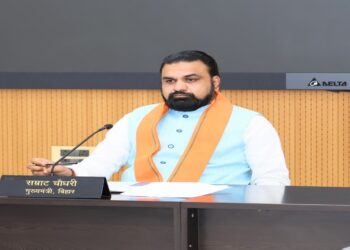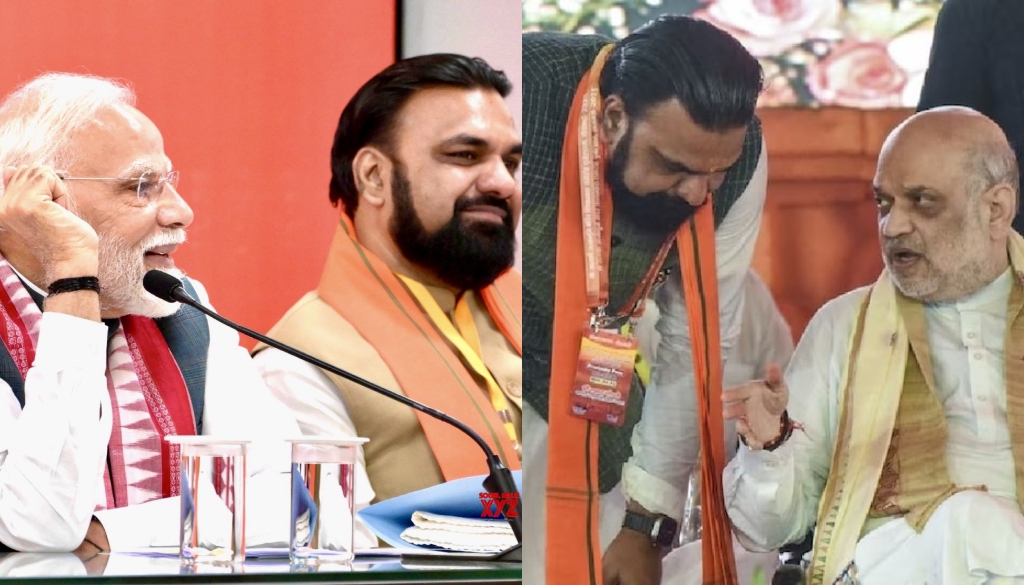
Patna: The elevation of Samrat Choudhary as chief minister of Bihar marks a significant political transition in the state, signalling both a generational shift and a recalibration of the Bharatiya Janata Party’s (BJP) long-term strategy.

Seven months after Amit Shah publicly backed him at an election rally in Tarapur, Choudhary has emerged as the consensus choice of the NDA to succeed Nitish Kumar. He is scheduled to take oath on April 15.
A calculated OBC pivot

At the heart of Choudhary’s elevation lies a carefully crafted social coalition strategy. The BJP has long sought to build its own leadership among non-Yadav OBCs in Bihar, a space historically dominated by Nitish Kumar and his Kurmi base.
Choudhary, who belongs to the Kushwaha (Koeri) community, fits into what is often referred to as the ‘Luv-Kush’ social equation — combining Kurmis and Koeris, together estimated to constitute around 7% of the state’s population.
With Nitish Kumar gradually stepping back from active state politics, the BJP appears to be attempting a controlled transition of this vote base rather than risking its fragmentation.
पूर्ण विश्वास है कि आपके मार्गदर्शन में बिहार विकास की दिशा में निरंतर बढ़ता रहेगा।
आपका सफलतम कार्यकाल और सुशासन का मॉडल प्रेरणास्रोत है। https://t.co/wnN84vXYgV
— Samrat Choudhary (@samrat4bjp) April 14, 2026
Balancing Mandal and Hindutva
Choudhary’s rise also reflects the BJP’s broader effort to blend caste-based (Mandal) politics with its ideological plank of Hindutva.
Unlike many traditional BJP leaders, Choudhary did not emerge from the Sangh ecosystem. However, his political positioning — marked by assertive rhetoric and strong opposition to Lalu Prasad — has aligned him closely with the party’s core narrative in Bihar.
Analysts say projecting him allows the BJP to simultaneously appeal to backward caste voters while maintaining ideological continuity.
The ‘taskmaster’ factor
Within the party, Choudhary has built a reputation as a reliable executor of the central leadership’s strategy, particularly for Prime Minister Narendra Modi and Amit Shah.
His tenure as state BJP president is widely seen as a turning point in reorganising the party structure in Bihar, which had long been perceived as subordinate to Nitish Kumar’s leadership.
He was also among the few BJP leaders who openly and aggressively targeted both Nitish Kumar and Lalu Prasad during the shifting alliance phases of 2022–24 — a role that elevated his visibility within the party.
From confrontation to coordination
Choudhary’s political adaptability has also been central to his rise. After Nitish Kumar returned to the NDA fold, he transitioned from being a vocal critic to a key ally, serving as deputy chief minister and aligning closely with the government’s agenda.
His tenure saw a significant shift in power dynamics, including the BJP taking charge of the home department — a portfolio long retained by Nitish Kumar.
आपका हृदय से आभार, यह विश्वास मेरे लिए बड़ी जिम्मेदारी है।
आपके सहयोग से जनसेवा, सुशासन और विकास के संकल्प को और गति देने के लिए प्रतिबद्ध हूं। https://t.co/wHTsfiBAp3
— Samrat Choudhary (@samrat4bjp) April 14, 2026
Experience across governments
Choudhary’s political career, which began in the 1990s, spans multiple regimes. He has served as a minister under governments led by Rabri Devi, Jitan Ram Manjhi and Nitish Kumar, handling portfolios such as agriculture, panchayati raj, finance and home.
He has also held organisational roles within the BJP, from state leadership positions to president, alongside serving as leader of the opposition in the legislative council.
A transition moment for Bihar politics
Choudhary’s appointment signals more than a leadership change — it reflects the BJP’s attempt to assert greater control over Bihar’s political narrative while managing the legacy and support base of Nitish Kumar.
Whether this transition successfully consolidates the party’s social coalition, or triggers new political realignments, will become clearer in the months leading up to the next electoral cycle.