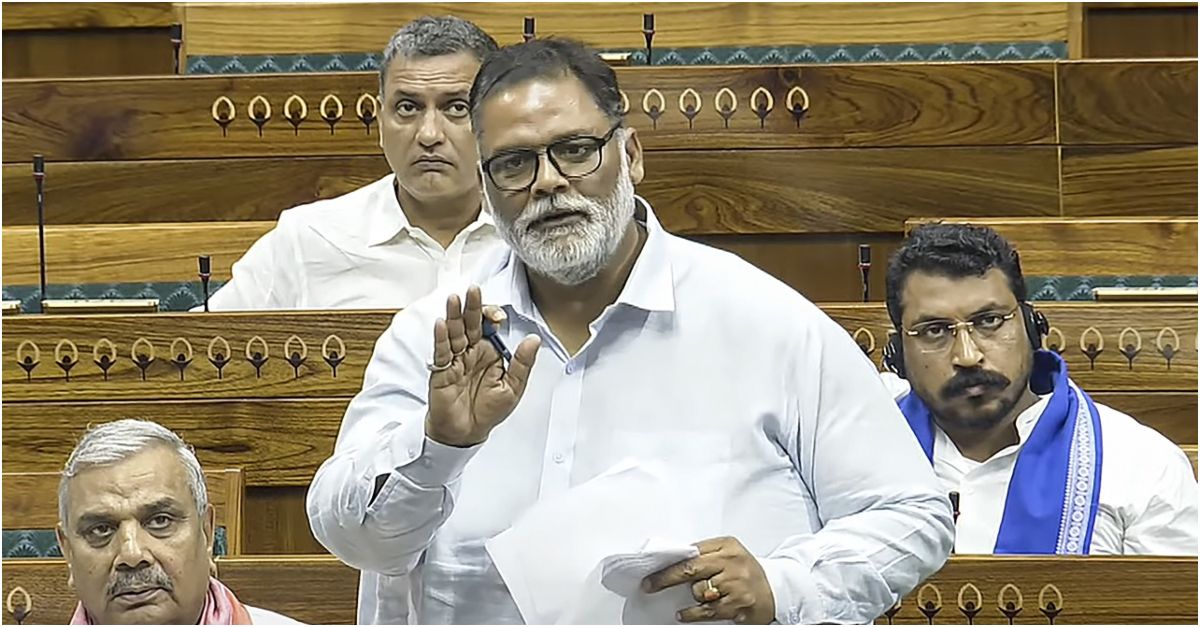
Patna: Parliament witnessed heated exchanges on Wednesday after Purnia MP Pappu Yadav made a series of controversial remarks during a discussion on the Women’s Reservation and Delimitation Bill, 2026, drawing sharp reactions from across the House.

Speaking during the debate, Yadav accused sections of the political class of being involved in sexual exploitation cases and made sweeping claims about the prevalence of pornography consumption among politicians. His remarks triggered protests from several MPs, with chants of “Shame, shame!” reportedly echoing through the House at multiple points.
Yadav alleged that a large number of lawmakers faced criminal accusations related to sexual exploitation, though he did not present official data in support of his claim. He further extended his criticism to what he described as broader patterns of moral conduct within public life.

“In India, politicians are at the forefront of cases of sexual exploitation, followed by babas and then officials,” Yadav said during his speech. “We are all naked in the bathhouse,” he added, in a remark that drew immediate objections from several members.
He also made a sarcastic reference to online behaviour, claiming politicians were among the highest users searching for pornographic content on the internet.
The remarks led to disruption in proceedings, with members objecting to the tone and content of his statements. Parliamentary sources said the Chair intervened to restore order as the debate continued.
Alongside his comments on political conduct, Yadav strongly opposed the Women’s Reservation Bill, calling it “a conspiracy against backward and minority communities”. He argued that the legislation, in its current form, would not adequately address representation gaps.
“The proponents of Manusmriti never respected figures like Ahilya, Kaushalya or Savitribai Phule. Those who denied women social and economic freedom are now speaking of reservation,” he said.
Yadav demanded that the reservation framework include separate quotas for Other Backward Classes (OBCs), Extremely Backward Classes (EBCs), Dalits, Adivasis and minorities.
He also raised concerns about the condition of women across sectors, alleging that a significant proportion face exploitation in industries such as cinema, media and fashion.
The debate on the Women’s Reservation and Delimitation Bill continues to be marked by sharp political divisions, with parties differing on the structure and implementation of quotas as well as the timeline for enforcement.