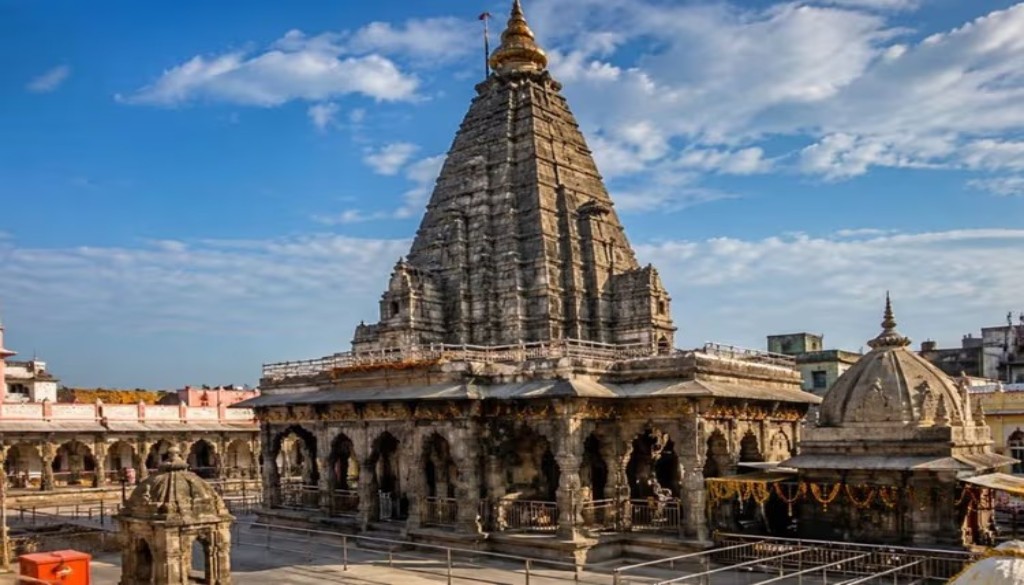
Gaya/Patna: The present architectural form of the Vishnupad Temple in Gaya, one of the most important centres of Hindu faith and ancestral rites, is widely linked to the efforts of Maharani Ahilyabai Holkar of Malwa.

According to historical accounts, Ahilyabai visited Gaya to perform rituals for the salvation of her ancestors. During the visit, she is said to have found the temple in a dilapidated condition and resolved to rebuild it. The reconstruction was undertaken with the support of local religious authorities and skilled artisans.

Reconstruction Project Spanning Two Decades
Historians note that the Vishnupad Temple, built around the sacred footprint associated with Lord Vishnu, gained its present form under Ahilyabai Holkar’s patronage in the 18th century.
Descendants of artisan families linked to the project say that around 600 craftsmen were brought from Jaipur for the reconstruction. More than 1,000 members from nearly 300 families reportedly participated in the broader effort.
Construction is believed to have begun in 1766 and continued for about 20 years, culminating in the completion of the temple in 1787. The structure is said to rise to nearly 100 feet.
Selection of Stone After Extensive Survey
Before construction began, surveys were reportedly conducted across several hills in the region to assess the quality and durability of available stone.
Stones from Tilasan, Bajna, Parjeet, Tamra, Hansraj, Uradiya and Raal hills in the Bathani area were examined. Ultimately, black granite from the Patharkatti region was selected for the temple because of its strength and longevity.
Traditional Construction Methods
The temple was built before the advent of modern construction machinery. Historical accounts suggest that artisans used chisels, hammers and iron tools to shape large stone blocks.
The stones were transported from Patharkatti to Gaya using bullock carts and horse-drawn carts. Earthen ramps and wooden rollers were employed to move heavy materials to higher levels during construction. Traditional binding materials and techniques were used to assemble the structure.
Support for Artisan Communities
Records and local accounts indicate that Ahilyabai Holkar arranged accommodation, food and wages for the artisans involved in the project. With assistance from the Tikari estate, facilities were established in the Patharkatti area for workers and their families.
After the project was completed, some artisan families were reportedly allowed to settle permanently in the region.
Decline of the Artisan Settlement
Many of the craftsmen who remained in Patharkatti continued producing stone artefacts and sculptures for their livelihood. However, increasing incidents of banditry and insecurity in the 19th century led a large number of families to return to Jaipur.
A smaller number of families stayed on and continue to preserve the region’s stone-carving traditions.
Training Centre Established to Preserve Craftsmanship
To support local artisans and sustain the sculptural tradition, a government-run training centre was later established in Patharkatti.
Experienced craftsmen trained thousands of learners in stone carving and sculpture. Local accounts suggest that more than 2,000 people received training before the programme was eventually discontinued.
Ahilyabai’s Association with Gaya
Historians say Ahilyabai Holkar stayed with local pilgrimage priests and religious families during her visits to Gaya. The priestly community played an important role in facilitating the temple’s reconstruction and maintained close ties with the ruler.
Legacy Beyond Gaya
Born on May 31, 1725 in Chondi village in present-day Maharashtra, Ahilyabai Holkar is regarded as one of India’s most respected rulers. She governed the Malwa kingdom from 1767 to 1795 and is remembered for supporting public welfare, administration and religious institutions.
Her patronage extended to several major pilgrimage centres, including Kashi Vishwanath, Ayodhya, Mathura, Badrinath, Kedarnath, Rameswaram and Gaya. Ahilyabai breathed her last on August 13, 1795 but many of the religious and civic works associated with her reign continue to shape India’s cultural landscape.