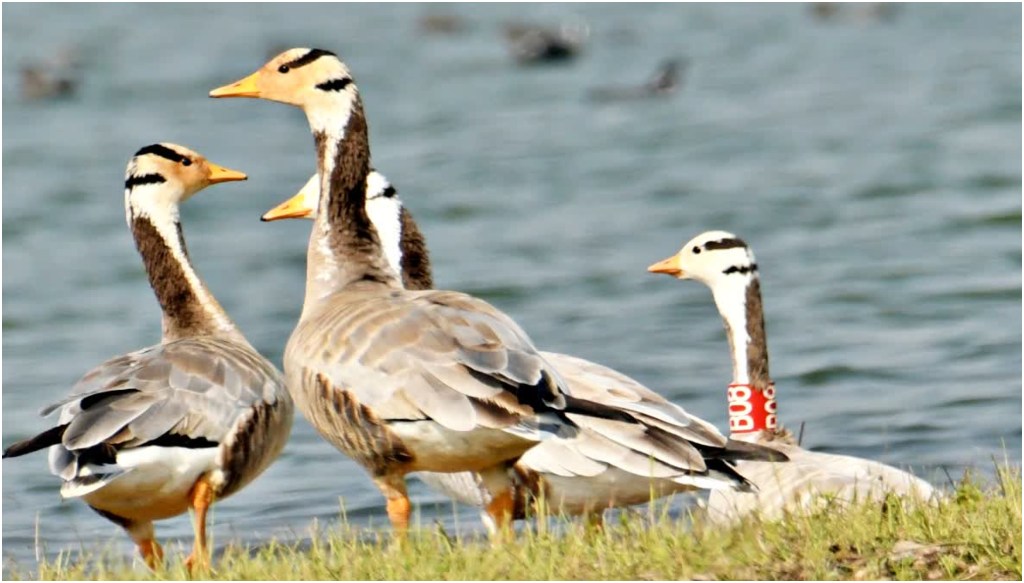
Patna: The remarkable return of a bar-headed goose tagged “Gagan” has shed new light on the scale and resilience of winter bird migration into Bihar, with conservationists hailing the journey as a major breakthrough for research in eastern India.

According to a newly released report from the Bird Ringing and Monitoring Station — a joint initiative of Bihar’s Department of Forests and Climate Change (DEF&CC) and the Bombay Natural History Society (BNHS) — Gagan completed an extraordinary round-trip journey between the Nagi Dam Bird Sanctuary in Jamui and Namkuo Lake in Tibet.
Tracked through a GPS-GSS transmitter, the goose first left Bihar in February, flying from Jamui to Bhagalpur, then crossing Nepal before reaching Tibet. The bird covered roughly 780 km and achieved a maximum altitude of 5,220 metres as it traversed the Himalayan barrier — among the highest recorded migrations for the species in the region.

On December 6, Gagan was sighted again at Nagi Dam, completing a full migration cycle of around 1,560 km. Researchers say this marks the first confirmed international long-distance migration record for a bar-headed goose originating from eastern India, strengthening the ecological significance of Bihar’s wetlands, including Nagi Nakati Sanctuary in Jamui and the Vikramshila Gangetic Dolphin Sanctuary in Bhagalpur.
The findings were compiled with support from scientists Dr P. Satyaselvam and Vartika Patel, researcher Avilash R., and the state forest department.
Anand Kishore, Principal Secretary of the Forest and Climate Change Department, said the record underscores Bihar’s commitment to scientific, evidence-led conservation. “The state’s wetlands are internationally important ecosystems,” he said, adding that the results highlight the need for stronger protection and monitoring. “We will continue to support research that contributes to national and international flyway conservation.”