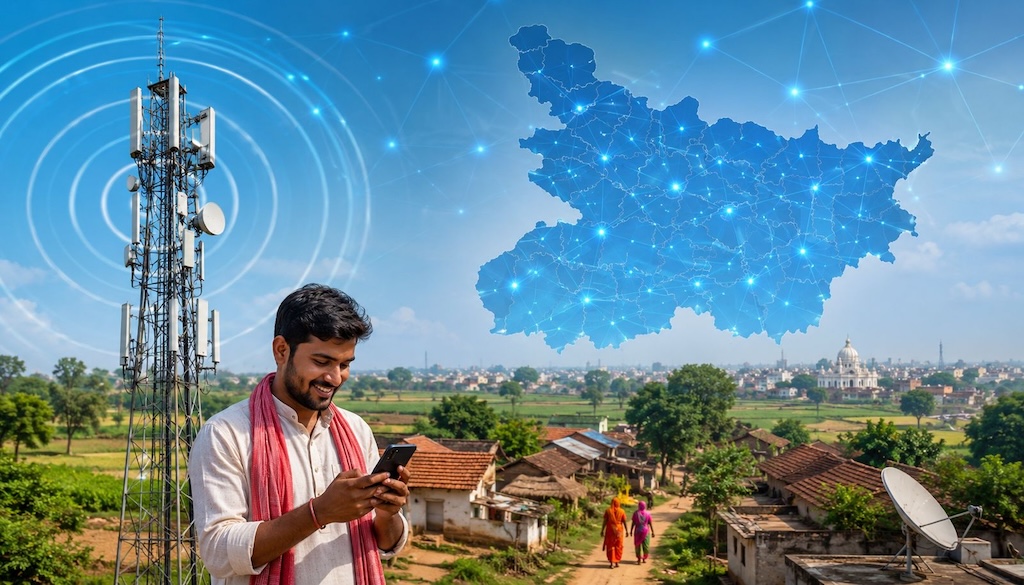
Patna: Bihar has emerged as one of the leading states in India’s 5G rollout, surpassing even technology-driven states such as Karnataka and populous states like Uttar Pradesh in terms of network coverage.

According to the latest figures, 94.52% of Bihar’s population now has access to 5G services, significantly higher than the national average of 86.18%.
By comparison:

- Karnataka has recorded 79.92% coverage
- Uttar Pradesh stands at 85.25%
The data highlights Bihar’s rapid digital expansion despite its longstanding image as a state lagging in infrastructure development.
Rural Bihar Drives 5G Expansion
Officials attribute Bihar’s strong performance largely to aggressive rural connectivity expansion.
Unlike Karnataka — where telecom deployment remained concentrated in urban centres such as Bengaluru — Bihar focused heavily on extending 5G infrastructure into villages and semi-rural regions.
Telecom companies, working alongside government-backed infrastructure projects, expanded connectivity across remote areas of the state.
A major contributor has been the BharatNet initiative, under which around 8,860 gram panchayats in Bihar have been connected through optical fibre infrastructure.
Officials said the project involved investments exceeding Rs 812 crore and aimed to deliver high-speed internet access to rural India.
As a result, residents in many remote villages are now able to access 5G-enabled services.
Persistent Network Gaps Remain
Despite the rapid rollout, connectivity problems continue in several parts of the state.
According to officials, mobile network coverage remains weak or absent across 424 locations along Bihar’s approximately 1,750-kilometre national highway network.
Telecommunication experts said large gaps between mobile towers were one of the primary reasons for poor connectivity.
Under standard telecom norms:
- tower distance in urban areas should ideally remain between 500 and 800 metres
- in many areas of Bihar, the distance exceeds 1.5 to 2 kilometres
- rural gaps often range from 3 to 5 kilometres, and in some cases extend up to 7 or 8 kilometres
Districts including:
- Siwan
- Rohtas
- Kaimur
- Muzaffarpur
- Samastipur
as well as border regions continue to face connectivity issues, according to telecom assessments.
TRAI Test Flags BSNL Performance Concerns
An independent drive test conducted by the Telecom Regulatory Authority of India (TRAI) in January in Samastipur district highlighted major differences in network quality among telecom providers.
The report found that:
- only 36.89% of calls placed through BSNL were successfully connected
- 10.04% of BSNL calls were dropped
In contrast:
- Bharti Airtel and Reliance Jio recorded call success rates above 99%
Significant differences were also observed in download speeds:
- Jio recorded around 158 Mbps
- Airtel reached 101 Mbps
- BSNL recorded only 12 Mbps
World Telecommunication Day Context
The developments come as World Telecommunication and Information Society Day continues to highlight the importance of digital connectivity and reducing the technological divide.
First observed in 1969, the day commemorates the establishment of the International Telecommunication Union in 1865 and promotes awareness regarding telecommunications, ICT infrastructure and digital inclusion.
Officials said Bihar’s growing 5G penetration reflected broader efforts to strengthen digital infrastructure and connectivity across rural India.