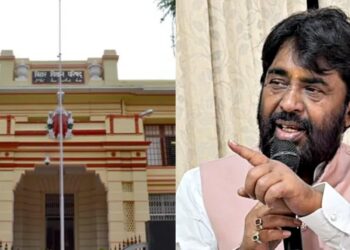

Patna: The Bihar cabinet on Wednesday approved 24 proposals, including a paperless e-Cabinet system and a decision to allow citizens aged 75 and above to register land, plots and flats from their homes through mobile registration units.

The meeting, chaired by Chief Minister Samrat Choudhary, also approved the transfer of one acre of government land in Patna to the Union Ministry of Home Affairs for an office-cum-residential complex of the National Investigation Agency (NIA).
Cabinet To Shift To Paperless System

Additional Chief Secretary (Cabinet) Arvind Choudhary said cabinet agendas, meeting documents and information on decisions will be made available to ministers digitally.
Information related to the implementation and progress of cabinet decisions will also be accessible through digital platforms. The National Informatics Centre (NIC) has been entrusted with implementing the system.
The government said the e-Cabinet system will reduce paper consumption, save time and expenditure, and make cabinet functioning faster and more efficient.
Home Registration Facility Extended To Seniors Aged 75+
The cabinet approved amendments to the Bihar Registration Rules to extend mobile registration services to senior citizens aged 75 and above.
Once the Bihar Registration (Amendment) Rules, 2026 come into force, eligible citizens will be able to register land, plots and flats at their homes through mobile registration units.
The facility was earlier available to citizens aged 80 and above. The age threshold has now been reduced to 75 in line with the chief minister’s announcement.
One Acre Of Patna Land Allocated For NIA Office
The cabinet approved the permanent transfer of one acre of land belonging to the Building Construction Department in Dhakanpura Mauza under Pataliputra Circle in Patna district.
The land will be transferred on a paid basis to the Union Ministry of Home Affairs for construction of an NIA office-cum-residential complex. The approved payment for the transfer is Rs 57.37 crore.
Forensic Laboratories To Come Under Home Department
The cabinet also approved a change in the administrative control of Bihar’s forensic investigation institutions.
The Forensic Science Laboratory, Police Laboratory (Handwriting Bureau), Fingerprint Bureau and Photo Bureau will function directly under the Home Department.
These institutions examine scientific evidence in criminal cases and submit reports to courts and other competent authorities.
According to the Home Department, forensic investigation offices in 23 of the country’s 32 states already function under the Home Department. The state government said the move is intended to improve the transparency, impartiality and timeliness of forensic investigations.
New Service Rules For Three Minor Water Resources Cadres
New service rules were approved for the Hydrologist, Hydrogeologist and Geophysicist cadres in the Minor Water Resources Department.
The posts will be filled exclusively through direct recruitment, with no provision for promotion. Candidates will require a bachelor’s degree in the relevant subject and at least three years of experience with the Central or state government or their undertakings.
You may like to read this article:
Bihar Cabinet Approves 22,000 Anganwadi Posts, Water Supply Projects And New Sugar Mills
New Cooperative Sugar Mills Planned In Raiyam, Sakri
The cabinet approved the establishment of new cooperative sugar mills on the sites of the defunct sugar mills in Raiyam in Darbhanga and Sakri in Madhubani.
Indian Potash Limited (IPL), New Delhi, will execute the projects. The state government will provide financial assistance equivalent to 40% of the approved project cost.
The proposed complexes will also include units producing other sugarcane-based products. The government said the projects are expected to improve market opportunities for sugarcane farmers, generate employment and encourage investment in the region.
Agriculture And Irrigation Proposals
The cabinet approved a Rs 97.48 crore scheme for 2026-27 under the Pradhan Mantri Krishi Sinchayee Yojana.
It also approved Rs 158.62 crore for salaries and pensions at Bihar Agricultural University, Sabour, and Rs 236.58 crore for agricultural machinery, drones and custom hiring centres for farmers.
A further Rs 30.17 crore was approved for vermicompost and biogas units across all 38 districts.
Water Supply And Bridge Projects
Administrative approval was granted for the Rs 53.71 crore Kishanganj water supply project and the Rs 150.96 crore Lakhisarai water supply project.
The cabinet also approved Rs 93.82 crore for a new reinforced cement concrete bridge over the Kiul river in Jamui and Rs 55.96 crore for a new bridge over the Suknar river in the district.
The revised cost of the Patna High Court’s multi-purpose building was approved at Rs 57.33 crore.
Equipment For Engineering Colleges And Polytechnics
The cabinet approved Rs 60.49 crore for the procurement of machinery and equipment for 38 government engineering colleges.
A separate proposal worth Rs 60.49 crore was approved for equipment procurement for 46 government polytechnic institutes.
The cabinet also approved enhanced financial powers for police officers for minor construction works.
Special Courts For SC/ST Atrocity Cases
The cabinet approved the establishment of Exclusive Special Courts in 19 judicial divisions to facilitate the speedy disposal of cases under the Scheduled Castes and Scheduled Tribes (Prevention of Atrocities) Act, 1989.
The courts will be established in Bettiah, Madhubani, Bhojpur, Siwan, Araria, Supaul, Khagaria, Jehanabad, Buxar, Jamui, Kaimur, Katihar, Sitamarhi, Munger, Madhepura, Banka, Sheikhpura, Aurangabad and Lakhisarai.
The government approved 19 posts of District and Additional Sessions Judge, with one post for each proposed court.
Three Additional Special Courts For Corruption Cases
The cabinet also approved the establishment of three additional special courts under Section 3 of the Prevention of Corruption Act, 1988.
Two courts will be established in Patna and one in Muzaffarpur to facilitate the speedy disposal of corruption-related cases.
The cabinet also approved the creation of 19 posts for special judges to hear cases involving atrocities against Scheduled Castes and Scheduled Tribes.