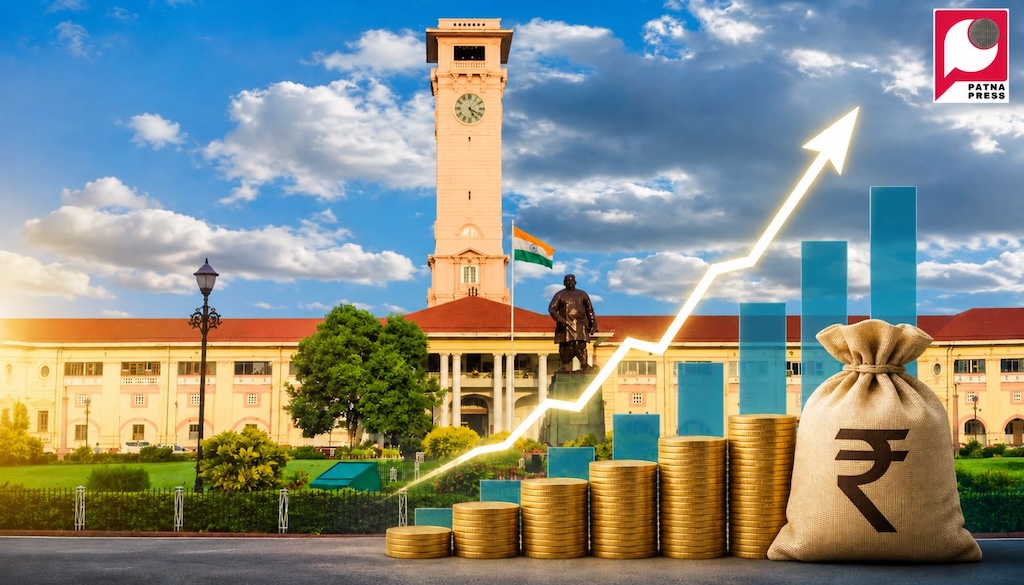
Patna: Government of Bihar is set to substantially increase its borrowing during the 2026-27 financial year, raising fresh concerns over the state’s growing debt burden and fiscal sustainability.

According to official figures, Bihar now plans to borrow Rs 72,901.31 crore during the current financial year, significantly higher than the original budget estimate of Rs 61,939.48 crore.
The sharp upward revision within the first quarter of the financial year is being viewed by economists and financial observers as a reflection of mounting expenditure pressures and constrained revenue generation.

Government Faces Rising Expenditure Pressure
Officials said the government requires large-scale financial resources to fund:
- development schemes
- social welfare programmes
- infrastructure expansion
- electoral commitments
However, with limited internal revenue sources, Bihar has increasingly relied on borrowings to finance expenditure.
According to sources, the government had initially considered raising borrowings close to Rs 1 lakh crore, but the figure was reportedly capped amid concerns over a widening fiscal deficit.
Bihar’s Total Debt Has Risen Sharply
Data indicates that Bihar’s total liabilities have expanded rapidly over the past 15 years.
| Year | Total Liabilities |
|---|---|
| 2010 | Rs 59,513 crore |
| 2015 | Rs 99,398 crore |
| 2020 | Rs 1.93 lakh crore |
| 2025 | Rs 3.70 lakh crore |
| 2026 (estimated) | Rs 4.03 lakh crore |
If current estimates hold, Bihar’s outstanding debt is projected to cross Rs 4 lakh crore during 2026.
Fiscal Deficit Emerging As Major Concern
Economists have also raised concerns over Bihar’s fiscal deficit trajectory.
According to available estimates:
- Bihar’s fiscal deficit reached 4.5% in 2024-25
- officials fear the figure could move close to 10% during 2025-26
Under central government fiscal rules, states are generally permitted to borrow only up to 3% of their Gross State Domestic Product (GSDP).
Bihar Sought Higher Borrowing Limit From Centre
Senior Bihar minister Bijendra Prasad Yadav had urged Nirmala Sitharaman to permit Bihar to borrow up to 5% of its GSDP.
However, the Centre reportedly rejected the request, citing fiscal consolidation targets recommended by the Sixteenth Finance Commission.
The commission aims to keep combined debt levels of the Union and state governments under control by 2030-31.
Interest Payments Consuming Larger Share Of Revenue
The impact of rising debt is increasingly visible in Bihar’s finances.
Officials said:
- more than 9% of Bihar’s total revenue receipts are currently being spent on interest payments alone
Economists warn that this could reduce the state’s capacity to spend on:
- infrastructure projects
- development schemes
- social welfare initiatives
Debt Growing Faster Than Economy
Financial data also indicates that Bihar’s debt growth has outpaced GSDP growth in several recent years.
| Financial Year | Debt Growth | GSDP Growth |
|---|---|---|
| 2017-18 | 13.02% | 11.33% |
| 2018-19 | 7.75% | 12.64% |
| 2019-20 | 14.48% | 12.51% |
| 2020-21 | 17.49% | 4.14% |
| 2021-22 | 13.34% | 9.18% |
| 2022-23 | 13.90% | 11.24% |
| 2023-24 | 13.44% | 13.71% |
Economists said the gap became particularly alarming during the Covid-19 period, when debt expanded sharply while economic growth slowed dramatically.
Government Banking On Investment And Urban Expansion
Despite concerns over rising liabilities, the state government maintains that efforts are underway to strengthen Bihar’s revenue base.
Officials said the government was focusing on:
- industrial investment
- urban expansion
- infrastructure development
- creation of new economic sectors
to improve long-term fiscal capacity and reduce dependence on borrowing.