Patna: With just one day left for the Bihar Assembly Election results, the state is on edge as counting centers across all 38 districts gear up for a massive counting exercise on November 14. This year’s election has made history with a record 67% voter turnout, the highest ever in Bihar. Notably, women outvoted men by 9%, marking a significant shift in the state’s political dynamics.

According to the poll of polls based on 16 exit polls, the National Democratic Alliance (NDA) is projected to win 154 out of 243 seats, suggesting a possible return of the Nitish Kumar-led government. If the exit polls prove accurate, women voters are expected to play a decisive role in the NDA’s comeback.
Meanwhile, RJD leader Tejashwi Yadav has raised concerns over possible irregularities during the counting process. “Slow down the counting or organize flag marches, our people will stop vote theft. Dishonesty will not be tolerated,” Yadav said on the second day of polling. Addressing a press conference on Wednesday, he alleged a “conspiracy to delay counting,” claiming that “there was manipulation last time as well” and warned that “any malpractice will not be tolerated.”

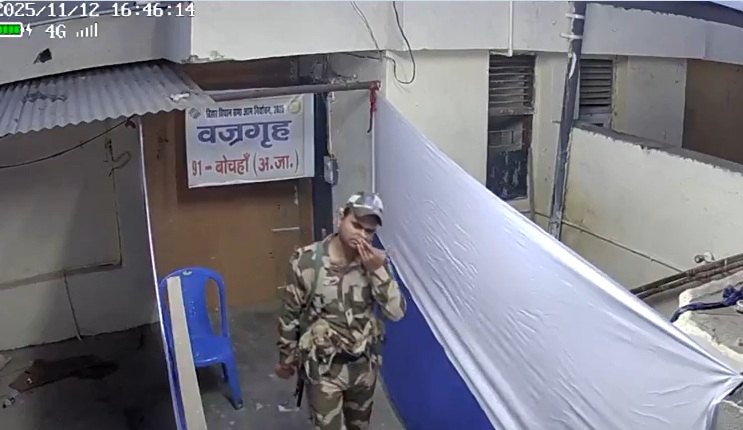
Strong Room and Counting Center Security
Strong rooms have been established in all 38 districts of Bihar, each with a separate counting center. The Election Commission has assured that EVMs and VVPATs are stored securely under a three-tier security system, with videography conducted in the presence of candidates, agents, and central observers.
The first two layers of security are managed by the Central Armed Paramilitary Forces (CAPF), including CISF and CRPF. The second layer is manned by the Bihar Special Armed Police (BSAP), while the District Armed Police (DAP) forms the third layer. Senior police officers and magistrates are on 24-hour duty to monitor the premises.
A control room has been established at each counting center for real-time supervision by senior district officials. All District Election Officers and Returning Officers have been instructed to inspect strong rooms daily.
CCTV cameras provide 24×7 live streaming of strong rooms, accessible to candidates and their agents from designated viewing areas. Backup power systems such as generators, inverters, and UPS units ensure uninterrupted monitoring.
Counting Process Explained
Counting will begin at 8 a.m. sharp. As per Election Commission guidelines, counting of postal ballots and ETPBS (Electronically Transmitted Postal Ballot System) will start first, followed by EVM counting after 30 minutes.
Each Assembly constituency will have separate tables for postal ballots, with four counting personnel per table — a supervisor, two assistants, and one micro-observer — under the supervision of an Assistant Returning Officer.
For EVM counting, 14 tables are set up in each counting center, with 14 EVMs counted simultaneously in one round. Each round takes about 10–15 minutes. The first trends are expected to emerge by 9 a.m., and results will be updated live on the Election Commission’s website.
The number of polling stations in each constituency will determine how soon results are declared — smaller constituencies are expected to announce results earlier.
According to officials, Mokama constituency is likely to declare its result first, while Digha will be among the last.
Legal Safeguards and Post-Result Procedure
Sections 128 and 129 of the Representation of the People Act, 1951, mandate confidentiality in the counting process. Information about specific officers or table allocations is kept secret.
Any misconduct or tampering at counting centers is punishable under Section 136 of the Act, with imprisonment of six months to two years, a fine, or both.
After results are declared, the Returning Officer (District Magistrate) will issue victory certificates to winning candidates. EVMs will remain in strong rooms for 45 days post-counting and stored securely for six months before being redeployed.
Counting at AN College, Patna
In the capital, counting will take place at AN College, where votes from 14 Assembly constituencies will be tallied. To maintain order, traffic diversions will be implemented from 5 a.m., with routes around Boring Road, Patliputra, Rajapur Bridge, and Shivpuri closed to regular vehicles. Only emergency vehicles, including ambulances, fire tenders, and judicial vehicles, will be allowed.
The AN College center will operate under three-tier security:
- First Tier: CAPF – one platoon of CISF and two platoons of CRPF.
- Second Tier: One company of BSAP.
- Third Tier: 12 sections of District Armed Police.
Additionally, three ASPs/DSPs, 13 police officers, and 12 magistrates will remain on round-the-clock surveillance, with continuous CCTV monitoring to prevent any breach.
As Bihar awaits the outcome of one of its most closely watched elections, all eyes are now on the counting centers where the future of the state’s political leadership will unfold tomorrow.